
Most conversations about agentic AI transformation are really conversations about technology: which model is ahead, which platform, which architecture. That’s the part that’s fun to argue about and easy to procure. It’s also not where transformations succeed or fail. If you’ve led a digital transformation through an organisation, and if you’ve run a company where the money was your own, you recognise the hard parts of agentic AI almost immediately — because they’re the same hard parts as every transformation before it, and they have very little to do with the model.

It was never a technology problem
Start from the uncomfortable truth: the model is the smallest part. It’s getting cheaper and more capable every week, and it’s increasingly a commodity you route to. The expensive, slow, genuinely hard parts of an agentic transformation are the same four things that made digital transformation hard: the organisation, the data, the accountability, and the trust. None of those arrive in a model release. Every one of them is a leadership problem wearing a technology costume.
Lesson one: pilots that never become production
Anyone who lived through digital transformation knows the innovation-theatre trap. A dazzling pilot, a proud demo, a press release — and then nothing that ever touches the P&L. Agentic AI is repeating this at industrial scale right now: enormous pilot activity, a fraction of it in production, and even less of it accountable for a number anyone cares about.
The founder’s instinct is the antidote, and it’s blunt: make it pay for itself, or don’t do it. When the capital is your own, “it’s a promising pilot” is not a sentence you can afford to say for long. The discipline that gets an agent from demo to production isn’t a better model — it’s the refusal to celebrate anything that hasn’t shipped and earned its keep. In production, not in pilots.
Lesson two: data readiness is the real prerequisite
The second lesson is the least glamorous and the most decisive. You cannot put probabilistic agents on top of data you haven’t made ready — ungoverned, unlineaged, inconsistent data — and expect a trustworthy result. Agents don’t fix a broken data foundation; they amplify it, faster, and with more confidence. The unglamorous work of quality, lineage, and governance is exactly where digital transformations were quietly won or lost, and agentic AI raises the stakes because the consumer of that data is no longer a careful analyst but an autonomous actor moving quickly. If your data isn’t ready, your agents aren’t either — no matter how good the model is.
Lesson three: the operating model, not the tool
The third lesson is the one every transformation leader learns the hard way: the technology was never the blocker. The blocker was the organisation — the incentives, the workflows, the change management, the human willingness to actually work differently. Dropping agents into an operating model designed for people doesn’t transform anything; it just adds a confusing new colleague nobody trusts.
Agentic AI needs a deliberate human–AI operating model: where the human sits, what the agent may decide, how outcomes are governed, and how much explainability the work demands before autonomy is allowed. And it needs a phased path — quick wins that build the trust and the track record that earn the right to scale. You don’t win this by deploying a tool. You win it by redesigning how work happens around the tool.
What’s genuinely new — and harder
So far this could be a digital-transformation essay. Here’s what’s actually different, and it makes the old discipline matter more, not less: non-determinism. You can’t write a fixed specification for a probabilistic system, can’t guarantee its output, and can’t audit it the way you audited deterministic software. Accountability itself gets harder, because you’re now answerable for the behaviour of an autonomous actor operating on real data at speed. And the ground moves weekly — the model you designed around is superseded before the project ships.
That combination is why so many capable organisations stall. The instinct is to wait for certainty — a stable model, a clear standard, a proven pattern — and certainty never comes. The transformation goes to the ones who can move responsibly without it: shipping in bounded, reversible steps, governing outcomes rather than trying to pre-specify them, and treating the model as a moving part rather than a foundation.
The startup lessons that carry over
This is where running a company teaches things a career inside a large organisation can’t. Four founder instincts map almost perfectly onto agentic transformation:
- Ship under constraint. You don’t gold-plate a system whose foundations shift weekly. Do the smallest useful thing, get it into real hands, and learn — perfect is the enemy of shipped, and doubly so when the frontier moves under you.
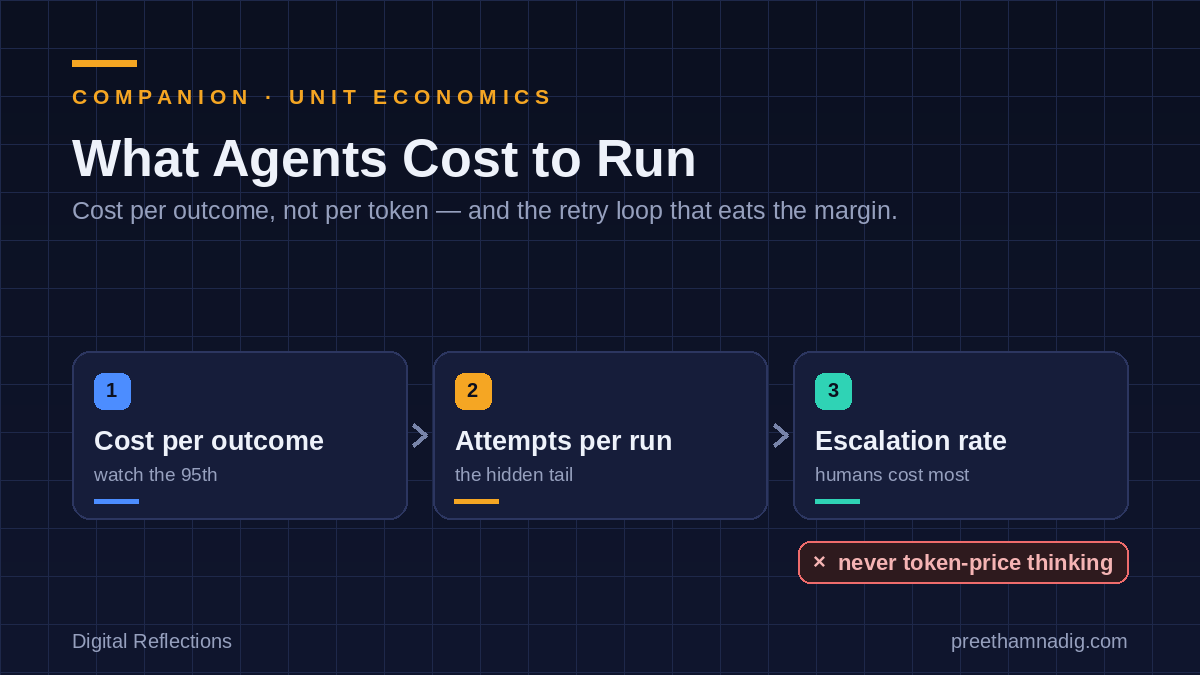
- Own what it costs to run. Someone pays for the tokens, the compute, and the 2am operations. A founder never gets to treat run-cost as someone else’s problem, and neither should anyone deploying agents at scale.
- Don’t hand off. The founder designs it, ships it, and owns the result. Agentic transformation fails in the gaps between the strategy deck and the person accountable for the outcome. Close the gap: one owner, end to end.
- Make-payroll thinking. When the money is real, ROI isn’t a slide — it’s survival. That clarity is exactly what cuts through the theatre: does this create value someone will pay for, this quarter, or not?
The through-line: it’s an accountability problem
Put it together and the diagnosis is simple. Agentic AI transformation is hard because it is an accountability problem wearing a technology costume. The organisations that succeed treat it as a business transformation with a P&L and a named owner, not a lab experiment with a budget. They make the whole thing accountable — for outcomes, for cost, and for trust — which, not coincidentally, is the same instinct that separates durable value from hype across the entire stack.
The tools are new; the hard parts are old
If there’s one thing to take from having done this before, it’s a warning against the most seductive idea in every technology wave: that this time, the technology does the transformation for you. It never has. Cloud didn’t, mobile didn’t, data didn’t, and agentic AI won’t. The tools are genuinely, thrillingly new — and the hard parts are exactly the ones you already know: get the data ready, redesign the operating model, own the outcome, and make it pay. The leaders who transform with agentic AI won’t be the ones with the best model. They’ll be the ones who remembered that the model was never the hard part.
Part of the Agentic AI series
- Agents Eat the Stack Top-Down
- The Substrate War
- Buy, Build, or Orchestrate
- Service-as-Software
- The Frontier Labs Are in the Squeezed Middle of Their Own Stack
Companions: Who Advises the Disrupted? · Agentic AI Is Not Just LLMs and Tokens · A Product Playbook for Agentic AI · Give Your Coding Agents a Process · A Longer Leash.


Leave a Reply