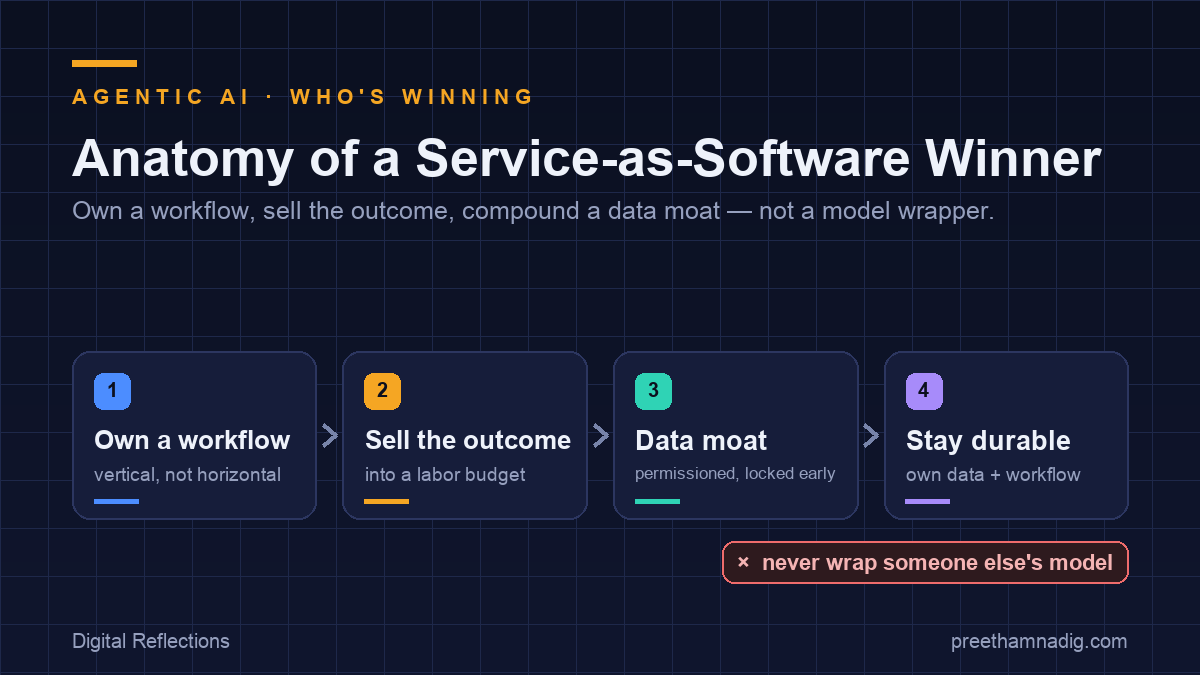
The last three posts were theory: agents eat the stack top-down, the record consolidates onto a governed substrate, and survival comes down to which layer you own and whether your price tracks value. This one is the proof. Because there’s now a class of AI startups compounding faster than any software company in history — reaching in roughly eighteen months a revenue milestone that took the last generation of software the better part of a decade. If the framework is right, these companies should look a very particular way. They do.

But start with the honest part: this is a power law, not a rising tide. For every one of these hypergrowth stories, thousands of AI startups quietly shut down — a graveyard of agents that demoed beautifully and never reached production. So the interesting question isn’t “is AI minting fast companies” (it is). It’s what separates the supernovas from the graveyard. Four things, repeatedly.
1. They don’t sell software. They sell a job done.
This is the pattern that reframes everything else, and it’s why the growth is so violent. The winners don’t price against a software budget — a per-seat line item competing with other tools. They price against a labour budget: the hourly cost of the person who used to do the work. When your product is measured against a professional’s salary rather than a subscription tier, the addressable spend is an order of magnitude larger, and the buyer’s math is trivial. That’s service-as-software — selling the outcome a human used to deliver, priced like the human, delivered like software.
It also explains the categories where this is happening first: the high-value professional workflows that are mostly reading, drafting and deciding over documents and tickets — the work where a competent agent can absorb the task and the cost being displaced is a real, measured hourly rate.
2. They own one workflow, deeply — vertical, not horizontal
The graveyard is mostly horizontal agents — general-purpose assistants that can supposedly do anything. They die because “anything” runs straight into reality: real enterprise data is messy, and a general agent has no domain knowledge to make sense of it. The reported failure rate is brutal — the large majority of horizontal agents never make the jump from a demo to a production system anyone pays for.
The winners go the other way. They pick one professional workflow and own it end to end — its data shapes, its edge cases, its compliance rules, its definition of “done.” A vertical agent for a buyer who already pays a person to do exactly that work has something no horizontal platform does: it actually finishes the job, on the messy real inputs, often enough to be trusted.
3. The moat is data and workflow — not the model
Here’s the move that separates a durable business from a clever demo, and it maps straight onto the earlier posts: the winners build a permissioned-data moat, and they lock it early. The consistent playbook is to win the first handful of customers with hand-built integrations, prove the outcome, and use that leverage to negotiate broad data rights before raising the round that scales. What compounds after that isn’t the model — everyone can rent a comparable model — it’s the proprietary data and the deeply-modelled workflow that make the agent right on inputs a newcomer has never seen.
This is data gravity at startup scale. The company is quietly becoming the system of record for its slice of work — which, per the earlier posts, is exactly the layer that endures.
4. Outcome pricing — but earned, not assumed
Because they sell a job done, the natural price is the outcome: tickets resolved, matters drafted, claims processed, hours of work eliminated. And the market is moving hard that way — per-seat pricing is shrinking fast while usage-, outcome- and hybrid models take over. But the disciplined version of this has a caveat the survivors respect: price hybrid until the accuracy is production-proven. Pure outcome pricing only holds when the agent is reliable enough to run unsupervised and the customer trusts it to. Lead with a blend, earn the right to charge for outcomes as the accuracy compounds. Promise outcomes you can’t yet guarantee and the model breaks — on your P&L, not the customer’s.
Where they sit on the map
Put those four together and these companies land precisely in the corner the last post called the winners’: they own a workflow (becoming the system of record for it) and they’re priced by value (the outcome, against a labour budget). The thousands in the graveyard sit in the opposite corner — thin, horizontal, priced against a demo or a seat, sitting on data they never owned. The startup landscape isn’t a different story from the theory. It’s the same story, with real revenue attached.
The durability test: moat or wrapper
One honest caveat, because not every fast-growing name is safe. The fastest ARR figures are hype-adjacent — self-reported, sometimes run-rate rather than committed revenue, sometimes consumption that can churn as fast as it arrived. And underneath the numbers is a real fork: does the company own data and a workflow, or is it a thin interface over someone else’s frontier model?
The ones that own the data and the workflow are durable — they’ve built the moat that survives the next model release. The ones that are mostly a nice interface over a model they don’t control are exposed to the exact risk the framework warns about, one level up: the model provider can move up into them, and their “veneer” gets eaten just like any other. That’s the question worth asking about any hypergrowth AI story in 2026 — not how fast it grew, but what it would still own if the underlying model became a commodity tomorrow.
What to take from it
If you’re building: own a workflow and its data, sell the outcome against a labour line, and earn outcome pricing by proving accuracy — not by promising it. Being a thin wrapper over a model is the squeezed middle with a shorter fuse.
If you’re buying or backing: the durable ones are the companies that own the data and the workflow, not the ones with the best demo. Ask what compounds when the model is a commodity — because it will be — and back the answer that isn’t “our prompt.”
The supernovas didn’t win by wrapping AI in a nicer interface. They won by absorbing a job, pricing it like the labour it replaces, and owning the data that proves they did it well. That’s not a software company in the old sense at all — and it’s why the old software benchmarks can’t keep up.
The Agentic Stack — a five-part series
- Agents Eat the Stack Top-Down
- The Substrate War
- Buy, Build, or Orchestrate
- Service-as-Software — you are here
- The Frontier Labs — Squeezed Middle
Companion: Who Advises the Disrupted? Consulting and Services in the Agent Era


Leave a Reply