This series has spent four posts on a single force: agents eating the enterprise stack top-down, the record consolidating onto a governed substrate, value re-rating by layer and pricing, and the startups winning by owning a workflow rather than a model. There’s one player I left until last, on purpose — the one sitting underneath all of it, and the one the whole story is supposedly good for: the large, Tier-1 frontier model providers.
Surely, if intelligence is the new electricity, the companies generating it are the safest bet on the board. It isn’t that simple. The uncomfortable truth is that the same top-down force the labs helped unleash on everyone else is now eating their own model layer from below — and a frontier lab that only owns the best model is sitting in the squeezed middle of its own stack.

The model is becoming a pluggable rail
Start with the pressure from below. Open-weight models are no longer a distant second tier. By aggregate capability they trail the closed frontier by a matter of months, and the catch-up time roughly halves with each generation. For a great many enterprise workloads the gap is already close enough that the economics decide it — the same volume of work can cost several times less on a self-hosted open model than on a closed frontier API, and the budget tier of the closed market has already collapsed, with frontier labs cutting their cheap models aggressively to defend the low end.
That is what commoditization looks like from the inside. The raw capability — intelligence per token — is turning into a pluggable inference rail: something you route to, swap, and price-shop, rather than something you’re locked to. The absolute frontier still commands a premium, but it’s a treadmill premium, not an annuity — you hold it only until the next open release a few months behind catches the tier you were charging for.
But “open” doesn’t mean “free at the frontier”
There’s a nuance that cuts against the simplest version of this story. Frontier-scale open models aren’t cheap to run — the newest of them are priced like mid-tier closed models, not like commodity inference. An open licence no longer implies a low price, because the frontier is capital-bound regardless of licence. Whether the weights are open or closed, running and training at the frontier takes enormous compute, and that cost doesn’t disappear when the licence changes. Which points at where the real scarcity now lives — and it isn’t the algorithm.
Value pools up and down — not in the middle
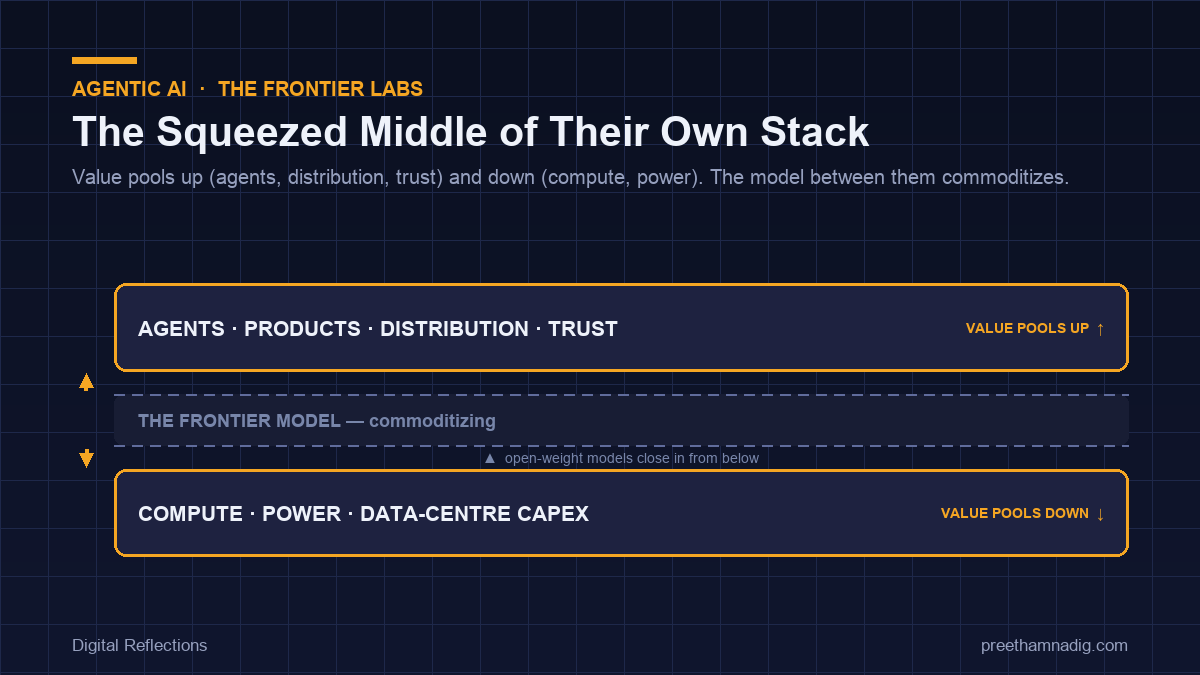
Here’s the shape of it. As the model commoditizes, value migrates away from the middle of the labs’ own stack in both directions:
- Up, into the harness. The durable margin is in the layers above the raw model — routing, evaluation, memory, orchestration, agentic workflows, vertical applications, and trust infrastructure. The model becomes a component; the product that wraps it is where the value accrues. This is exactly why the labs are using their cash to push up into the agent and application layer: the inference business itself is low-margin and high-volume, and staying purely there is staying in the thinnest part of the stack.
- Down, into the infrastructure. The binding constraint has quietly become compute and power. Data-centre interconnection queues in the biggest markets now run years; new capacity can’t get utility power before the end of the decade. Whoever secured compute, silicon and power holds an edge that compounds — an edge that has nothing to do with model architecture.
The raw model sits in between, and it is the thinnest, most contested band of all — pressed up by the value migrating into products and pressed down by the value migrating into infrastructure, with open weights closing from beneath. That’s the squeezed middle, and it’s the labs’ own core.
The moat was never the weights
Which reframes what a frontier lab’s moat actually is. It is no longer a fundamentally different architecture — that gap is closing on a schedule. The durable moat now sits in proprietary data, inference infrastructure, distribution, and brand trust. The weights are the part everyone can approximate a few months later; the data, the compute, the channel to the customer, and the reputation to be trusted with regulated work are the parts that don’t copy on a schedule.
So the durable lab is vertically integrated — and the rest consolidate
Put those together and the survivor profile is clear: the durable frontier lab owns both ends — compute and power beneath the model, and agents, products, distribution and trust above it. Own only the middle, and you are the most capital-intensive commodity business in technology.
This is the same durability test from the last post, one level up. A lab fused to a hyperscaler — with compute, an enterprise distribution channel, and a recurring cloud annuity — can absorb the model commoditizing, because it monetizes the platform and the infrastructure even as the API margin compresses. A pure-play model API without a consumer surface or a cloud annuity is the “wrapper” risk turned all the way up: a thin, capital-hungry layer over commoditizing weights and rented power. Not everyone can run the capex treadmill; expect consolidation, and expect some labs to become wholesale inference for others rather than brands in their own right.
The one moat the open frontier isn’t closing
There’s a meaningful exception, and it’s the one that ties back to the rest of this series. The open frontier is closing fast on capability — but the gap on safety and governance practice is widening, not narrowing. For regulated enterprises, the ability to be trusted with sensitive work — the audit trail, the guarantees, the accountability — is a real and durable differentiator, and it’s precisely the governed-substrate logic from earlier in the series, applied to the model provider itself. Trust doesn’t come open-weight. That’s a moat worth building on.
What to take from it
If you’re a lab: owning the best model is table stakes with a short shelf life. Own the harness above it and the infrastructure below it, or be prepared to become someone else’s wholesale inference. And lean into the one thing that doesn’t commoditize on a schedule — being trusted.
If you’re a buyer or a leader: don’t over-index on today’s frontier. Route by task, not by brand; keep the deterministic, governed core of your systems independent of any one provider; and treat model capability as a fast-moving, swappable input while you invest in the things that actually compound — your data, your workflows, and the trust layer around them.
The capstone
The whole series has been one argument seen from different angles: as intelligence gets cheap and agents get capable, value stops sitting in the thing everyone can now do and moves to the things that are hard to copy — owning the workflow, owning the data, owning the substrate, owning the outcome, owning the trust. The frontier labs are not exempt from their own thesis. The lab that only owns the best model is in the squeezed middle of its own stack, on the same commoditization curve it is inflicting on everyone else. The ones that endure will be the ones that own the layers the model sits between — the harness above, the infrastructure below, and the trust that wraps the whole thing. Everything in the middle is being generated, rented, and caught up to. As always, the durable value is at the edges.
The Agentic Stack — a five-part series
- Agents Eat the Stack Top-Down
- The Substrate War
- Buy, Build, or Orchestrate
- Service-as-Software
- The Frontier Labs — Squeezed Middle — you are here
Companion: Who Advises the Disrupted? Consulting and Services in the Agent Era


Leave a Reply