
This is the third piece in a thread. The first argued that agent swarms are eating the enterprise stack top-down — engagement first, intelligence next. The second argued that the system of record is unbundling: the application dissolving into agents while the record slides down onto a governed substrate. Both raise a very practical question for anyone who buys or builds software. If the app layer is the exposed layer, what does that do to the oldest decision in enterprise technology — buy versus build — and to the mid-stack vendors caught in the middle?
The short answer: it was never really buy versus build. That framing is collapsing into something more useful — a question about which layer you own, and whether your price tracks value. Two axes, not one.

Buy vs. build, inverted
For twenty years the default was buy. Building was slow, expensive and risky; a mature product you could licence beat a project you had to staff, ship and maintain forever. Agentic development quietly detonated one side of that equation. The cost of building the workflows that make your business distinct fell hard — an agent can generate, wire and maintain a great deal of the software you used to hire a team and a year for. At the same time, the rented alternative got more expensive and more precarious: repriced mid-contract, consolidated, and — in at least one memorable 2026 episode — switched off entirely. Build got cheaper and safer. Buy got dearer and riskier. The default flipped.
But it doesn’t flip everywhere, and that’s the important part.
The split runs along the same seam
Buy-versus-build now bifurcates along exactly the line the last two posts drew:
- The thin veneer — the interface and workflow layer an agent can assemble — moves to build, or more precisely generate. It is no longer worth buying a seat-priced point solution for a workflow your agents can compose on demand.
- The hard substrate and its primitives — the global connectivity network, the telemetry backend, the transactional data layer — stay buy, or better, consolidate. You don’t build your own carrier relationships or your own petabyte ingestion pipeline; those are moated by data gravity, network effects, reliability and compliance.
So it isn’t buy or build. It’s build the veneer, buy the primitives, and orchestrate agents across both — a three-way choice (build / buy / buy-and-extend) in which the plain “buy a point solution” option is doing the least work it ever has.
The fault line: seat-based pricing
Underneath all of this is a mechanism that deserves top billing, because it’s how “agents bypass the app layer” actually shows up in a P&L: seat-based pricing. The software economy was built on charging per human login. Agents break that link violently — when one agent does the work of ten users, you are paying for ten seats to do the work of one, and everyone notices at once.
The re-rating that hit software in 2026 wasn’t only a bet that agents replace apps. It was a bet that the pricing model those apps were built on had lost its connection to value. And the market is repricing accordingly: pure per-seat is collapsing toward a thin slice of the market, while usage-, outcome- and hybrid pricing take over — most vendors changed how they charge within a single year. (I’ll keep the figures directional; the direction is the point.)
Two axes, not one
Put those together and you get a cleaner predictor of which software survives than “will an agent replace it.” It comes down to two axes:
- Layer — are you a substrate or primitive (data gravity, a network, a hard correctness guarantee), or a thin veneer (an interface over someone else’s data)?
- Pricing — does your price track value (usage, outcomes), or seats (human logins)?
Winners sit in one corner: substrate or primitive, priced by value. They ride agent adoption as a tailwind — more agents, more usage, more revenue. Losers sit in the opposite corner: a thin veneer charged by the seat — the squeezed middle, hollowed out from both sides at once. The other two corners are unstable: a valuable substrate priced by seats is safe but mispriced (fix the pricing); an exposed veneer priced by usage is fairly priced but has to move down the stack to survive.
Three archetypes make it concrete
- The communications primitive. Priced by usage, sitting on a moated network. Agents need to act in the world — send, call, verify — so agent adoption is pure volume. As the human seats it used to sell give way to automated outcomes, its unit economics actually improve. Top-right corner; tailwind.
- The observability layer. A telemetry backend with real data gravity, priced by consumption. Agents generate more signal, not less, so its usage grows with the shift — and it can become the substrate that operations agents run on. But its dashboards — the surface a human logs into to investigate — are the exposed veneer, and “agent bill-shock” cuts both ways. Mostly substrate, resilient, with a veneer it has to shed.
- The collaboration and workflow app. The interface where humans coordinate work, priced by the seat. This is the exposed corner twice over: the workflow is what agents absorb, and the seat is what agents break. Its only durable move is the one from the last post — stop being the app you log into, become the system of record for its domain, and reprice off seats. Grow down, or get eaten.
The real casualty is the middle
Notice the actual victim isn’t any single category — it’s the vast middle of seat-priced point solutions that are neither a primitive nor a differentiating build. Bought because building used to be too expensive; priced by a login agents no longer need; sitting on data someone else owns. That is the software that gets composed away — not with a bang, but by simply never being the thing anyone chooses to buy again.
What to do about it
If you buy software:
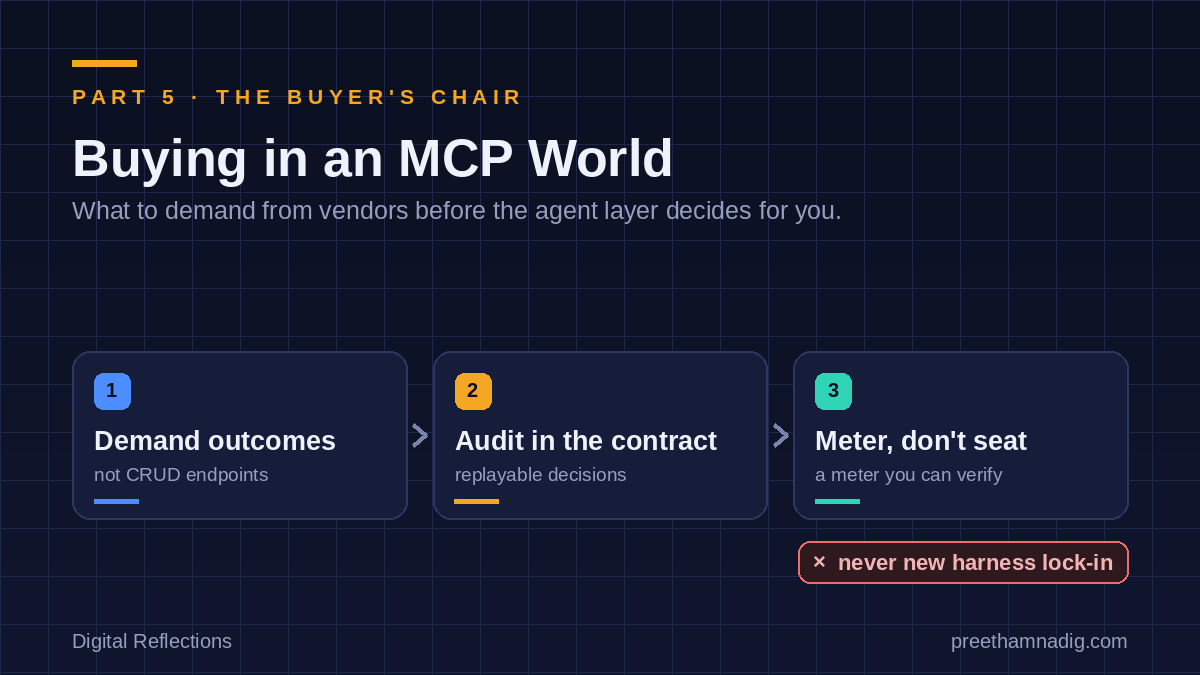
- Build the veneer, buy the primitives, orchestrate across both. Stop paying point-solution prices for workflows your agents can assemble; concentrate spend on the moated primitives and the governed substrate.
- Audit your seat-based lock-in. Every seat-priced contract is now a re-rating waiting to happen — in your favour if you renegotiate, against you if you don’t.
If you build software:
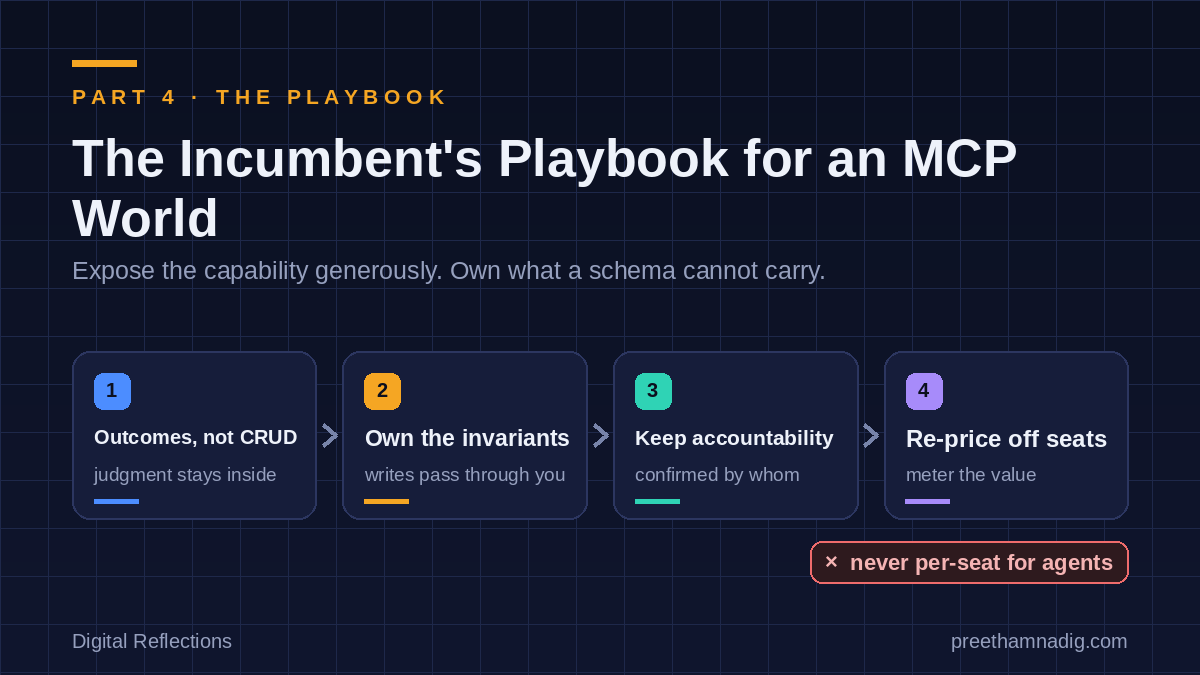
- Be a primitive or a substrate, or be priced by value — ideally both. Own data gravity, a network, or a hard correctness guarantee; charge for outcomes, not logins. Anything else is the squeezed middle.
The question that replaced buy vs. build
The oldest question in enterprise technology was buy versus build. The agent era retired it. The question now is which layer you own, and whether your price tracks the value you create — and the software that survives is the software that can answer both. Own the substrate, or the primitive, or the outcome. The veneer is being generated, and the seat is being automated away.
The Agentic Stack — a five-part series
- Agents Eat the Stack Top-Down
- The Substrate War
- Buy, Build, or Orchestrate — you are here
- Service-as-Software
- The Frontier Labs — Squeezed Middle
Companion: Who Advises the Disrupted? Consulting and Services in the Agent Era


Leave a Reply