Building on my previous framework for navigating the AI landscape, this post offers a practical maturity model for organizations ready to progress from experimentation to enterprise-scale AI.

In my previous post, I introduced a two-dimensional framework for evaluating AI projects: the intersection of Deterministic vs. Non-Deterministic systems and Human-Enabled vs. Fully Autonomous operations. The response from readers confirmed what I’ve observed in the field: leaders aren’t just hungry for frameworks to classify AI projects—they want a roadmap for how to sequence them.
Here’s what I’ve learned after guiding multiple initiatives through their Data and AI journeys: the quadrant you start matters less than the intentionality of your progression. Let me walk you through a maturity model that can help you move from quick wins to scalable, autonomous systems without breaking what’s already working.
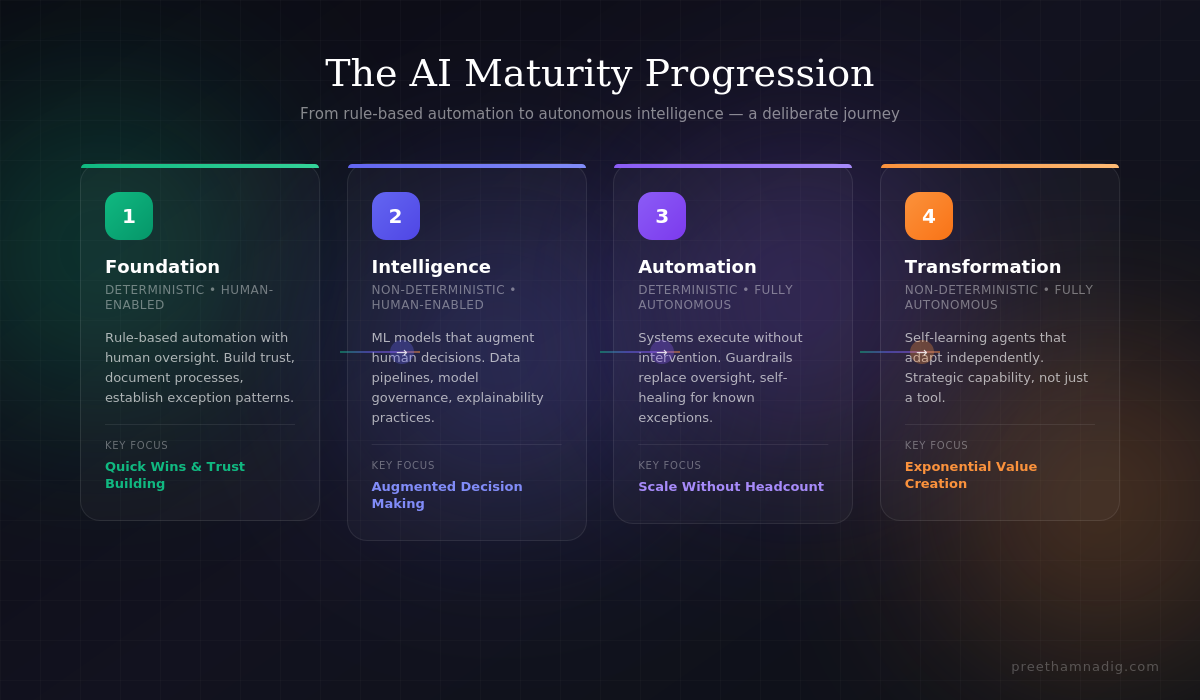
The AI Maturity Progression
Most organizations don’t—and shouldn’t—leap directly to fully autonomous, non-deterministic AI systems. The organizations that succeed treat AI adoption as a journey with deliberate phases, each building capabilities and organizational muscle for the next.
Phase 1: Foundation — Deterministic & Human-Enabled
Where most organizations should start.
This is the “quick wins” quadrant for good reason. Deterministic systems with human oversight offer the lowest risk, fastest time-to-value, and—critically—build organizational confidence in AI.
Characteristics:
- Rule-based automation with clear if-then logic
- Humans review, approve, or override AI recommendations
- Predictable outputs that can be audited and explained
- Low data requirements compared to ML-based approaches
Examples:
- Invoice processing workflows where AI extracts data and flags exceptions for human review
- Customer service ticket routing based on keyword classification
- Compliance checking against defined rule sets
What you’re building: Trust, process documentation, exception handling patterns, and the organizational habit of human-AI collaboration.
Key metric to track: Time saved per process multiplied by human override rate. If humans are overriding constantly, your rules need refinement. If they never override, you may be ready for more autonomy.
Phase 2: Intelligence — Non-Deterministic & Human-Enabled
Where data becomes your competitive advantage.
Once your organization has mastered rule-based automation, you’re ready to introduce probabilistic models—but keep humans in the loop. This phase is about augmenting human decision-making, not replacing it.
Characteristics:
- Machine learning models that surface predictions, recommendations, or insights
- Humans make final decisions informed by AI analysis
- Requires quality data infrastructure built in Phase 1
- Outputs may vary; explainability becomes important
Examples:
- Churn prediction models that alert customer success teams to at-risk accounts
- Demand forecasting that informs (but doesn’t auto-execute) inventory decisions
- Sentiment analysis dashboards that guide marketing strategy
What you’re building: Data pipelines, model governance frameworks, explainability practices, and the organizational capability to interpret probabilistic outputs.
Key metric to track: Decision quality improvement—are the decisions made with AI assistance measurably better than those made without? Track outcomes over time.
Phase 3: Automation — Deterministic & Fully Autonomous
Where efficiency scales without proportional headcount.
This phase feels like a step sideways on the framework, but it’s actually a critical capability unlock. You’re extending autonomy to systems with predictable, auditable behavior—learning to manage outcomes instead of processes.
Characteristics:
- Rule-based systems that execute without human intervention
- Guardrails and monitoring replace real-time oversight
- Self-healing capabilities for known exception patterns
- Clear escalation paths for edge cases
Examples:
- Smart grid management that autonomously balances energy loads
- Automated infrastructure scaling based on defined thresholds
- Self-correcting inventory replenishment within set parameters
What you’re building: Monitoring and alerting infrastructure, outcome-based success metrics, and the organizational comfort with “managing guardrails” rather than “managing tasks.”
Key metric to track: Intervention rate and incident resolution time. You want autonomous systems that rarely need human intervention—but when they do, the handoff should be seamless.
Phase 4: Transformation — Non-Deterministic & Fully Autonomous
Where AI becomes a strategic capability, not just a tool.
This is the frontier—systems that learn, adapt, and operate independently within defined boundaries. Few organizations reach this phase across their entire operation, and that’s fine. The goal isn’t universal autonomy; it’s deploying autonomous AI where it creates disproportionate value.
Characteristics:
- Self-learning agents that improve without explicit reprogramming
- Operates on emergent patterns, not just predefined rules
- Requires sophisticated monitoring for drift and alignment
- “Black box” risks demand robust governance
Examples:
- Autonomous logistics optimization that adapts to real-time market conditions
- Dynamic pricing engines that respond to competitive and demand signals
- Proactive maintenance systems that predict and address failures before they occur
What you’re building: AI governance at scale, continuous learning pipelines, outcome alignment mechanisms, and the organizational capability to set strategic constraints rather than tactical instructions.
Key metric to track: Value generated per unit of human oversight. At this phase, the ROI case should be exponential—if you’re still measuring linear productivity gains, you may have Phase 3 systems mislabeled as Phase 4.

The Maturity Assessment: Where Are You Now?
Before planning your progression, honestly assess your current state across five dimensions:

| Dimension | Foundation | Intelligence | Automation | Transformation |
| Data | Ad hoc, siloed | Centralized, cleaned | Real-time pipelines | Self-enriching data lakes |
| Talent | Technical specialists only | Cross-functional AI literacy | AI-fluent operators | AI strategists |
| Governance | Manual review for everything | Model validation processes | Automated guardrails | Outcome-based monitoring |
| Trust | Skepticism, heavy oversight | Informed confidence | Delegation within bounds | Strategic partnership |
| Culture | “AI is IT’s problem” | “AI helps me work” | “AI handles the routine” | “AI enables what wasn’t possible” |
Most organizations overestimate their readiness for later phases. I’d rather see a company execute Phase 1 exceptionally well than stumble into Phase 3 prematurely.
Navigating the Transitions
The transitions between phases are where most AI initiatives fail. Here’s what to watch for:
Phase 1 → Phase 2 (Foundation to Intelligence)
- Prerequisite: Your data from Phase 1 processes must be clean, consistent, and accessible
- Risk: Attempting ML without data quality results in garbage-in-garbage-out at scale
- Unlock signal: When humans consistently trust rule-based outputs and ask “what patterns are we missing?”
Phase 2 → Phase 3 (Intelligence to Automation)
- Prerequisite: Your humans must be ready to step back from decisions they’ve been making
- Risk: Automating without robust monitoring creates blind spots
- Unlock signal: When human approvals become rubber stamps for predictable scenarios
Phase 3 → Phase 4 (Automation to Transformation)
- Prerequisite: Your governance model must handle systems you can’t fully explain
- Risk: Autonomous systems that drift from organizational goals
- Unlock signal: When you can clearly articulate the boundaries within which AI should optimize
The Portfolio Approach
Here’s the strategic insight most organizations miss: you don’t need to be in one phase at a time. Mature organizations maintain a portfolio across all four quadrants simultaneously.
Your portfolio mix depends on your industry, risk tolerance, and strategic priorities. A regulated financial services firm might have 60% of AI initiatives in Phase 1-2, while a retail company might lean toward Phase 3-4. Neither is wrong—both are appropriate to context.
What matters is intentionality. Every AI initiative should be placed in a quadrant deliberately, with a clear view of what capability it builds for the next phase.
The Roadmap in Practice
If I were advising a leadership team starting their AI journey today, here’s the sequence I’d recommend:
Months 1-6: Deploy 2-3 Deterministic/Human-Enabled projects in high-volume, low-risk processes. Document everything—especially exceptions.
Months 6-12: Use the data generated to pilot one Non-Deterministic/Human-Enabled project. Focus on augmenting a decision that already has clear success metrics.
Months 12-18: Promote your most mature Phase 1 project to Phase 3 autonomy. Keep humans in the monitoring loop, not the execution loop.
Months 18+: Evaluate whether Phase 4 opportunities exist. For most organizations, this is where external expertise becomes valuable.

Final Thought
The most common mistake I see is treating AI adoption as a technology problem. It’s not. It’s an organizational capability problem that happens to involve technology.
The quadrants aren’t just about what your AI can do—they’re about what your organization can handle. Build the capability to operate in each quadrant before you deploy there. The organizations that succeed aren’t the ones with the most advanced AI; they’re the ones whose AI matches their organizational maturity.
The journey from quick wins to scalability isn’t about moving faster. It’s about moving deliberately.

Leave a Reply