
If agents carry the information and take the routine decisions, what is left for people to look at? Quite a lot — but it’s a different set of screens, built for a different relationship. The old interface existed so that a person could operate the system. The interface that remains exists so that a person can stay in charge of it. That is a design problem we have barely started on.

Five screens that survive
1. Approve. A decision on a prepared proposal. The design test is whether a competent person can say yes or no in seconds, with the reason in front of them. The agent’s job is to make that the only thing the person has to do; the screen’s job is to make the right answer obvious and the wrong answer hard to give by accident.
2. Resolve. The exception queue. This is where cases land that the agent shouldn’t or can’t settle. It needs context gathered, a recommended resolution, the alternatives, and the cost of each. This screen replaces hundreds of routine ones and carries far more of the product’s value.
3. Consent. Some acts belong to a person by law or by principle: signing, agreeing, authorising spend. In financial services this is regulation; in a household it is simply who is entitled to say yes. A form that exists to capture informed consent isn’t data entry and shouldn’t go away. It should get clearer.
4. Audit. A trustworthy record of what the agent did, on whose authority, with what information. It’s the screen a regulator, an internal reviewer or an unhappy customer will ask for, and it’s the screen that lets everyone else relax. If you can’t reconstruct why an action happened, you can’t safely let the agent take it.
5. Explain. “Show me why.” The ability to open any outcome and see the chain behind it. Used rarely, but its mere existence is what makes the unattended rungs of the trust ladder acceptable. People relax when they know they could look.
Everything else becomes disposable
The long tail of one-off views — the custom report, the filtered list, the comparison table someone needed on a Tuesday — no longer needs to be designed and shipped in advance. Interfaces generated at the moment of need, from the user’s intent and the data underneath, are moving from demo to practice, and open protocols for agent-driven interface components are emerging to carry them. The mental model is simple: the screen becomes a disposable rendering of what the person asked for.
This is liberating and it has a catch. A disposable interface is only safe on top of something that isn’t disposable.
The durable layer
When screens are cheap, the valuable thing is what they sit on: clean, resolved, well-governed data and a well-defined set of actions an agent is allowed to take. A generated screen over messy data is a confident-looking mistake. This is why the quiet infrastructure work — identity, entity resolution, permissions, the action catalogue — becomes the real product surface in an agentic world. It’s also why the incumbents with the deepest data and workflow have more to protect than a first glance suggests, as I argued in What Dissolves When You Become Callable.
Designing for supervision
The craft shifts from making a task easy to perform to making a system easy to oversee. A few principles I’d hold on to:
Lead with the decision, not the data. Show what needs a person’s judgement and why, and tuck the rest behind it. Make the default the safe choice and make reversal one gesture. Show confidence honestly — an agent that’s unsure should look unsure. Keep the person’s attention for what only they can supply: values, context the system can’t see, accountability. And measure the interface by how rarely it needs the person, not by how long they spend in it. Engagement time, the old north star, becomes an anti-metric.
A test for your own product
List every screen in your product. Mark each as approve, resolve, consent, audit, explain — or none of those. The ones that are none of those are the candidates for an agent to do the work instead, or for a disposable rendering to replace. What you have left is the interface that remains, and it’s a much smaller product than the one you have today, which should be a relief and a warning in equal measure.
Nobody Wants a Form — a five-part series on the interface in an agentic world
- Nobody Wants a Form
- The Trust Ladder
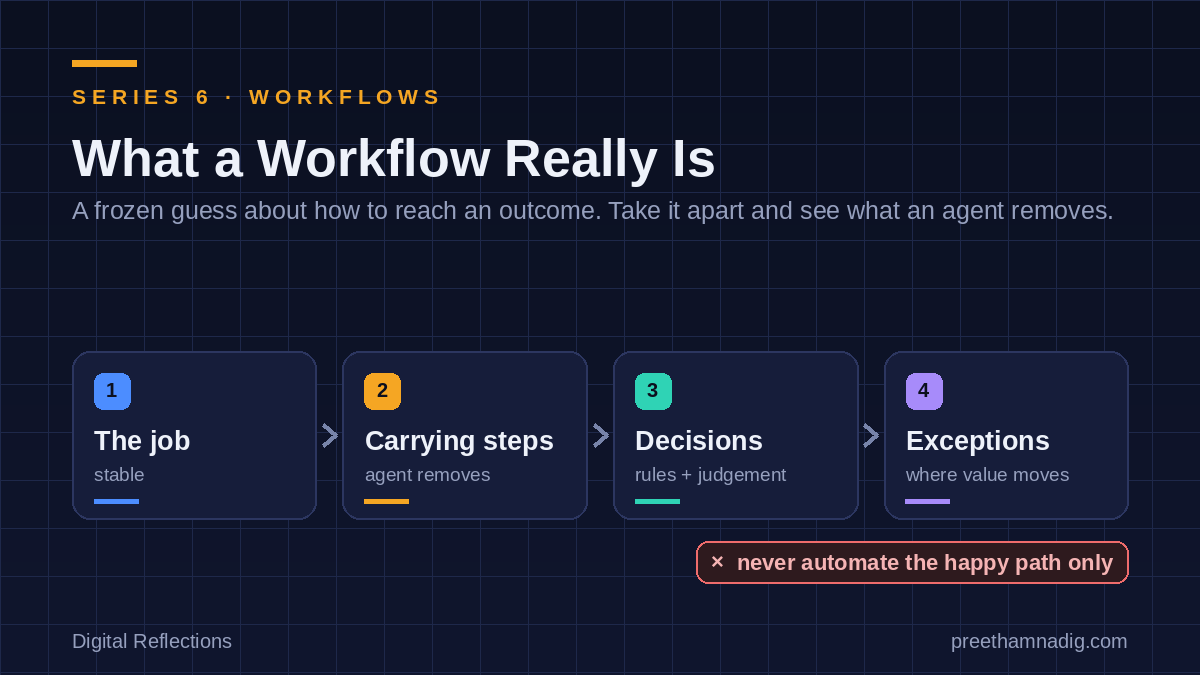
- What a Workflow Really Is
- The Interface That Remains — you are here
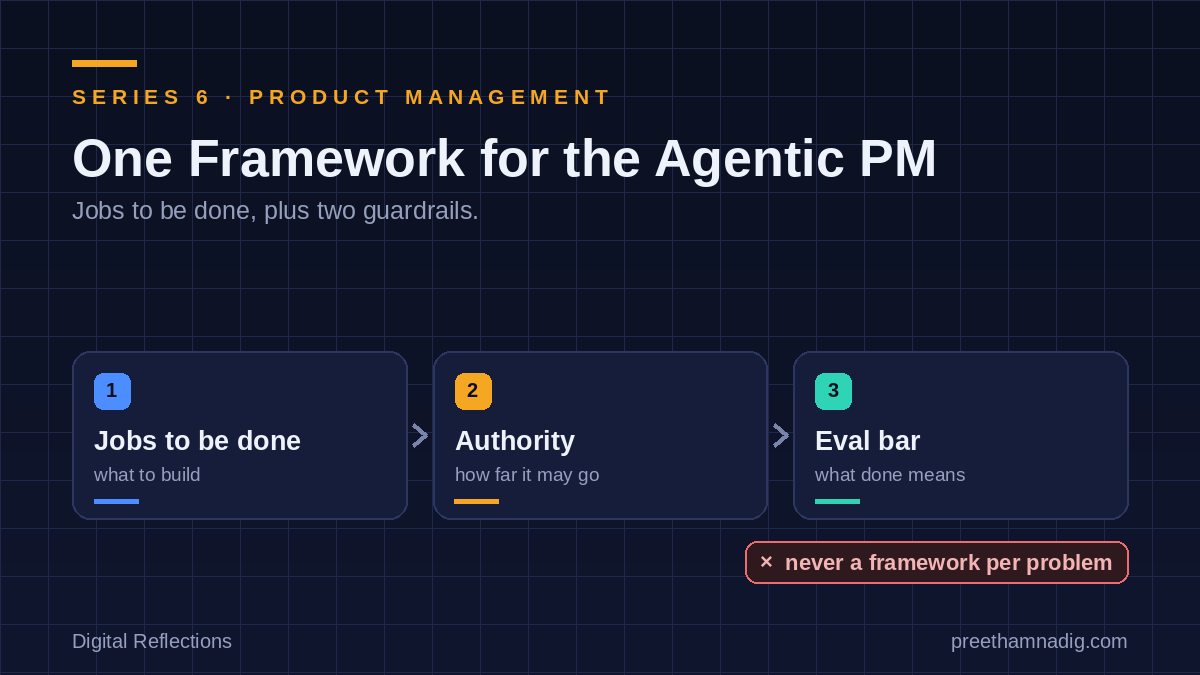
- One Framework for the Agentic PM
Companions: Why Agents Still Fail at Real Workflows.
Related: Entity Resolution Is the Bottleneck · What Dissolves When You Become Callable.

Leave a Reply