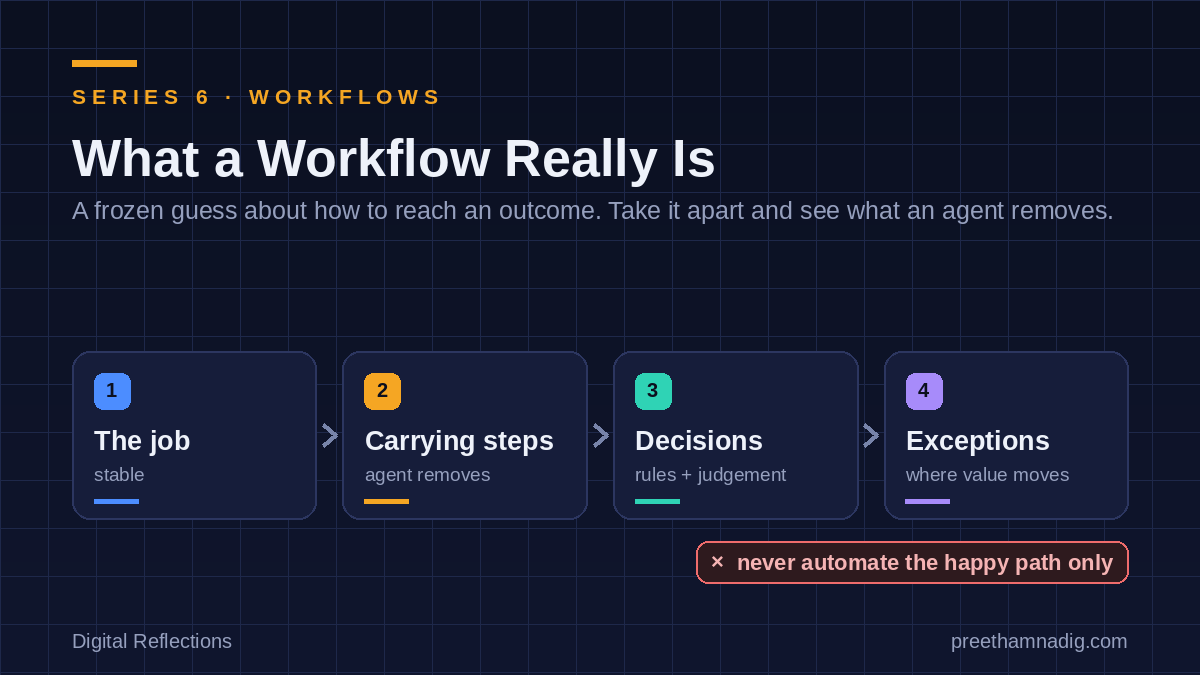
Every workflow in your organisation is a fossil. At some point someone worked out a reliable way to get a result, wrote it down as a sequence of steps and screens, and everyone has followed it since. The workflow isn’t the goal — it’s a frozen guess about how to reach the goal, shaped by what people and software could do at the moment it was drawn. Change what’s possible and the guess deserves another look.

Four layers hiding in every workflow
When I take a workflow apart, I find the same four layers, and they behave very differently once an agent can act.
The job. The outcome someone actually wants. “Get this supplier paid correctly.” “Get this prospect to a decision.” “Get this claim settled fairly.” The job is stable; it was true before the workflow and will be after.
The carrying steps. Moving information from where it lives to where it’s needed: re-keying an invoice number, copying a customer’s details between systems, attaching a document, forwarding for approval. These exist because the systems couldn’t talk to each other and a person could. This is the layer an agent removes first and almost entirely.
The decisions. Places where something must be judged: is this invoice legitimate, is this lead worth a call, does this claim fall inside the policy. Some follow clear rules, some need judgement. An agent can take the rule-shaped ones and can propose on the judgement-shaped ones.
The exceptions. Everything that doesn’t fit: the invoice with no purchase order, the customer whose records conflict, the claim with a missing document. Exceptions are rare per case and endless in kind, and they are where the real expertise of the people involved actually lives.
Worked example: paying a supplier invoice
An invoice arrives by email. In most organisations someone opens it, keys the details into a finance system, finds the matching purchase order, checks quantities, routes it for approval, waits, chases, and finally schedules payment. Count the steps and almost all of them are carrying.
Redrawn around the job — pay the right supplier the right amount once — the shape changes. The agent reads the invoice, matches it to the order and the receipt, and checks it against the contract terms. If it matches, it queues payment within the rules it has been given. If something is off, it doesn’t guess: it opens an exception with the discrepancy highlighted and a proposed resolution. The person sees a short queue of genuinely interesting cases, not a stack of routine ones.
Notice what happened to the screens. The data-entry form is gone. The record view is now a place to see what happened and why. The approval screen survived but became a decision on a prepared proposal. And a new screen appeared that never existed before: the exception queue, which is now the most important part of the product.
The same exercise in other domains
Lead handling in sales. Job: get a good prospect to a real conversation quickly. Carrying steps: enriching the lead, logging the touch, routing to the right rep. Decisions: is it worth pursuing. Exceptions: the prospect who is already a customer under another name — which is, not coincidentally, an entity-resolution problem.
Campaign reporting in marketing. Job: know what worked and shift budget accordingly. Carrying: pulling numbers from five platforms into one deck. Decisions: what the numbers mean. Exceptions: the attribution that doesn’t add up.
Know-your-customer review in financial services. Job: onboard legitimate customers without letting illegitimate ones through. Carrying: gathering documents and checking registries. Decisions: risk rating. Exceptions: the complex ownership structure, which is where a skilled analyst’s time should go and increasingly doesn’t.
What this tells a product team
First, automate the carrying layer without ceremony. Nobody will miss it and the saving is large. Second, the decisions layer is where the trust ladder applies — each decision sits on a rung of its own, as the previous post described. Third, and most overlooked, the exception layer is where your product’s value moves. When routine cases flow through untouched, the quality of how you surface, explain and resolve the odd ones becomes the experience. Teams that spend their design effort on the happy path will find the happy path has vanished.
There is a quieter lesson too. Many workflows contain steps that exist only because of an earlier limitation nobody remembers — a second approval added after an incident years ago, a field kept for a report nobody reads. Taking a workflow apart is the cheapest audit you will ever run. Ask of every step: what outcome does this serve, and who would notice if it stopped?
Nobody Wants a Form — a five-part series on the interface in an agentic world
- Nobody Wants a Form
- The Trust Ladder
- What a Workflow Really Is — you are here
- The Interface That Remains
- One Framework for the Agentic PM
Companions: Why Agents Still Fail at Real Workflows.
Related: Entity Resolution Is the Bottleneck · Put the Model Where Being Wrong Is Cheap.


Leave a Reply