Two things are true about agents in the enterprise right now, and they sound like they can’t both be. Adoption has gone vertical: in one survey of more than 500 enterprise leaders, updated this month, 71% now run agents in production, up from 40% a year earlier. And a major analyst firm still expects more than 40% of agentic AI projects to be cancelled by the end of 2027, for rising cost and unclear value. Both are true. The same survey quietly explains why.

The number that explains the contradiction
Only 30% of the leaders surveyed said their agents complete more than 60% of their tasks without a person stepping in. That’s the disappointing headline. The interesting finding is what sits underneath it.
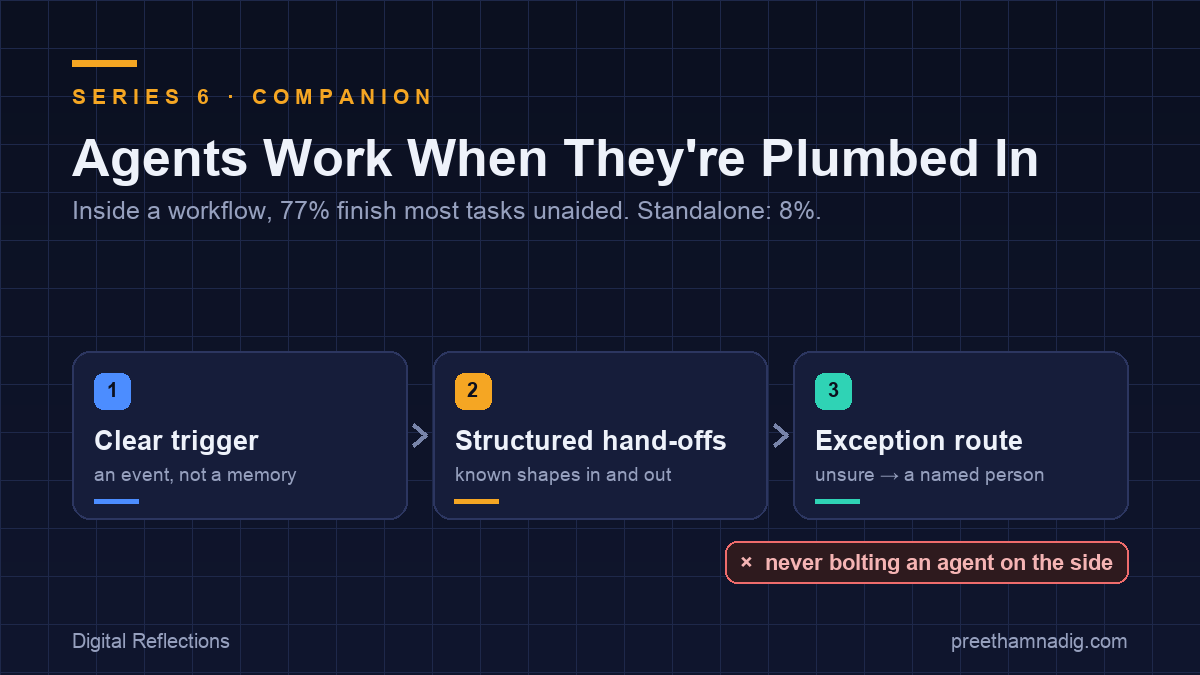
Where more than half of an organisation’s agents are part of broader automated workflows, 77% of leaders report that level of autonomy. Where half or fewer are connected to workflows, it falls to 8%.
It’s a survey, not a controlled experiment, and organisations that wire agents in carefully probably do many other things carefully too. But a gap that wide is not noise. Same models, same vendors, same year — and a nearly tenfold difference in how much work the agents actually finish. The variable isn’t intelligence. It’s plumbing.
An agent alone is a chatbot with ambition
A standalone agent sits on the side of the business. Someone has to remember it exists, open it, explain the situation, copy its output somewhere useful, and check it. Every one of those steps is a person, which means every task “the agent did” was really a task a person did with an agent’s help. That’s useful, but it isn’t automation, and it rarely survives a budget review.
An agent inside a workflow is different in kind. It is a step that got automated. Something upstream triggers it with the context it needs. Something downstream takes its output in a known shape. When it’s unsure, the work routes to a named person instead of stalling. Nobody has to remember it; the workflow does.
What “plumbed in” actually means
A clear trigger. The agent starts because an event happened — an invoice arrived, a ticket was raised, a record changed — not because someone thought to ask it.
Structured hand-offs. It receives inputs in a defined shape and returns outputs in a defined shape, so the next step can act without a person reformatting anything.
Deterministic steps either side. The rules, the lookups and the transactions stay in ordinary code. The agent does the part that needs judgement and nothing else — the argument of Put the Model Where Being Wrong Is Cheap, applied to a whole process.
Failure that routes somewhere. Low confidence, a broken rule or a missing field sends the case to the exception queue with its context attached. That’s the screen from The Interface That Remains, and it’s what keeps “mostly right” from becoming “quietly wrong.”
Why standalone agents get cancelled
Look at the projects that get abandoned and you tend to find the same three gaps. No defined job: the agent was built because agents were the thing, not because a step needed removing. No end state: nobody wrote down what “done” looks like, so nobody can tell when it’s finished or wrong. No way to see the value: if the agent isn’t a step in a process, there’s no before-and-after to point at — only anecdotes, and anecdotes lose budget arguments.
All three are design failures, not model failures. A more capable model inside the same design would fail the same way, just more fluently.
A test for your portfolio
Take every agent you run or are building and answer two questions in one line each:
- Which workflow does it sit in? Name the process, the trigger and the step after it.
- Which step did it remove? Not “helps with” — removed, or shrank to a yes/no.
An agent with clear answers to both is plumbing, and it will probably earn its keep. An agent that can’t answer the first is a standalone tool looking for a job, and it’s the one most likely to be in the 40%. Re-scope it around a step in What a Workflow Really Is terms, or retire it before it becomes a line in someone’s cancellation report.
The takeaway: stop asking which agent to build. Ask which workflow step to take away — then build the trigger, the hand-offs and the exception route around it. The model is the easy part.
Nobody Wants a Form — a five-part series on the interface in an agentic world
- Nobody Wants a Form
- The Trust Ladder
- What a Workflow Really Is
- The Interface That Remains
- One Framework for the Agentic PM
Companions to the series above — Why Agents Still Fail at Real Workflows · Agents Work When They’re Plumbed In — you are here.
Related: Put the Model Where Being Wrong Is Cheap · Why Agentic AI Transformation Is Hard — and the Lessons That Carry Over.

Leave a Reply