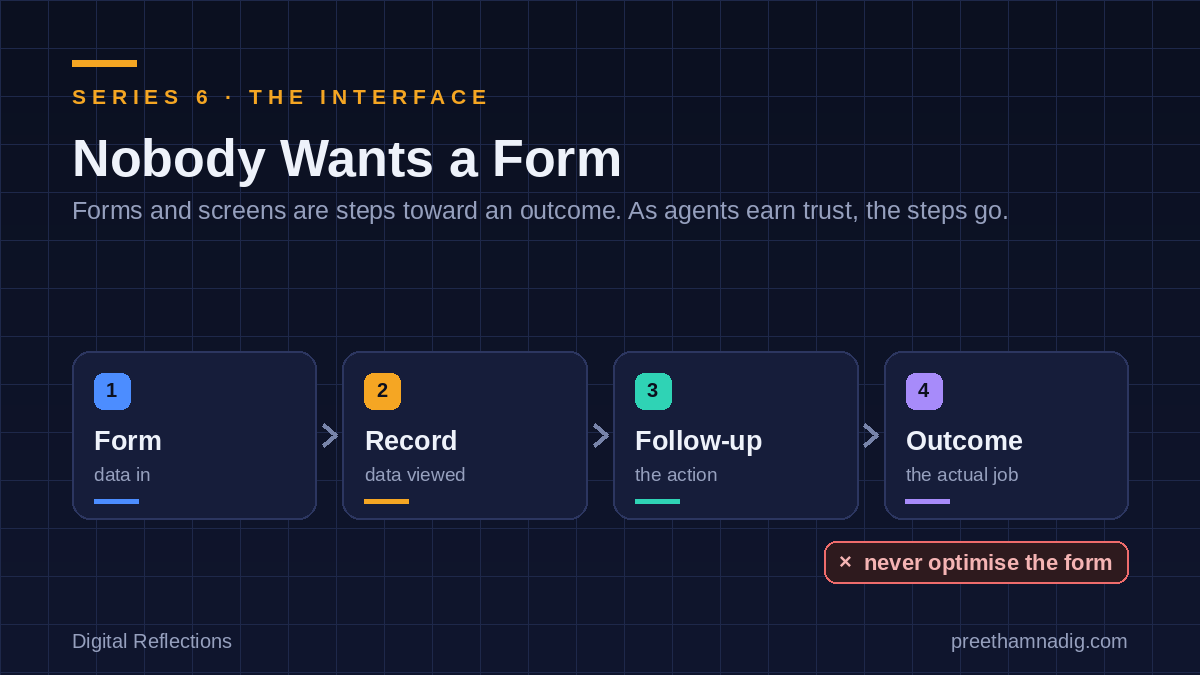
Nobody has ever wanted to fill in a form. A sales rep doesn’t want to update a record; they want the deal to close. A marketer doesn’t want to configure a campaign; they want the right people to hear the right thing. A customer filling in a loan application doesn’t want a loan application; they want the loan. Every form, every data-entry screen and every record view in the products and digital platforms we’ve built exists because a machine couldn’t be trusted to work out the next step on its own — so we asked a person to carry the information across by hand.

Every screen is a step toward a follow-up
Look at what a typical business application is actually for. You enter data so that something can be decided. You view a record so that you can decide what to do next. You click a button so that a follow-up — an approval, an email, a payment, a ticket — can happen. The form, the record and the dashboard are all intermediate steps. The thing that matters sits at the end: a call to action, and past that, an outcome someone actually cares about.
For thirty years the human has been the glue between those steps, because software could store and display but could not judge. We built an enormous craft around making that glue work better: field validation, progressive disclosure, inline help, wizards. All of it is craft in service of a person doing a job that the person never wanted to do.
What changes when the machine can act
Two capabilities are improving together. Models are getting better at reasoning about a messy situation and choosing a sensible next step, and they are getting better at actually taking that step — calling a tool, updating a system, completing a transaction. Open protocols for exposing capabilities to agents, and emerging ones for letting agents initiate payments, mean the “take the step” part is becoming plumbing rather than a research problem.
The third ingredient is the one people skip, and it’s the human one: trust. As people watch an agent get small things right, repeatedly and reversibly, they stop wanting to check every step. That’s not a technology curve; it’s the same curve by which you stopped proofreading your colleague’s work once they’d earned it.
Put those together and the path from intent to outcome stops needing a person to walk every step of it. The question changes from “how do we make this form easier to fill in?” to “does this form need to exist at all?”
Examples from outside the usual suspects
Sales. A CRM is a set of forms about a deal. Reps fill them in because management needs the pipeline visible. An agent that reads the email thread, the call transcript and the calendar can maintain the record itself and ask the rep only one thing: “the buyer went quiet after the pricing call — shall I send the follow-up I’ve drafted?” The job — move the deal forward — remains. The data entry doesn’t.
Marketing. Campaign setup is a thicket of audience definitions, budgets, schedules and approvals spread over a dozen screens. The job is “reach the people most likely to need this, within this budget, this quarter.” State the job and the constraint, and the agent assembles the campaign, runs it, watches the results and proposes adjustments. The human reviews a proposal, not a configuration.
Financial services. Onboarding a customer is the most form-dense experience in the industry: identity, address, source of funds, suitability, consent. Much of it is information that already exists in documents and registries. The job is “open a compliant account for this person.” The agent gathers, cross-checks and flags exceptions; the person confirms what only they can confirm.
Operations. Expense reports, purchase requests, leave approvals, vendor onboarding — each a form whose only purpose is to carry information to a decision that follows predictable rules.
The pattern is identical every time: a task that exists to move information from where it is to where a decision gets made, performed by a person because nothing else could be trusted to do it.
The interface doesn’t disappear — it changes jobs
It would be too easy to say forms are dead, and it would be wrong. Look at what survives in each example. The rep still confirms the follow-up. The marketer still approves the spend. The customer still signs the consent. The interface moves from doing the work to supervising it: approval, exception handling, consent, audit, and the occasional “show me why.” Those are real jobs, and they need good design — arguably better design than a data-entry form ever did, because the stakes of a single click are higher.
That shift is the subject of this series. Not “AI will replace the interface,” which is a slogan, but a more useful and more defensible claim: the interface is the cost of an agent we couldn’t yet trust, and as trust is earned, the cost falls.
Where this series goes
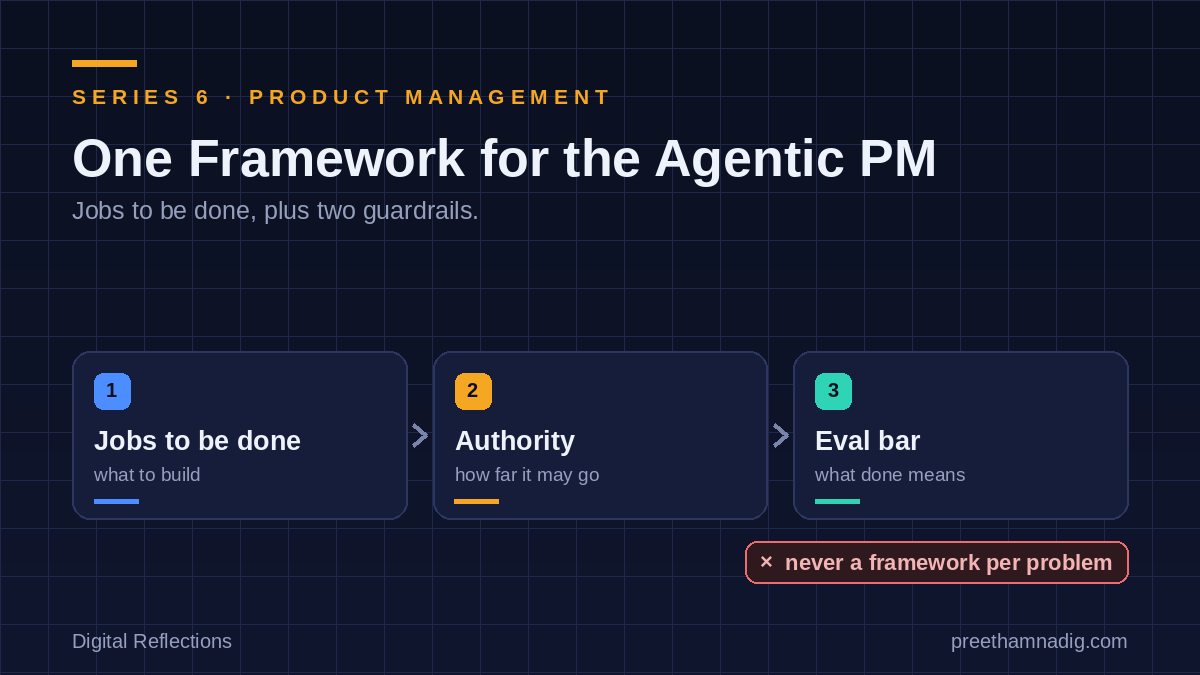
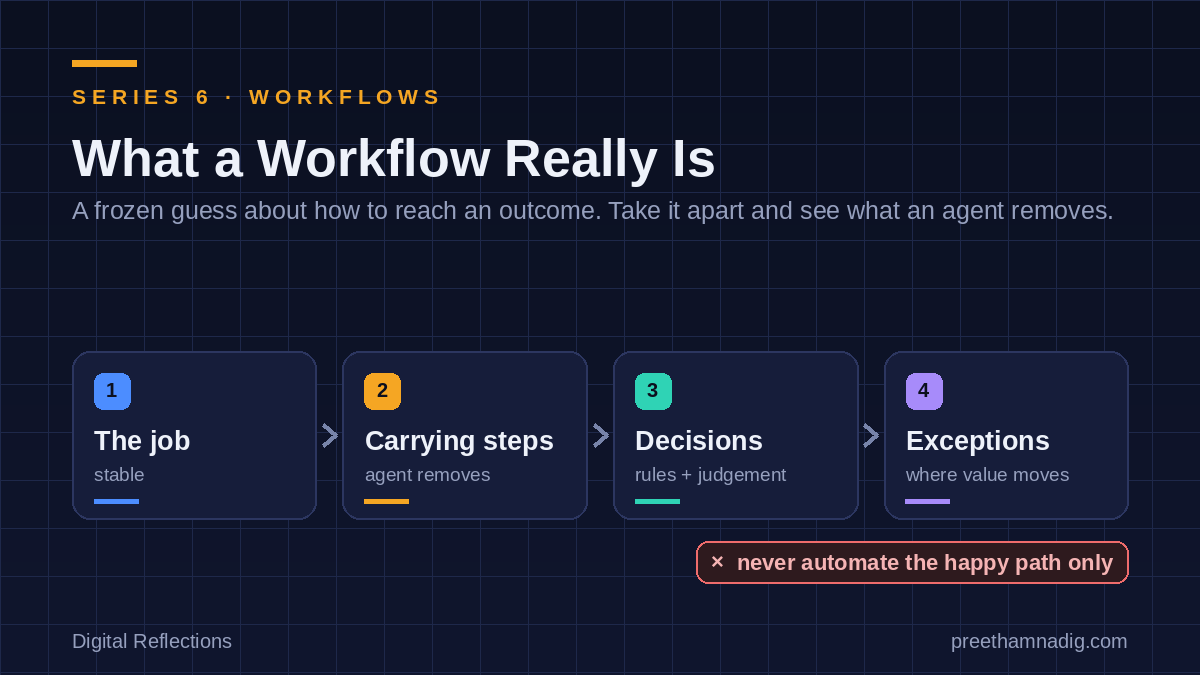
Five parts and a companion. The next post is about the thing that actually limits the pace — The Trust Ladder: how autonomy is earned one reversible step at a time. Then What a Workflow Really Is, taking apart a real workflow to see what an agent removes and what must stay. The Interface That Remains covers the screens that survive. And One Framework for the Agentic PM argues that the one framework a product manager needs for all of this is the oldest and simplest: jobs to be done. A companion, Why Agents Still Fail at Real Workflows, keeps us honest about how far there is still to go.
The thing to carry out of this post is a single question to ask of any screen in your product: what outcome is this a step toward, and could the step be taken for the person instead?
Nobody Wants a Form — a five-part series on the interface in an agentic world
- Nobody Wants a Form — you are here
- The Trust Ladder
- What a Workflow Really Is
- The Interface That Remains
- One Framework for the Agentic PM
Companions: Why Agents Still Fail at Real Workflows.
Related: What Dissolves When You Become Callable · Service-as-Software — What the Hypergrowth AI Startups Figured Out.


Leave a Reply