
If the interface is the cost of an agent we couldn’t yet trust, then the pace at which interfaces recede is set by trust — not by model capability. That’s the part of the story that rarely makes the keynote. A model can be able to do a task long before anyone is willing to let it, and the gap between those two moments is where most of the real product work lives.

Trust is built the way it always was
You didn’t trust a new colleague with the company card on day one. You checked their work, then spot-checked it, then stopped. At each stage the cost of being wrong was small enough to survive, and the evidence accumulated. Autonomy for agents follows the same arc, which means it can be designed instead of hoped for. I think of it as four rungs.
Rung one: suggest
The agent produces a recommendation and the person does everything else. A suggested reply, a flagged anomaly, a drafted summary. Nothing the agent does can cause harm, because it does nothing. This rung is underrated: it’s where you collect the data that tells you whether the agent’s judgement is any good, and it costs the person almost nothing.
Rung two: propose
The agent prepares the action — the email written, the payment staged, the record updated in draft — and presents it for a yes or a no. The decisive design choice is that approval is a single click on a complete proposal, not a form to fill in. I built exactly this into a small family assistant I tinkered together: it can work out that a flight booking or a calendar change is what’s needed, but it only ever proposes, and doesn’t act until a parent approves. Approval rates here are your most valuable metric. If people approve ninety-nine proposals in a hundred without edits, you have evidence — not a hunch — that this rung is ready to be retired.
Rung three: act with undo
The agent acts, and the action is reversible, visible and bounded. A scheduled message with a grace period before it sends. A refund up to a set amount. A change that is logged and can be rolled back in one step. The principle is that reversibility substitutes for approval: you no longer need the person to say yes beforehand if they can cheaply say “no, undo that” afterwards. This is where the interface starts to genuinely recede, because the person moves from the path of the work to the edge of it.
Rung four: act unattended
The agent acts and the person reviews outcomes in aggregate, intervening only on exceptions. This is the rung that earns the headlines and it is the one to be most careful with. It is appropriate only where the action is low-stakes, or reversible, or both, and where you have a monitored track record on the previous rung. Most workflows will have some steps at rung four and others permanently at rung two.
Not every step climbs at the same speed
The mistake is to put a whole product on one rung. The right unit is the action, not the product. Within a single financial-services onboarding, “pre-fill the address from a verified document” can sit at rung four, “request a missing document” at rung three, and “approve the account” at rung two for years — perhaps permanently, if regulation or risk appetite says a human must be accountable. A useful rule of thumb: the rung an action can reach is set by the blast radius if it’s wrong and how cheaply it can be undone. Money leaving the building, anything that talks to a customer on your behalf, and anything irreversible climb last. In the same family assistant, the one thing it will never do is transact — a boundary I chose deliberately and have not been tempted to revisit.
What you must build to let people climb
Four things, none glamorous. Visibility — a plain record of what the agent did and why, readable by the person it acted for. Reversibility — undo as a first-class feature, not an apology. Evidence — an eval set that says whether this action, with this agent, is actually getting better. And a ratchet that can go down — if an action’s error rate rises, it should drop a rung automatically. Trust that can only go up is not trust; it’s drift.
What this means for the interface
Each rung changes what the screen is for. At rung one the screen is the whole job. At rung two it’s a decision. At rung three it’s a feed with an undo button. At rung four it’s a dashboard and an exception queue. The form dissolves in stages, and the stage it reaches depends on trust the product has to earn. Which is why the question for a product team isn’t “when will the form go away?” It’s “what evidence would let this action move up a rung, and are we collecting it?”
Nobody Wants a Form — a five-part series on the interface in an agentic world
- Nobody Wants a Form
- The Trust Ladder — you are here
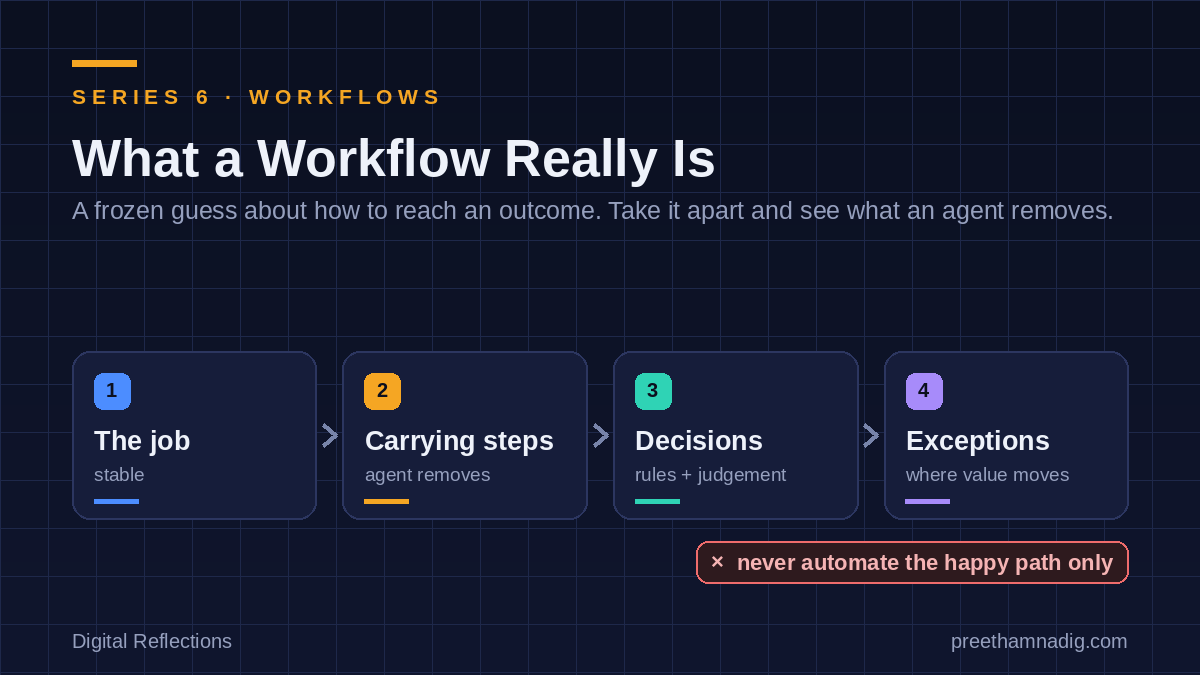
- What a Workflow Really Is
- The Interface That Remains
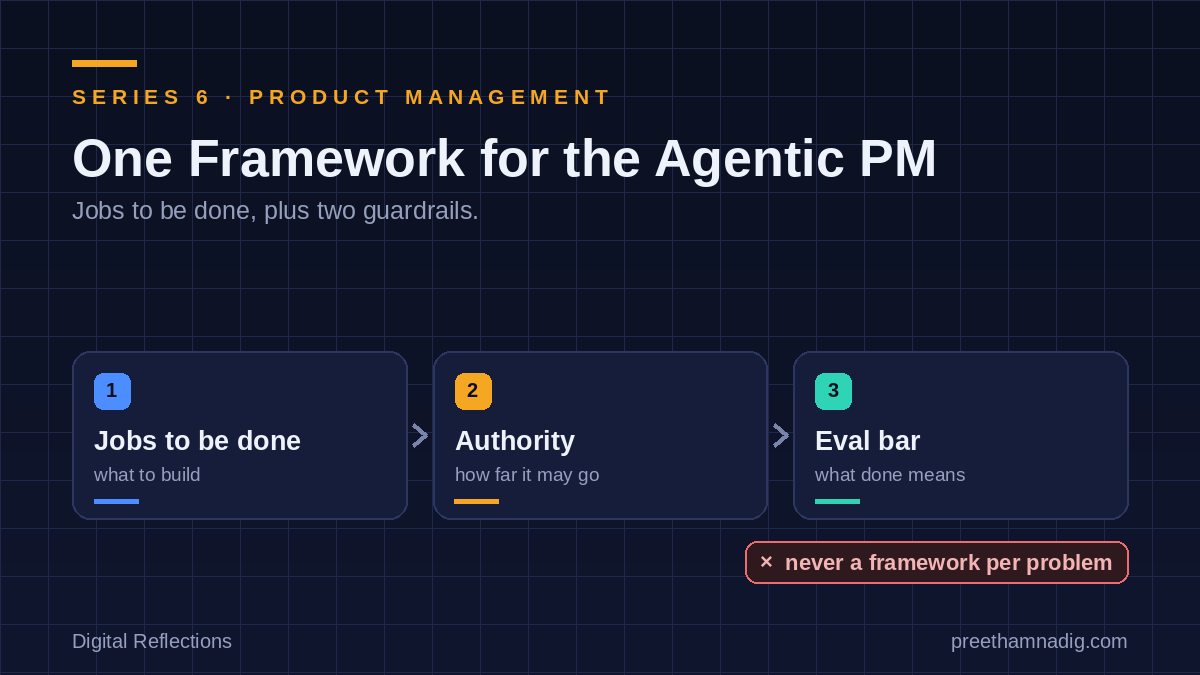
- One Framework for the Agentic PM
Companions: Why Agents Still Fail at Real Workflows.
Related: What a Good Eval Set Actually Looks Like · An Agent Is a State Machine, Not a Loop.
Part of a personal DIY hobby, tinkered together on weekends for my own family, built entirely with open-source, self-hosted models.


Leave a Reply