My family’s AI agent has one rule I’d defend above all the others: it never acts on its own. It notices that a reminder is needed or a calendar entry is missing, and it proposes one with an Approve / Not now pair of buttons. Only a human tap makes anything happen. I wrote about that gate in Propose, Don’t Act, and for a DIY hobby agent on local open-source models it is the whole safety story. Data teams are about to learn the same lesson at much higher stakes. Data-platform vendors have started shipping agents that watch jobs and tables, diagnose failures and propose fixes, with a person approving any change to production. That is the right shape. The hard part is deciding where the line sits.

Why pipelines are the right first target
Most places you could put an agent have a fuzzy definition of failure. Data pipelines don’t. A job fails or it doesn’t; a freshness check passes or it doesn’t; a row count lands inside its expected range or it doesn’t. That clear signal is rare, and it is what makes data operations such a good first home for agents.
The surroundings help too. There are logs, run histories and lineage, so an agent can see what changed and what depends on what. There is usually a staging environment, so a fix can be tried before it is trusted. And there is a long record of how people actually fixed things: tickets, commits and runbooks, which is the raw material for judging whether an agent’s diagnosis is any good.
But data operations has a hazard that a calendar reminder doesn’t. A bad fix rarely shows up as a red job. It shows up as a green one. Loosen a type cast, skip the malformed rows, widen a join, and the pipeline passes while quietly writing wrong numbers into tables that dashboards, models and month-end reports read from. The data engineer won’t be the first to notice. A finance analyst, a forecasting model or a customer will. Everything below follows from that.
Detect, diagnose, propose
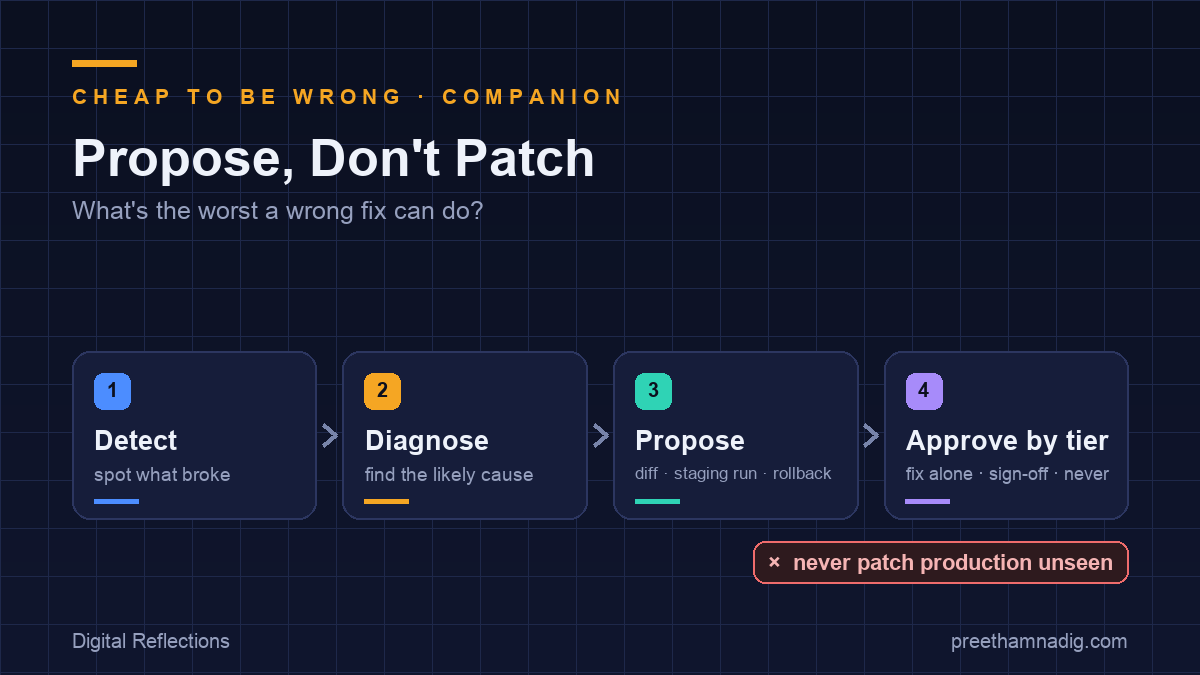
The useful agent in a pipeline has three verbs, and “repair” isn’t one of them. It detects the failure or the anomaly. It diagnoses a likely cause from the logs, the recent changes and the lineage. And it proposes a change, handed to a person as a complete package rather than a vague alert. A good proposal contains:
- The diagnosis, with its evidence. The log lines, the upstream schema change, the run that started failing. Not “the model thinks”, but “here is what I saw”.
- The change itself. A diff to the code or config, in the same review flow a person’s change would go through.
- A test result from staging. The fix run against a copy, with row counts and quality checks compared before and after.
- The blast radius. Which downstream tables, reports and models read from what this touches.
- The way back. How to roll it back, and whether rolling back is clean or leaves data behind.
Approving that should be a decision, not a research project. If the reviewer has to rebuild the diagnosis to trust it, the agent has saved nobody any time.
The tier table
Not every fix deserves the same gate. The design work is sorting actions into tiers, and the sorting question is simple: if this fix is wrong, what breaks, can we undo it, and who finds out first?
| Tier | Examples | Why it sits here |
|---|---|---|
| Fix alone | Retry a transient failure within a set budget; restart a stuck task; raise a timeout or resize compute within fixed bounds; refresh a derived view | Reversible, scoped to one job, changes no logic and no data definition. A wrong call costs a few minutes or a little compute. |
| With sign-off | Schema changes; transformation or join logic; backfills; rolling back a deployment; changing a data-quality threshold | Changes what the data means or rewrites history. A wrong call can turn a red job green while making the output wrong. |
| Never | Deleting tables, partitions or rows; anything touching regulated or customer personal data; loosening access; disabling a test or check to get a job through | Irreversible, or a compliance matter, or it removes the very control that would catch the agent being wrong. |
“Never” here means the agent may notice and recommend, but the change is made by a person through the ordinary process. It doesn’t mean the agent pretends the problem isn’t there.
Research points the same way. A recent research paper on self-healing data and AI pipelines proposes an open-source reference architecture with a deterministic policy gate: low-risk, reversible actions such as retries run without a person, mid-risk ones such as backfills and rollbacks need a single approver, and schema changes are recommendation-only, made by a human through a reviewed change. It’s a proposed design rather than a measured result, but its central claim rings true: the main gap is architectural, not technological.
Two things make a tier table real rather than decorative. First, it is enforced in code, not in a prompt: a “fix alone” action runs with credentials that simply cannot alter a schema, the point of An Agent Is a State Machine, Not a Loop. Second, the unit is the action, not the agent. The same agent can retry a job on its own and still need sign-off to touch a join, which is The Trust Ladder applied to a single pipeline.
Shadow mode first
Before an agent fixes anything, even the safe tier, let it watch. Run it in recommend-only mode for several weeks: every time something breaks, it writes up its diagnosis and proposed fix, and a person fixes the problem the usual way without looking. Then compare.
Did the agent name the same cause the engineer found? Would its fix have worked? Would it have been harmful: would it have made the job pass while breaking the data? That last question matters most, and shadow mode is the only cheap way to answer it, because the proposals that would have done damage never reach production. You end up with a scored track record built from your own failures, your own pipelines and your own team’s judgement, not a vendor demo.
Shadow mode also tells you which tier each action type has earned. If retry proposals match what people did nineteen times in twenty and the twentieth was harmless, retries can move to “fix alone”. If logic fixes look plausible but keep getting the downstream impact wrong, they stay behind sign-off, perhaps for good.
What to measure
Three numbers tell you whether the agent is earning its keep, and one tells you whether it’s safe:
- Fix acceptance rate. Of the proposals a person reviewed, how many were approved as written, how many approved after edits, and how many rejected. Rising “as written” is the trust signal; a high “after edits” share means the diagnosis is good but the fix isn’t yet.
- Time to resolution. From detection to a fix in production, compared with the same kind of failure before the agent arrived. This is the number the business feels.
- Bad proposals caught in review. How often a reviewer stopped something that would have done harm. This isn’t a failure of the system; it is the system working, and it tells you the gate is earning its place.
- Bad fixes that escaped. The safety number. Any fix that passed review or ran unattended and later had to be reversed, especially one a downstream user found first. One of these in the “fix alone” tier should demote that action type automatically.
Promotion between tiers should be slow and earned on that evidence; demotion should be fast and automatic. That asymmetry is what lets a data leader say yes to more autonomy without betting the reporting cycle on it.
The question to ask
The temptation with any capable agent is to ask what it can fix. In a pipeline, it can probably fix a great deal: the code is right there and the error message usually points at the problem. That is exactly why capability is the wrong test.
So for every action you’re thinking of handing over, ask a different question: what’s the worst a wrong fix can do, and who sees it first? If the answer is “a job retries twice and an engineer sees it in the morning”, let the agent do it alone. If the answer is “a number in a board pack is wrong and the finance team finds it”, the agent proposes and a person decides. And if the answer is “data is gone, or a customer’s data went where it shouldn’t”, the agent can tell you about it, and that’s all.
A companion to the six-part series Cheap to Be Wrong — an architecture for agentic systems.
Related: Propose, Don’t Act · An Agent Is a State Machine, Not a Loop · The Trust Ladder · Agents Work When They’re Plumbed In.
Leave a Reply