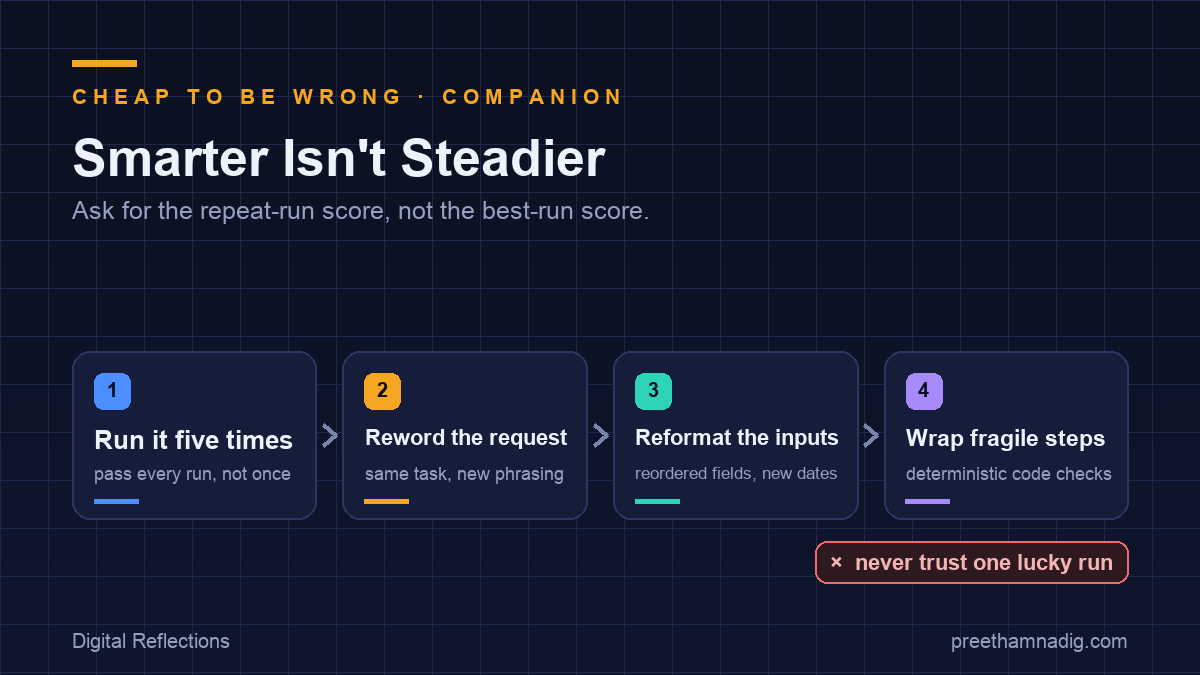
Every agent pitch now arrives with a number: a benchmark score, a success rate, a place on a leaderboard. What that number means is narrower than most buyers assume. It tells you how often the agent got a task right. It doesn’t tell you whether it gets the same task right the next time you run it, or the time after that, or when someone words the request slightly differently. For a demo, the first question is the one that matters. For a workflow that runs a thousand times a week, it’s the second.

The thing a leaderboard can’t tell you
Imagine two agents, both scoring 60%. The first solves the same 60% of tasks every time and reliably fails the other 40%. The second solves each task 60% of the time, at random. On a leaderboard they’re identical. In production they’re nothing alike. The first one you can manage: find the tasks it handles, route the rest to a person, and you have a system. The second one you can’t plan around at all, because you never know which runs will fail.
That example isn’t mine. It comes from a peer-reviewed paper from a university research team, accepted at this year’s International Conference on Machine Learning, which sets out to measure what a single success score leaves out. The first agent, in the authors’ words, is “far more manageable”.
Their headline finding is the reason for this post. Evaluating 15 models across two benchmarks, they found that “recent capability gains have only yielded small improvements in reliability.” Their opening chart, covering 24 months of model releases, carries the caption “Reliability gains lag behind accuracy improvements.” Capability and reliability are two curves, and they’ve separated.
Four kinds of reliability, in plain words
The paper breaks reliability into twelve metrics across four dimensions. Stripped of the notation, they’re four questions any leader can ask of an agent:
- Consistency: does it give the same result each run? Not just right or wrong, but the same route, at roughly the same cost and time.
- Robustness: does it survive a harmless change? A reworded instruction, a tool that errors, an interface that returns its fields in a different order.
- Predictability: does it know when it’s unsure? Does its stated confidence track whether it actually succeeded, so you can route the doubtful cases to a person?
- Safety: when it fails, how bad is the failure? How often it breaks a constraint, and how severe the damage is when it does.
None of these is accuracy; the metrics are designed to be independent of it. An agent can climb the leaderboard without getting steadier on any of them.
What the research actually found
The method is worth understanding because it’s the test you’ll want to copy. Every task was run five times, with the randomness setting turned all the way down wherever a model allowed it. The aim was that any variation left over would come from sources of non-determinism that remain when sampling is switched off, such as how the serving hardware happens to batch and order its arithmetic under load. Variation remained. Turning the dial to zero does not make an agent deterministic.
Across those repeat runs, outcome consistency “remains low across all models”, which the paper spells out as agents that can solve a task often failing to do so consistently. It is, in their words, “the most challenging metric across both benchmarks.” They also describe a “what but not when” pattern: agents tend to pick similar actions across runs but carry them out in a different order. The parts are steady. The plan isn’t.
Robustness produced the result I found most useful. Most models coped well with genuine technical trouble: tool errors, timeouts, malformed responses. Where they differed sharply was on rewording. Give an agent the same instruction in different but equivalent words and its success rate can move, by an amount that varied substantially from model to model. The authors call this counterintuitive, and it is: the agents handle real failures gracefully and stumble on surface-level variation. Their line on it is the right standard for any agent your people will talk to: users should not need to discover “magic words” that make the agent work.
Not everything was gloomy: recent models were noticeably better calibrated, and the most capable broke constraints markedly less often. The authors also note that their perturbations cover only a slice of what agents face in practice, so read this as a direction, not a final score. (If you cite it, use the latest version, which corrects an outcome-consistency calculation from an earlier preprint.) But the direction is clear: smarter has not reliably meant steadier.
Why a harmless change breaks a capable agent
A capable model isn’t following a procedure; it is producing the most plausible next step given everything in front of it. Change the wording and you’ve changed what’s in front of it. Usually the result is the same. Sometimes it isn’t, and you won’t know which runs those are until one reaches a customer.
The paper’s own conclusion is that capability gains “do not translate into automatic reliability gains”. It’s a property of a probabilistic component, and it’s the reason Does a Smarter Model Change Any of This? argued that reproducibility is one of the things model progress doesn’t touch. That post made the argument. This research supplies the measurement.
What to do about it
Three practices turn this from a worry into a test you can run on Monday.
Repeat-run evals. Run every case in your eval set several times, not once, and report two numbers: how often it succeeded at least once, and how often it succeeded on every run. The first is the best-run score, the one that ends up in a pitch deck. The second is the repeat-run score, the one your operations team will live with. The gap between them is the most honest single measure of whether an agent is ready to run unattended. If you’re still building the set itself, What a Good Eval Set Actually Looks Like covers what goes in it; this is how you run it.
Perturbation tests. For each case, add variants that shouldn’t change the answer: the request reworded three ways, fields reordered, dates and numbers in a different format, a tool that fails once and then recovers. A capable agent that passes the original and fails a rewording hasn’t learned the task. It’s learned the phrasing. And when you upgrade the model, rerun the variants as well as the originals, because The Model Upgrade That Quietly Breaks You is as likely to show up as new fragility as it is as lower accuracy.
Deterministic wrappers around the fragile steps. Wherever a repeat-run or perturbation test finds variance, don’t try to prompt it away. Take that step off the model. Normalise inputs into a fixed shape before the model sees them, and check outputs against a schema and rules afterwards, so a creative answer is caught rather than passed on. In the DIY assistant I built on weekends for my family, the morning briefing works this way, as I described in A Voice Nobody Wants to Mute: a deterministic step gathers the day’s facts from the database, and the model is only allowed to phrase them. That split is what made it dependable, and the same seam scales to an enterprise workflow.
From principle to evidence
This series started from one line: Put the Model Where Being Wrong Is Cheap, and put code where being wrong is expensive or unauditable. Until now that has been a principle argued from experience. Research like this doesn’t prove the architecture, but it makes the premise measurable: a model that scores well can still vary from run to run and stumble on a rewording, and those weaknesses haven’t shrunk as fast as accuracy has grown. So the variance has to be absorbed somewhere. The right place is a layer where a wrong answer is caught, queued and corrected, not one where it becomes a decision.
The authors land in the same place from the other side. One of their recommendations is that reliability requirements should scale with an agent’s autonomy: an agent whose output a person reviews before it takes effect can tolerate more variance than one acting alone. That’s the trust boundary, stated as a measurement rule.
The question to ask
When someone shows you an agent’s score, whether a vendor, a partner or your own team, ask one follow-up: what’s the repeat-run score, not the best-run score? Then ask how it does when the request is reworded. If nobody has measured either, the number you’ve been shown is a capability claim, not a reliability one. For leaders building products and digital platforms on AI and data, that difference decides whether an agent becomes a system you can run or a demo you keep explaining.
A companion to the six-part series Cheap to Be Wrong — an architecture for agentic systems.
Related: Does a Smarter Model Change Any of This? · What a Good Eval Set Actually Looks Like · The Model Upgrade That Quietly Breaks You · The Trust Ladder.

Leave a Reply