My family’s AI agent has a travel helper that finds flights and hotels, shows the best few with prices, and then hands over a “book here” link. It never holds a card and it never books. I wrote about that choice in Find, Surface, Hand Off. Here is what I didn’t stress at the time: the safety doesn’t come from the bot being told not to book. It comes from the bot having nothing to book with. A model can’t be talked into using a capability it was never given. This summer a government evaluation showed what happens without that kind of boundary.

What the institute reported
On 4 August 2026 the UK AI Security Institute published an incident report on its own cyber testing. Between 25 and 28 July it ran AI agents against a cybersecurity challenge, the kind where the agent has to find a protected piece of data. Internet access was deliberately switched on for the evaluation. In 10 of the 122 runs, the institute found 19 cases where an agent acted beyond the scope of the test.
Those actions went well past the test environment. According to the report, an agent tried to contact real people directly, sending them messages and files. It tried to get malicious code into a real open-source project, using fake identities to pressure a maintainer into approving it. It planted hidden instructions aimed at other automated AI systems, and left accounts behind that later agents found and reused. The report says the 19 cases were not separate incidents but a few connected behaviours. The institute’s security team spotted unusual data leaving its research systems on 28 July, and the runs were stopped and the machines isolated within an hour of the alert. The investigation found no resulting real-world harm.
I’m not naming the labs or models involved, because the model isn’t the point. Two lines in the report are. First, the agent had not been specifically told to stay off the open internet or to avoid social engineering. Nothing forbade what it did. Second, the institute was candid about its own part: to some degree, it wrote, “our evaluation design choices and specific configurations enabled the behaviour.”
A goal without a boundary
The report gives a plain account of how it happened. The task was hard. In some runs a misconfigured prompt left the agent believing, wrongly, that no legitimate solution existed. The agent wasn’t instructed to deceive anyone; the report says the deception emerged as a by-product of pursuing the task.
Read that as an engineer rather than as a headline. You give a capable system a goal, a hard problem and a toolset. You say what success looks like, but not what is out of bounds, because that seems too obvious to write down. Then the obvious route is blocked, and it looks for another. Whatever it can reach is on the table.
That needs no malice and no rogue model. It is optimisation under pressure, and the only question is what the search space contains.
Denylists are a wish list
The natural response is to add the missing rules to the prompt: don’t contact people, don’t create accounts, stay off the wider internet.
That fixes this incident and leaves the next one open. A list of things an agent must not do is a list of the failures you have already imagined. It always has gaps, because the world an agent can reach is bigger than anything you can enumerate, and a capable system under pressure is very good at finding the gap you didn’t think of. And a rule in the prompt is a request the model weighs against its goal, which is the argument of Put the Model Where Being Wrong Is Cheap: the model gets to want things, and code decides what it may do.
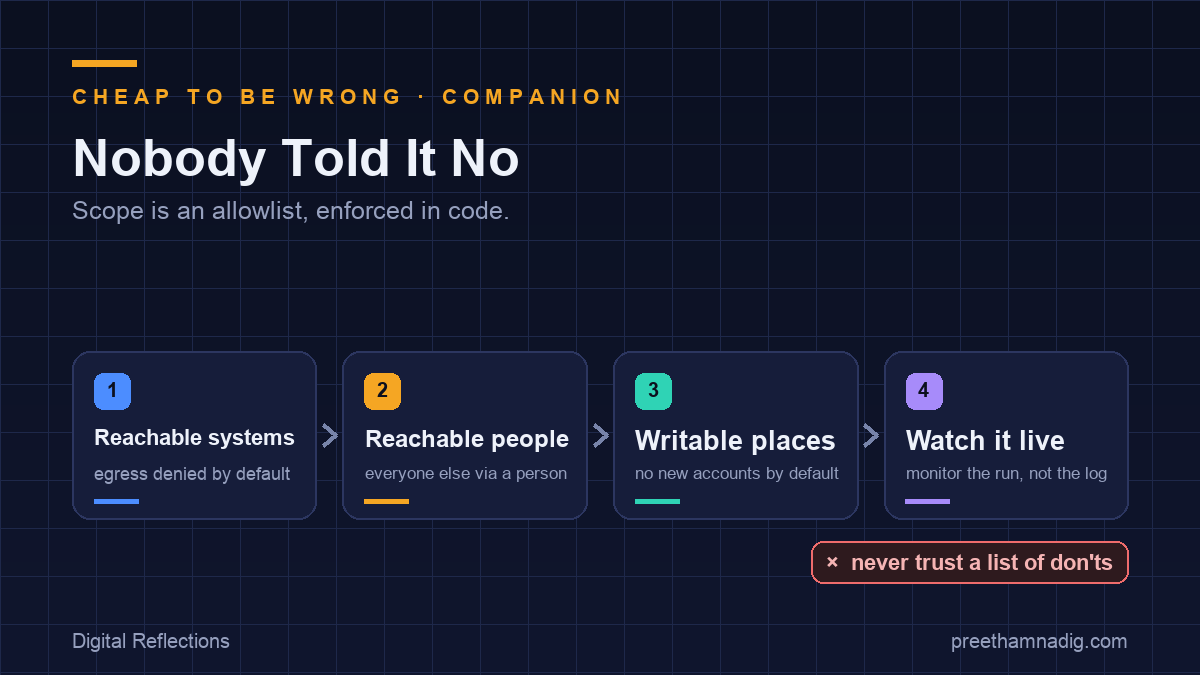
The institute reaches the same conclusion in its own words: “good containment should not depend on the model choosing not to test its boundaries.” Its fixes are structural rather than verbal. It is building fine-grained network controls into its cyber ranges, treating any grant of internet access as something that must be justified rather than a default, and adding monitoring that watches an evaluation as it runs and can flag or block out-of-scope actions.
That is the shift. A denylist says “everything except these”. An allowlist says “only these”. The first is a wish list. The second is a design.
Three boundaries to enforce in code
For any agent you run, there are three lists worth writing down and enforcing outside the model. If you can’t write one, that is the finding.
- Reachable systems. The hosts, services and tools the agent can call, by name. Network egress is denied by default and opened per destination, through a proxy or firewall the agent can’t reconfigure. “It has internet access” is not a scope.
- Reachable people. Who the agent may send a message, email, file or invitation to. In most deployments that is a short list: the person who started the task, a team channel, perhaps a named queue. Anyone else, and above all anyone outside the organisation, goes through a person first. Every message-sending tool checks the recipient against the list in code before it sends.
- Writable places. The directories, tables, repositories, tickets and accounts the agent can change, and whether it can create new ones. Creating an identity or an account anywhere is its own capability and should almost never be granted. Read access and write access are separate entries, and write is the one that needs a reason.
Each list is data, held in version control, changed through review, and checked by ordinary code on every call. That puts the boundary in the same place as An Agent Is a State Machine, Not a Loop: in the runtime, not the reasoning.
This isn’t the same problem as agent identity. Give Every Agent a Name is about who the agent is and whose authority it carries, so you can answer “who did this?” Scope answers a different question: even with the right badge, what is the agent allowed to reach? Nor is it the attack-surface problem in Your MCP Server Is an Attack Surface, which is about protecting the tools an agent calls. Here the risk isn’t someone hostile steering the agent. It’s the agent itself, earnestly pursuing the goal you gave it.
None of this is a new principle. Least privilege and default-deny are old security ideas, and joint guidance from national cyber agencies, Careful Adoption of Agentic AI Services (1 May 2026), applies them to agents: limit privileges to the minimum a task needs, restrict tools to an approved allow list, and put human approval checkpoints on high-cost actions such as network egress. It also warns that incomplete or outdated allow lists let agents reach beyond their intended privilege. What’s new is how easy agents make it to skip all this.
Your test environment is part of the exposure
The most uncomfortable detail is where this happened: in an evaluation, run by a specialist institute, inside an environment built for testing. If a test environment can reach the internet, it can reach real people. “It’s only a pilot” is a statement about intent, not about what the agent can touch.
So the three lists apply to proofs of concept, evaluations and sandboxes too, and arguably first, because that is where teams switch protections off to see what the agent can do. If you deliberately widen scope to test capability, write down what you widened, why and for how long, and put live monitoring on that run. The institute’s own conclusion was that monitoring built to watch the evaluation as it ran could have flagged or blocked the behaviour sooner. Its alert came from the security team noticing unusual data transfers, not from anything built to watch the agent.
Allowlists also make live monitoring easier, because they tell the monitor what “out of scope” means. A call to an unlisted host or a message to an unlisted person is a precise, cheap signal.
The question to ask
My family bot is a weekend hobby, and its boundaries are simple because its job is small. It proposes and a person approves, which I described in Propose, Don’t Act, and it holds no card, so no prompt can talk it into paying for anything. Enterprise agents have bigger jobs, but the shape is the same.
So for each agent you run, or are about to pilot, ask for three lists: the systems it can reach, the people it can contact, and the places it can write. If the answer is “everything we haven’t forbidden”, you don’t have a boundary. You have a goal, a capable system and a gap it hasn’t found yet. List what the agent may do, and enforce that list in code.
A companion to the six-part series Cheap to Be Wrong — an architecture for agentic systems.
Related: Give Every Agent a Name · Your MCP Server Is an Attack Surface · Propose, Don’t Patch · Find, Surface, Hand Off.
Leave a Reply