The diagnostic tells you which parts of your product are substrate and which are façade. This is what to do about it. None of these moves is a way to avoid being called — that fight is lost and was never worth winning. They are ways to make being called strengthen your position instead of dissolving it. The order roughly matches how quickly each one pays back.

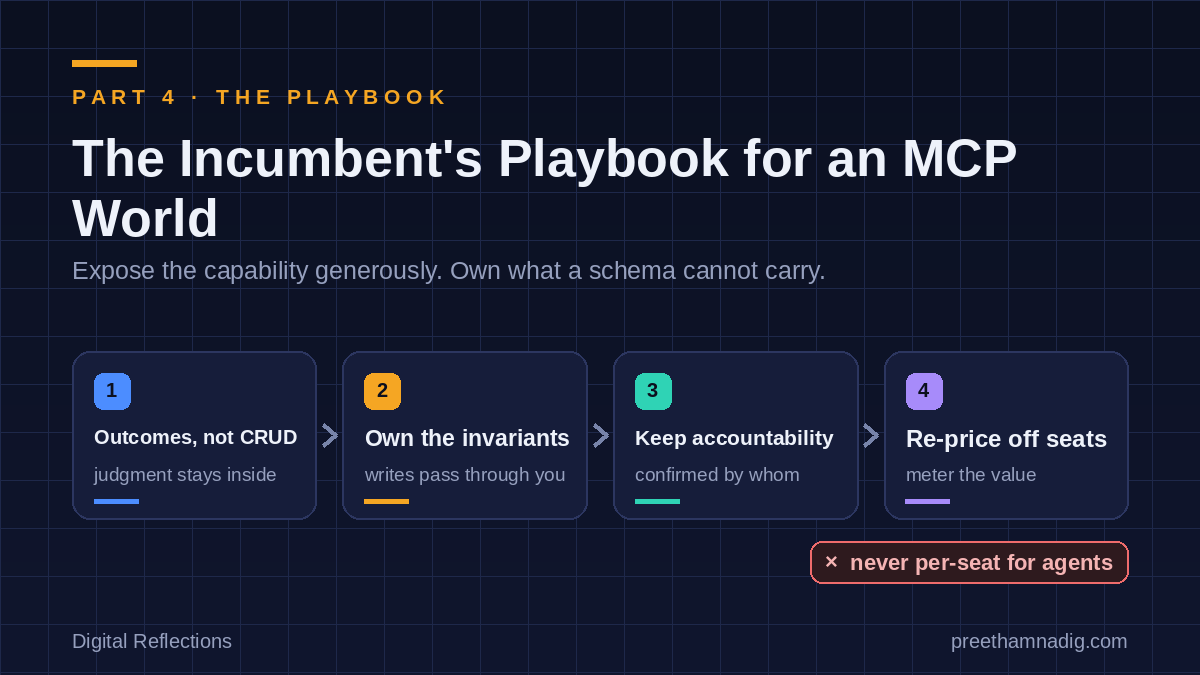
Expose outcomes, not CRUD
The single highest-leverage design decision in your server. A surface offering create_record, update_record and list_records is a database with extra authentication, and it invites the harness to do the thinking — which means the harness accumulates the expertise and you supply storage.
A surface offering settle_claim, close_period, run_eligibility_check does the opposite. Each call carries your validation, your sequencing, your domain rules, and returns a result the caller could not have assembled themselves. Outcome-level tools are dramatically harder to replicate, and they keep the judgment inside your product where it compounds.
Make the writes pass through your invariants
If you are or could be the authoritative record, make that structural. The rules that determine whether a change is valid should live in your system and be impossible to route around — not because you are being obstructive, but because that is what makes you the record rather than a cache of it. An agent that must satisfy your constraints to make a change real is an agent that cannot replace you with an endpoint.
Keep the accountability layer, and make it visible
Audit, approval, reversibility, named confirmation, replay. These are the parts of enterprise work the orchestration layer is least eager to own and, in regulated domains, least permitted to. Do not bury them beneath the tool surface — expose them as first-class capabilities. “Who confirmed this, when, and on what basis” is a question your product should be the best in the world at answering, and it is a question a general-purpose harness will happily delegate to you forever.
Re-price off seats, now
This is the most urgent item with the clearest mechanics. Agent traffic breaks per-seat pricing immediately and in the buyer’s favour. Move to a model that tracks delivered value: a platform floor plus metered calls, or outcome-based pricing where you can genuinely measure the outcome. Do it before a large customer notices the arbitrage rather than after, because the conversation is very different when you initiate it.
Instrument intent, not just calls
You lose the intent signal by default. Get some of it back deliberately: design the tool contract so callers pass the goal, not only the parameters — what this is for, which case it belongs to, what the caller is trying to achieve. Well-designed tools can ask for this without being obstructive, and the resulting telemetry is the closest replacement for the product analytics the interface used to give you.
Own the vocabulary
Protocols make components interchangeable, but only where the schema is shared. If your domain’s vocabulary — the entity definitions, the status model, the reference data everyone reconciles against — is yours and widely used, then a competitor exposing a “comparable” surface still has to map into your terms. Publishing and stewarding that vocabulary is one of the few ways to rebuild switching cost in a world designed to remove it.
Bundle what a tool call cannot deliver
Guarantees. Liability. Human escalation when the automated path fails. Regulatory attestation. An SLA with money behind it. These do not fit in a response payload, which is exactly why they hold value when the payload becomes commoditised. They also give the buyer a reason to keep a commercial relationship with you rather than an integration.
Be the harness where you have the deepest data
Being called is not incompatible with calling. In the narrow domain where your data and rules are unmatched, orchestrate: sequence the steps, call other tools, own the outcome end to end. You are unlikely to win the general-purpose harness fight and should not try. You have a genuine advantage in the vertical slice where nobody else can see what you see.
What to stop doing immediately
Withholding the server. It does not protect the interface; it removes you from the layer where the work is going and hands the distribution to whoever moved first.
Shipping thin CRUD and calling it done. The fastest server to build is the one that most efficiently reduces you to storage.
Treating it as an integration project. Scoped as plumbing, it gets built by whoever has capacity and encodes none of the decisions above. This belongs to whoever owns the product strategy.
Holding per-seat pricing while agent traffic grows. Every month of delay is revenue you will not get back and a renegotiation that gets harder.
The through-line
Expose the capability generously; own the things a schema cannot carry. The record, the invariants, the accountability, the vocabulary, the network, the guarantee. An incumbent that does this becomes more reachable and no easier to replace — which is the only combination that actually compounds. The companies that struggle will be the ones that spent this period optimising the shape of their endpoints while the question was never about endpoints at all.
When Your Product Becomes a Tool — a five-part series on MCP and incumbent strategy
- When Your Product Becomes a Tool
- What Dissolves When You Become Callable
- Substrate or Façade — Who Survives Being Called
- The Incumbent’s Playbook for an MCP World — you are here
- Buying in an MCP World
Related: What Do You Charge for a Data or AI Platform? · Put the Model Where Being Wrong Is Cheap.


Leave a Reply