Almost every serious software incumbent is now shipping an MCP server. The reasoning is sound and the pressure is real: if agents are going to do the work, your product had better be reachable by them. What gets discussed far less is what the decision actually does to the business — because for a large number of these companies, exposing their capabilities as callable tools is the moment their product stops being a product and becomes a component in someone else’s workflow. The uncomfortable read is that a lot of incumbents are moving faster toward irrelevance by doing the obviously correct thing.

What an MCP server actually does
Strip away the framing and the change is simple. Your capabilities — the things your software can do and the data it holds — become a schema that any agent can discover and call. That is genuinely useful. It is also a structural change to your position, because a capability that can be called from anywhere no longer needs to be reached through the place you built.
The interface you spent ten years refining, the navigation people were trained on, the workflow your product enforced by being the screen everyone worked in — none of that is on the other side of the tool call. The agent gets the capability without the container. What you have published, in effect, is the useful half of your product with the part that made it yours removed.
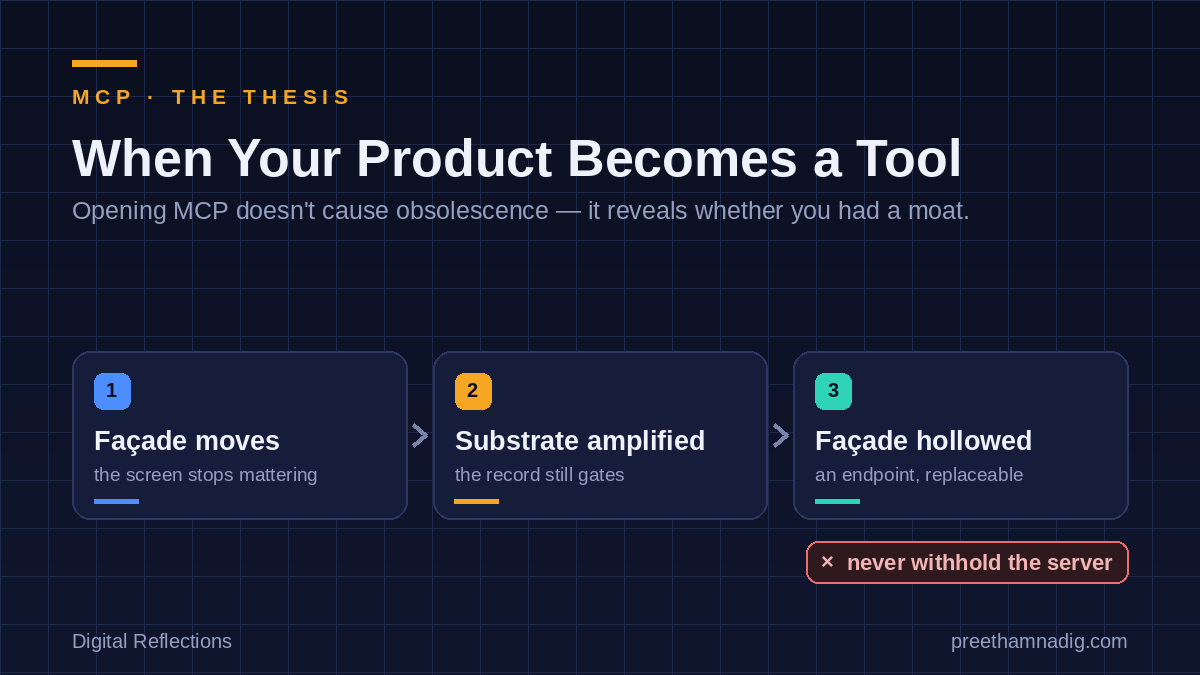
The façade moves, and it moves permanently
The interface is the part people underestimate. For most enterprise software, the moat was never really the logic; the logic was always reproducible. The moat was that your screen was where the work happened, which meant your product accumulated the habits, the training, the integrations built around it, and the organisational memory of how things get done here.
When an agent becomes the surface, all of that relocates. The user’s attention sits in the harness. The context — what they asked for last week, what the organisation prefers, how the work usually goes — accumulates in the harness too, across every tool it can reach. You are left holding a capability while somebody else holds the relationship, and the relationship was the business.
The objection, and why it fails
The natural response is to slow down: keep the server thin, delay it, make the good stuff reachable only through the product. This does not work, and it is worth being precise about why.
Refusing to be callable does not keep the work inside your interface. It routes the work around you. A competitor who did open becomes the one the agent can actually use. Where no competitor exists, the harness reaches your product the ugly way — through scraping, through the API you already published, through robotic automation that drives your UI. And in the meantime you are absent from exactly the layer where the buying decision is increasingly made. Withholding does not preserve the façade. It costs you the distribution and leaves the façade just as exposed.
So the protocol is a revealer, not a cause
Here is the version of the argument I would actually defend. Opening MCP does not make an incumbent obsolete. It reveals whether that incumbent was ever anything more than a convenient interface over a commodity capability.
If your value was the screen plus the workflow convenience, being callable dissolves you — quickly, and in public. If your value was something the tool call still has to go through — the authoritative record, data nobody else holds, a network, a regulated process with your name on the accountability — then being callable amplifies you. You stop being reachable only when someone opens your app and start being reachable in every workflow that needs what you hold.
Both outcomes come from the same decision. That is the whole point: the protocol is not doing the sorting. It is exposing a sorting that already happened, years ago, in what each company chose to build.
Where the value goes instead
The direction of travel is consistent with everything else in this wave. Value pools at the layer that owns the outcome and at the layer that is genuinely hard to reproduce, and it drains from the layer in between. The harness captures the outcome — it holds the goal, the context and the sequence. The substrate captures what cannot be copied. The interface, historically the most valuable real estate in enterprise software, is now the thin band being pressed from both sides.
That is not a prediction about MCP specifically. It is the same squeeze that has been visible for a while, arriving at a layer that thought it was safe.
What this series covers
This is the first of five. The next three work through the mechanics and the response; the last takes the buyer’s side of the table.
What Dissolves When You Become Callable — the mechanism, concretely: what you actually lose when the tool call replaces the screen, including the two losses nobody budgets for.
Substrate or Façade — Who Survives Being Called — the diagnostic. How to work out, before the market tells you, which side of the line you are on.
The Incumbent’s Playbook for an MCP World — the constructive half. What to expose, what to hold, how to re-price, and what to stop doing immediately.
Buying in an MCP World — the same analysis from the buyer’s chair, and what to demand from vendors before signing anything.
The question worth sitting with
Before the roadmap meeting about which endpoints to expose, there is a prior question, and it is not a technical one. If everything your product does were available as a tool call tomorrow, would anyone still open your application? If the honest answer is no, the MCP server is not your problem — it is the disclosure. And the work that follows is not integration work. It is figuring out what you own that a schema cannot carry.
When Your Product Becomes a Tool — a five-part series on MCP and incumbent strategy
- When Your Product Becomes a Tool — you are here
- What Dissolves When You Become Callable
- Substrate or Façade — Who Survives Being Called
- The Incumbent’s Playbook for an MCP World
- Buying in an MCP World
Related: Agent Swarms Are Eating the Stack Top-Down — But Not the Foundation · The Model Is the Least Defensible Part of Your Agent.


Leave a Reply