When I built a travel assistant for my family’s AI agent, the decision I’d defend hardest was a limit. It finds flights and hotels, surfaces the best few with prices, hands over a link — and then stops. It never holds a card and never books. I wrote about why in Find, Surface, Hand Off: the blast radius of a wrong booking is your money and your holiday, and the human is better at the last step anyway. That was the right call for a DIY hobby agent running on open-source models at home. But it raises an obvious question for anyone building products and digital platforms: what would have to be true for an agent to take that last step safely? Over the past year the industry has started building the answer.

The rails now exist
Quietly, the plumbing for agents as buyers has arrived. In September 2025 a large technology company published an open protocol for agent payments built around signed mandates, and in April 2026 handed it to the industry alliance behind passkeys to develop as a shared standard. Separately, an open checkout protocol, Apache-licensed, defines how an agent and a business run a checkout together while the business stays the merchant of record.
The card networks have moved too. In October 2025 one introduced a trusted-agent framework: approved agents sign their requests, so a merchant can tell an agent with real purchase intent from the malicious automation its bot defences were built to block. And in March 2026 a European bank and another network announced what they called Europe’s first live end-to-end payment executed by an AI agent — run in a controlled environment, “within predefined limits and permissions,” and explicitly not yet a commercial rollout.
That last caveat is the honest state of play. The rails exist; the traffic mostly doesn’t, yet. Which makes this the right moment to design for it, before it arrives in volume.
Three layers: discovery, mandate, settlement
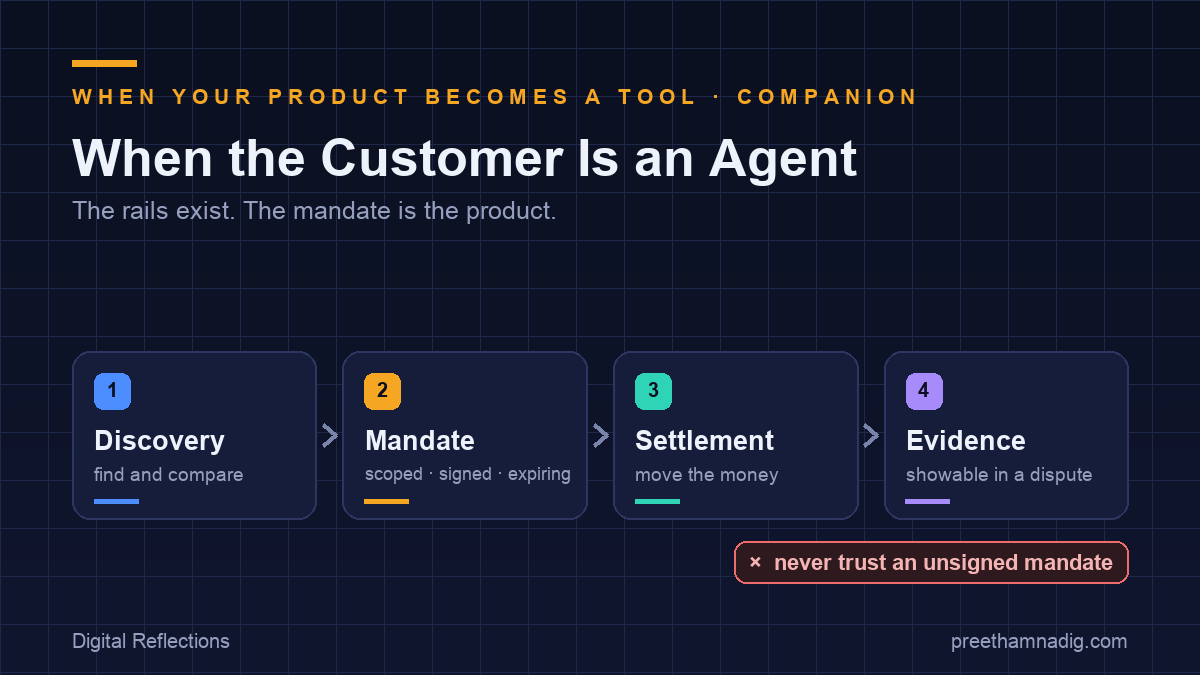
Strip the protocols back and an agent purchase has three layers.
Discovery is finding and comparing — the part my family agent already does. It is mostly the territory of the When Your Product Becomes a Tool series: being callable, exposing structured offers, surviving comparison by a machine.
Settlement is moving the money. It is the most mature layer by far, because it is the one the payments industry has spent decades hardening. Tokens, networks, chargebacks — the machinery exists; it just needs to know an agent is in the loop.
Mandate sits in between, and it is the new layer: a record of what the human actually authorised. Not “this card may be used,” but “buy a refundable ticket on these dates, under this amount, from these kinds of sellers, before Friday.” It is the part that didn’t need to exist when a person clicked the button themselves — the click was the authorisation.
The mandate is the product
If you take one idea from this post, take this one: in agentic commerce, the mandate is the product. Discovery is a commodity, and settlement is infrastructure. The mandate is where trust is won or lost, and it needs four properties.
- Scoped. It says what may be bought, from whom, for how much. An agent may act inside it and never widen it. Anything outside it — a better deal that breaks a limit, a substitution — goes back to the human.
- Signed. It can be verified by someone other than the agent. The open payments protocol above describes its mandates as tamper-evident, cryptographically signed credentials, which is exactly the right instinct.
- Time-bound. It expires. A standing “buy whatever seems sensible” mandate is a borrowed credential with better branding.
- Showable. It can be produced, months later, in a dispute — by the merchant, the bank and the customer, and all three see the same thing.
This is the commerce face of an argument I made from the identity side in Give Every Agent a Name: agents need their own identity, delegation that only narrows, and a signed statement of what the person intended. A purchase mandate is that statement with a price attached.
What changes when the visitor is an agent
For anyone running a digital platform that sells something, an agent visitor breaks a lot of comfortable assumptions.
There is no funnel. An agent doesn’t browse, linger or get retargeted. It arrives with a mandate, asks structured questions and leaves. Most of the craft we’ve built around conversion — layout, urgency, the nudge at checkout — simply doesn’t register.
Persuasion gives way to policy. What wins is a clear, machine-readable offer: price, availability, delivery, and above all the terms — cancellation, refund, substitution. An agent comparing ten sellers will favour the one whose policy it can read and check against its mandate. Ambiguous terms become a reason to be skipped.
Your bot defences need a new category. Most platforms treat automated traffic as hostile by default. Signed agent credentials make a third answer possible — not “human” or “bot,” but “a verified agent acting for a known customer, within a mandate.” Platforms that can’t tell the difference will either block their best new customers or wave through their worst.
Data becomes the experience. If the agent is reading your catalogue, the catalogue is the storefront. Clean product data, accurate stock and honest delivery estimates stop being back-office hygiene and become the thing the customer actually experiences. It is the same lesson as Buying in an MCP World, seen from the seller’s side.
Liability is unassigned — design as if you’ll be asked
Here is the part to say carefully. Payments and consumer-protection rules were written for a person authorising a payment. Take one concrete example from the US: under Regulation E, a transfer made by someone the consumer gave their card or access details to is generally not treated as unauthorised, until the consumer tells the bank that person’s access is revoked. Is an agent “someone you gave your card to”? If it misreads the mandate, is the purchase authorised? As far as I can find, those questions don’t yet have settled answers in the major markets, and regulators are still working through them. (I’m not a lawyer, and none of this is legal advice — read it as a reason to talk to yours.)
Unassigned liability doesn’t mean no liability. It means it lands on whoever can’t produce evidence when the dispute arrives. So design as if you will be the one asked. Keep the mandate the agent presented, verified, alongside the order. Log which offer and which terms the agent saw at the moment it bought. Make cancellation and refund real operations an agent can call, not a phone number. Decide in advance what your platform does when an order looks outside a plausible mandate — and make that decision in deterministic code, not in a model’s judgement.
The question to ask
My family agent will keep stopping at the handoff for now; a hobby agent at home has no reason to carry that risk. But the industry is building the conditions under which stopping becomes optional — and when it does, the platforms that win will be the ones that can prove, cleanly, what was asked for and what was done.
So ask it now: if an agent bought from you today and the customer disputed it tomorrow, what evidence would you have? If the answer is an order number and a card token, you are relying on rules written for a world where the customer clicked the button.
A companion to the five-part series When Your Product Becomes a Tool — MCP and incumbent strategy.
Related: Give Every Agent a Name · Buying in an MCP World · Find, Surface, Hand Off.
Leave a Reply