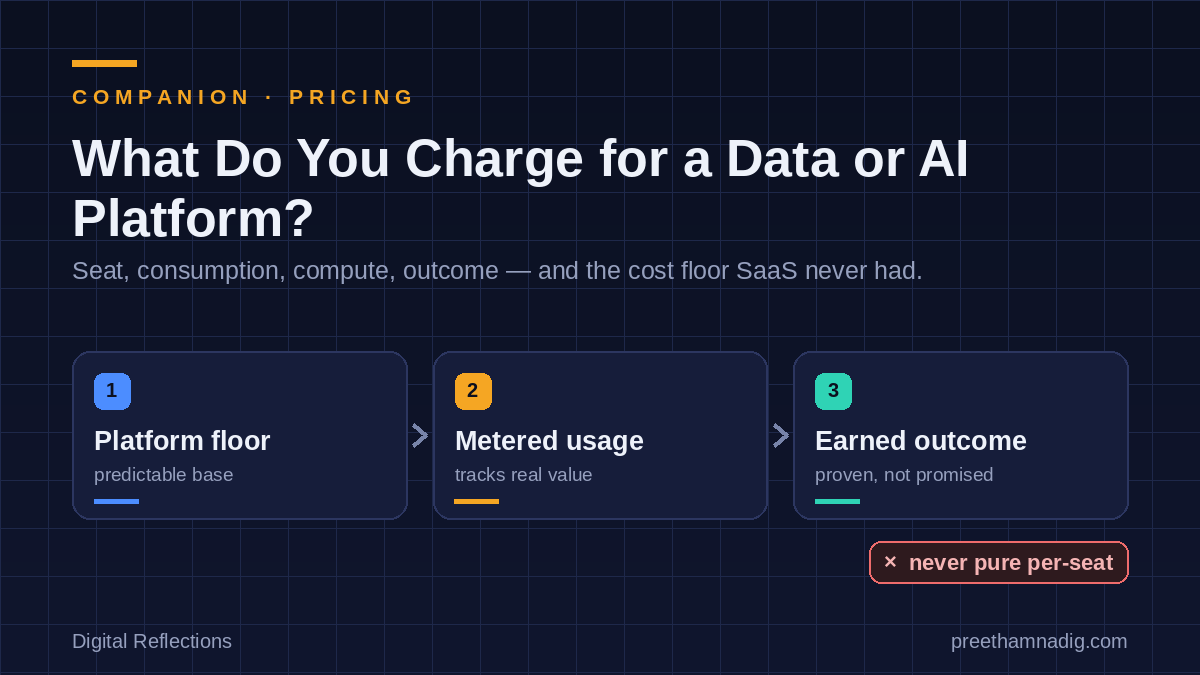
Of every decision I made running the startup I founded, pricing is the one I revisited most often and got wrong the longest. We changed the model more than once, and each time the change was driven less by strategy than by the discovery that the previous model was quietly punishing either the customer or us. If there is one topic where I’d want a founder entering the current wave to skip my learning curve, it’s this one — because data and AI platforms are structurally harder to price than the software that came before them, and the reasons are worth naming precisely.

Why this is genuinely hard
Three things make a data or AI platform resist conventional pricing.
The value is variable. The same platform delivers wildly different value to two customers with the same headcount, because value tracks the volume and importance of what flows through it, not the number of people who log in. One customer’s usage is a rounding error; another’s is core to their operation. A price that’s fair to the first is nearly free to the second.
The cost is variable and never zero. Classic software had a marginal cost close to nothing, which is why per-seat pricing worked so well for so long — every extra seat was almost pure margin. A data platform carries real infrastructure cost per unit of work, and an AI platform carries inference and compute cost that scales directly with usage. You have a genuine cost of goods that moves with consumption. Price without modelling it and you can grow revenue while your gross margin decays.
The buyer has no budget line. Especially early in a wave, the thing you’re selling doesn’t map to an existing procurement category. That isn’t only a sales problem — it’s a pricing problem, because the shape of your price determines which budget can absorb it.
The models, honestly
Per-seat. Predictable for the buyer, easy to forecast, trivially understood by finance — which is why it dominated. Its weakness is now structural: when the work is done by automation rather than by people, seats stop tracking value. One agent doing the work of ten logins breaks the arithmetic in the buyer’s favour, and you’re left charging for chairs nobody sits in. Pure per-seat on an AI platform is a slowly failing position.
Consumption or usage. Charge per unit of the thing that actually happens — records processed, documents handled, calls made. This aligns your revenue with delivered value and scales naturally with a growing customer. The cost is predictability: buyers hate a bill they cannot forecast, procurement struggles to approve an open-ended number, and a usage spike that should be a good day becomes an angry phone call. Unpredictability is a real product defect, not just a commercial inconvenience.
Compute or infrastructure-based. Price off the resources consumed. It’s defensible and easy to justify, and it has a perverse incentive baked in: every efficiency you engineer reduces your own revenue. You end up commercially punished for making your platform better, and you’ve also anchored the conversation on cost rather than value, which caps what you can ever charge.
Metered hybrids. A platform fee that buys access, capacity and support, plus metered usage above an included allowance. This is where most durable answers land, because it gives the buyer a predictable floor to budget against and gives you revenue that grows with value. The design work is in choosing the meter and setting the included allowance so the typical customer rarely feels surprised.
Outcome pricing. Charge for the result — the resolved case, the eliminated hour. It’s the best alignment available and the most dangerous to promise early. You take on delivery risk you may not be able to control, attribution becomes contentious the moment the number disappoints, and a shortfall lands on your P&L rather than the customer’s. Outcome pricing is something to earn once your accuracy is proven and measurable, not something to lead with because it sounds modern.
The question underneath all of them
Every model above is really an answer to one question: what is the unit of value, and can both sides see it move? If you cannot name a unit that grows when the customer gets more value, and that the customer would accept as fair, no pricing model will rescue you — you’ll just be choosing which party the mismatch hurts.
The corollary matters as much. Whatever unit you choose, you must be able to measure it credibly, show it to the customer, and reconcile it at invoice time. Metering you cannot explain is worse than a blunter model the buyer trusts.
How I’d approach it now
Instrument before you price. Before choosing a model, measure what varies across your customers — volume, complexity, cost to serve. You cannot pick a unit of value without data on how value actually distributes, and that data takes months to accumulate. Start collecting it far earlier than you think you need to.
Price against the budget you displace. The most useful anchor isn’t a competitor’s price list; it’s whatever the customer spends today on the outcome you’re replacing — the licence, the vendor, or the labour. That budget already exists and already has an owner, which solves the missing-budget-line problem at the same time.
Lead hybrid. A platform floor plus metered usage is the pragmatic default: predictable enough to approve, elastic enough to grow. Make the included allowance generous enough that a normal month never generates a surprise.
Model gross margin per unit from day one. Know what a unit of usage costs you to serve, and watch that number as a first-class metric. This is the discipline the previous software generation genuinely didn’t need, and the one most easily skipped by founders whose instincts were formed by it.
Re-price at product-market fit, not before, and not after. Early pricing is a hypothesis and should be easy to change. Once the pattern of value is clear, re-price deliberately — and give existing customers a fair path across, because the goodwill costs less than the churn.
Pricing is product work
The mistake I made longest was treating pricing as a commercial decision to be settled once and revisited reluctantly, rather than as part of the product. It determines which customers you attract, which usage you encourage, whether your margins survive scale, and whether your revenue grows when your customer succeeds. Get the unit of value right and everything else is tuning. Get it wrong and you will spend years compensating with discounts, exceptions and heroics — which is roughly what we did, until we stopped and worked out what we were actually selling.
Companion to the five-part series I’ve Seen This Wave Before — lessons from a Big Data era startup, applied to the AI era.
Related: Buy, Build, or Orchestrate — and Why Seat-Based Pricing Is the Fault Line · Service-as-Software — What the Hypergrowth AI Startups Figured Out · Services Before Product-Market Fit.


Leave a Reply