There is a new category on the slides this year: the context layer — everything an agent needs to know about your data before it is safe to act on it. I read the pitch and had the strangest feeling of recognition. A decade ago, when I was running the startup I founded in the Big Data wave, the same slide had a different title. It said master data management. Same nouns: one definition of a customer, one owner, one golden record, governed and trusted. Same promise. And, in a lot of the enterprises I sold into, the same outcome: a large central programme, a beautiful glossary, and very few people who ever used it.

The MDM déjà vu
I want to be fair to master data management, because the problem it named was real. Organisations genuinely had five definitions of “active customer” and three systems that each believed they owned the address. The programmes that tried to fix it were not foolish. What went wrong was usually the shape of the effort, not the idea.
The typical pattern went like this. A central team was funded to define the enterprise’s core entities. It ran workshops. It produced a data dictionary of several hundred terms, each negotiated across departments, each a small political settlement. Then it waited for the rest of the organisation to adopt it — and the rest of the organisation, which already had reports that worked well enough, mostly didn’t. A definition with no consumer decays. Nobody notices when it goes stale, because nobody is reading it.
The part that did deliver, as I wrote in I’ve Seen This Wave Before, was unglamorous: the structured data a company already had, finally cleaned, joined and governed for a specific question someone needed answered. The value came from the use, not the catalogue.
What an agent needs beyond a definition
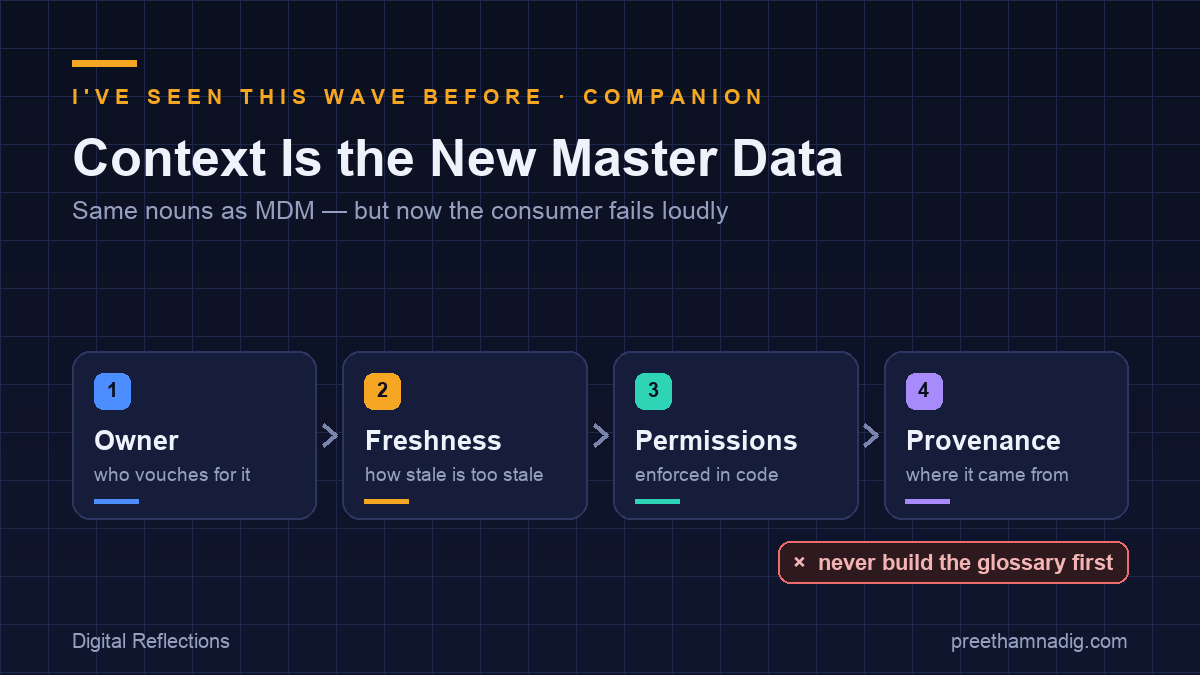
The modern answer to “one definition of revenue” is a semantic layer, and it is necessary. An agent that computes revenue its own way, from whatever tables it finds, will be confidently and differently wrong every time. But a definition is only one of the things a careful analyst knows when they pick up a number. An agent needs the rest of that knowledge written down, because it cannot absorb it over coffee:
- Ownership. Who is accountable for this figure, and who do you ask when it looks odd? An agent can’t escalate to “the finance people.” It needs a named owner, or at least a named queue.
- Freshness. When was this last updated, and how stale is too stale for this question? The same table can be fine for a monthly trend and dangerous for a refund decision made this afternoon.
- Permissions. Who may see it, and in what form? A person usually knows not to paste a salary band into a customer email. An agent knows only what it is told, and only if that rule is enforced outside the model rather than requested in a prompt.
- Provenance. Where did this come from, and through which transformations? This is not new thinking — a standards body published a data model for provenance back in 2013, right in the middle of the MDM years. What’s new is a consumer that actually needs to read it at the moment it acts.
Put those four around a definition and you have what the new category is selling. It is master data with the governance metadata finally attached — and, crucially, attached in a form a machine can check rather than a wiki a person might read. It also sits directly on top of the problem I described in Entity Resolution Is the Bottleneck Nobody Budgets For: knowing that two records are the same customer is the foundation; knowing what the customer’s numbers mean, who vouches for them and who may see them is the floor built on it.
Why it might work this time
Here is the difference, and I think it is a real one. MDM’s consumers were people looking at reports, and people are forgiving. They know the dashboard is a bit off. They apply a mental correction, mutter about the data team, and get on with their day. A bad definition survived for years because human judgement quietly absorbed the error.
An agent does not absorb the error. It acts on it. It quotes the wrong figure to a customer, approves against the stale balance, or includes the field it should never have seen. That is painful, but it has one useful property: it fails loudly and attributably. When an agent gets context wrong, you can usually trace which definition, which freshness assumption, which permission was missing. For the first time, bad context has a visible cost and a specific address. That is exactly the feedback loop the MDM programmes never had — and it is why I’d give the context layer better odds than its predecessor.
Build it consumer-first
The lesson from last time is simple to state and hard to follow: do not start with the enterprise glossary. Start with three agent workflows that matter, and build exactly the context they need.
Pick three where a wrong answer has a real cost — a support agent quoting entitlements, a finance agent reconciling invoices, an operations agent prioritising cases. For each one, list every number and entity it touches. For each of those, write down the four things above: owner, freshness tolerance, who may see it, where it came from. You will find gaps almost immediately, and they will be the right gaps, because a live consumer surfaced them.
Then make the context executable. A definition the agent reads, a freshness check that blocks the action when the data is too old, a permission check in code, a lineage reference written into the agent’s log. Each workflow you add reuses what the previous ones built. That is how the glossary gets written this time: one consumed term at a time, never a term nobody asked for. If you’ve read Start With the Problem, Not the Wave, this is the same discipline at a smaller scale.
Who owns it, and who pays
The context layer belongs to the data team, not the AI team. The AI team will want it, because it is the thing blocking their agents. But definitions, lineage, quality and access are the data team’s craft; they are also exactly the assets I argued in The Substrate War — Will Your Data Platform Become Your System of Record? become more valuable as agents sit on top of them. Hand context to whoever happens to be building the current agent and you get a context layer per agent — which is the five-definitions-of-customer problem again, rebuilt in a new place.
Funding is where MDM really died, so it deserves a deliberate answer. Don’t fund the context layer as a standalone programme with a multi-year roadmap and no users; that is the pattern that failed. Fund it as a line inside each agent initiative — a fixed share of every agent budget goes to the context that agent consumes — held centrally so the work is shared rather than duplicated. The agent programme gets context it can trust; the data team gets a steady, attributable reason to exist; and the glossary grows only where someone is reading it.
The test
Every technology wave rediscovers that the model, the lake or the platform is the easy part and that meaning is the hard part. The good news is that, this time, the consumer will tell you exactly where your meaning is missing — usually in front of a customer.
So run one test before anything else: pick your most important agent and ask it which number is the official one — and whether it can tell you who owns it, how fresh it is, and whether it was allowed to see it. If it can’t, you don’t have an AI problem. You have a master data problem with a new name, and a much less patient user.
Companion to the five-part series I’ve Seen This Wave Before — lessons from a Big Data era startup, applied to the AI era.
Related: Entity Resolution Is the Bottleneck Nobody Budgets For · The Substrate War — Will Your Data Platform Become Your System of Record? · Put the Model Where Being Wrong Is Cheap.
Leave a Reply