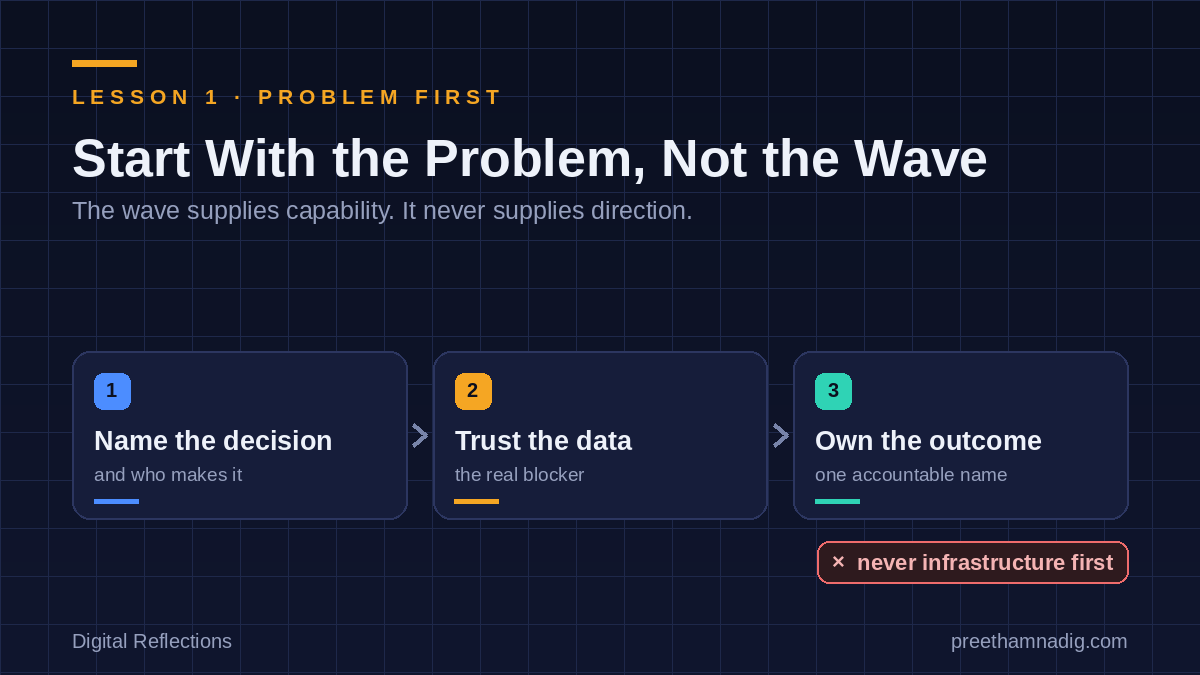
The defining pitch of the Big Data era was that unstructured data was the new world, and that an organisation without a lake to hold it was already behind. It was a genuinely exciting story and it moved budgets. I sold into that market from a startup I founded, so I watched a lot of these programmes start. The pattern I saw again and again was that the infrastructure decision came first and the question came second, if it came at all. The clusters went in. The lake filled. And then, some months later, someone asked what decision this was supposed to improve.

What actually delivered the value
Here is the part that stayed with me. A good share of those programmes did eventually produce something worth having — and when they did, the value usually came from an unfashionable place. Not the novel unstructured sources. Not the exotic processing. It came from the structured data the organisation already had, finally cleaned, joined across systems, governed, and made trustworthy enough that someone would act on it. The questions that mattered turned out to be answerable with what was already in the building, once somebody invested the unglamorous months in harnessing it properly.
That is a slightly deflating conclusion for a technology wave, and it is the most useful thing I learned. The capability was real. The scarcity was never the capability. The scarcity was a clearly stated problem plus data you could trust.
The same play, running again
I now watch organisations approach AI the same way, and the resemblance is uncomfortably close. There is a strong prior that this technology is transformative — correct — and that prior is being converted directly into infrastructure and pilots without an intervening step where someone writes down the specific, valuable thing that will be different afterwards. The vocabulary has changed completely. The sequence has not changed at all.
And I would expect the same resolution. Plenty of AI programmes will deliver real value, and a lot of that value will come from somewhere modest: a narrow problem worth solving, data made reliable enough to depend on, a workflow actually redesigned so the output gets used, and one person accountable for whether the number moved. AI is not a silver bullet for every problem. It is an unusually powerful capability that still has to be pointed at something.
The test I wish we had applied earlier
The most useful discipline is embarrassingly simple, and it is a question, not a framework: what decision changes, who makes it, and how will we know it got better? A programme that can answer all three is grounded. A programme that can only answer the first — or that answers with a capability rather than a decision — is buying infrastructure and hoping a problem shows up.
Two follow-ups sharpen it further. First: if this worked perfectly, what would somebody do differently on a Tuesday? If the answer is vague, the problem is vague. Second: is the blocker actually capability, or is it that the underlying data is untrustworthy and nobody owns the decision? In the Big Data era the honest answer was usually the second one, and no amount of new infrastructure fixed it. I see no reason to think this wave is different.
Why the hype is genuinely hard to resist
I want to be fair to everyone who bought infrastructure first, because I understand the pressure they were under. When a wave is cresting, doing nothing looks like negligence. There is board-level anxiety about being left behind, competitors announcing initiatives, and a vendor ecosystem with every incentive to frame the capability as the strategy. Naming a narrow problem and solving it properly looks unambitious next to a platform announcement. It is also, reliably, what produces results.
The organisations that came out of the Big Data era well were not the ones that moved first or spent most. They were the ones that picked a real question, got the data underneath it trustworthy, and let the technology choice follow from that. That is not a counsel of caution. It is a counsel of sequence.
Skip the noise, keep the capability
None of this is an argument for sitting the wave out — I have never once seen scepticism pay better than engagement. It is an argument about order of operations. Let the wave tell you what is newly possible. Do not let it tell you what your problem is. The teams that get value from AI over the next few years will look a lot like the teams that got value from data over the last ten: unglamorous about the problem, serious about the data, clear about who owns the outcome, and entirely willing to use a boring solution when a boring solution is what the problem needs.
I’ve Seen This Wave Before — a five-part series on two technology waves
- I’ve Seen This Wave Before
- Start With the Problem, Not the Wave — you are here
- Being Early Is Not an Advantage
- Services Before Product-Market Fit
- When Your Partner Ships Your Product
Related: Put the Model Where Being Wrong Is Cheap.


Leave a Reply