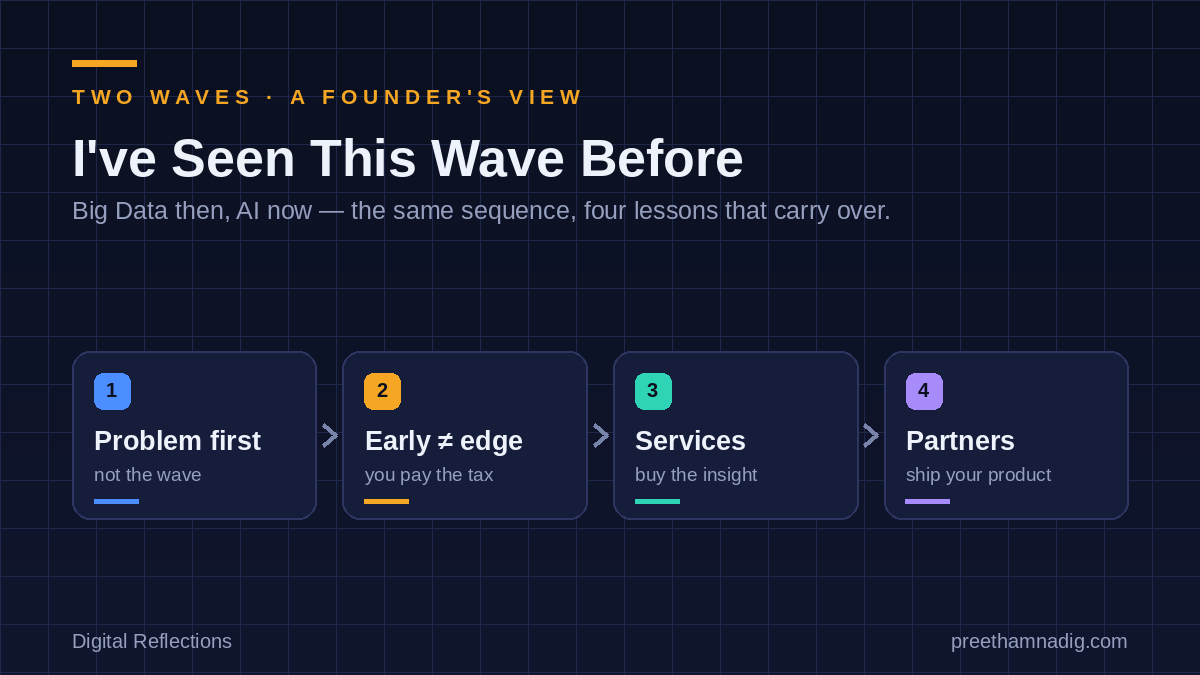
A decade ago I founded and ran a startup in the Big Data and Cloud wave. We sold into enterprises that were certain the ground was shifting under them, and they were right — it was. I have spent the last two years close to the AI wave, and the thing I keep noticing isn’t how different it is. It’s how precisely the sequence rhymes: the same buying behaviour, the same founder traps, the same gap between what the technology can do and what an organisation is ready to absorb, and eventually the same shakeout down to a few durable layers. What follows is not nostalgia. It’s the four things I got to learn expensively the first time, offered in the hope they’re cheaper for someone the second.

The first wave, as it actually felt
The pitch of the Big Data era was that unstructured data was the new world and the old world was obsolete. Boards funded that story directly. Organisations stood up Hadoop clusters and data lakes as strategic initiatives, and the infrastructure went in before anyone had written down the question it was meant to answer. I sold into that market, so I want to be careful here: this was not stupidity. The capability was real and the direction of travel was correct. What was missing was a north star — a specific, valuable question the organisation actually needed answered.
What happened next is the part worth remembering. A large share of those programmes eventually delivered value, and when they did, the value usually came from somewhere unglamorous: the same structured data the company already had, finally cleaned, joined, governed, and made trustworthy enough to act on. The lake was rarely the hero. The discipline of harnessing what was already there usually was. Meanwhile the platform layer consolidated hard, and cloud plus a small number of stacks turned out to be the long play. Most of the rest is a footnote.
The second wave, from the inside
Now watch the current wave with that memory loaded. Capability is real and moving fast. Boards are funding the story directly. Organisations are standing up AI infrastructure as a strategic initiative, and a good deal of it is going in ahead of a written-down problem. The vocabulary is new; the shape is not.
And I would expect the resolution to rhyme too. A large share of AI programmes will deliver real value, and much of that value will come from somewhere unglamorous: a well-scoped problem, data made trustworthy, a workflow redesigned so the output actually gets used, and a clear owner accountable for the outcome. The model will be a component. The platform layer will consolidate to a few durable substrates. Being right about the direction will turn out to have been the easy part.
Why a founder’s version of this is different
Most writing about technology waves is written from the buyer’s chair — how to evaluate, how to adopt, how to govern. I lived the other side. I had to find customers before the category had a name, explain a problem before the buyer agreed they had it, keep a company alive through the gap between a real capability and a ready market, and partner with the very incumbents who could decide to build my product themselves. That vantage produces a different set of lessons, and they’re the ones that transfer.
There are four, and each gets its own post in this series.
One: the wave supplies capability, not direction
The most expensive mistake of the Big Data era was letting the technology set the agenda. Organisations that started from a problem and reached for the capability got value. Organisations that started from the capability and went looking for a problem mostly bought infrastructure. AI is not a silver bullet for every problem, and the discipline of naming the problem first is the cheapest advantage available right now. Start With the Problem, Not the Wave.
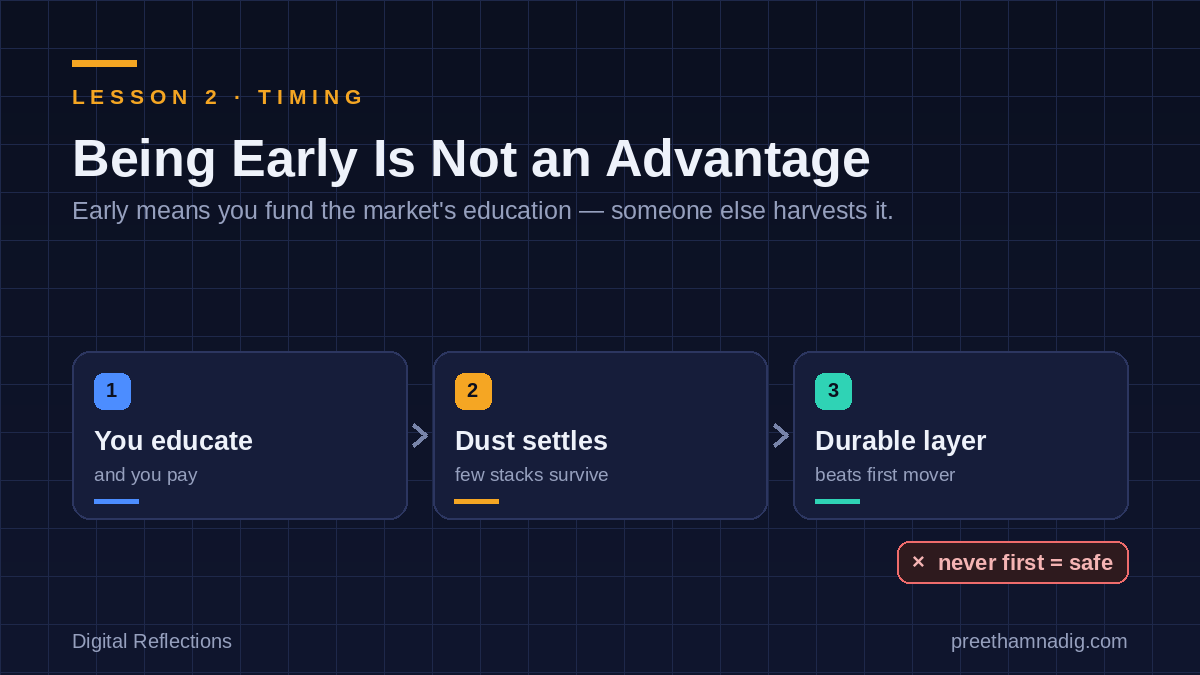
Two: being early is not an advantage
I believed, genuinely, that arriving early was the whole game. It isn’t. Early means you pay the education tax — you fund the market’s learning, and someone who arrives after the dust settles harvests the clarity you paid for. There is a right moment to enter a wave and it is usually later than a founder’s instinct says. Being Early Is Not an Advantage.
Three: services are how you buy your way to a product
Before we found product-market fit, what worked was services — consulting and implementation around data and machine learning. It paid the bills, and more importantly it taught us the problem in enough detail to eventually build the right platform. The current wave has rediscovered this and given it a new name. Services Before Product-Market Fit.
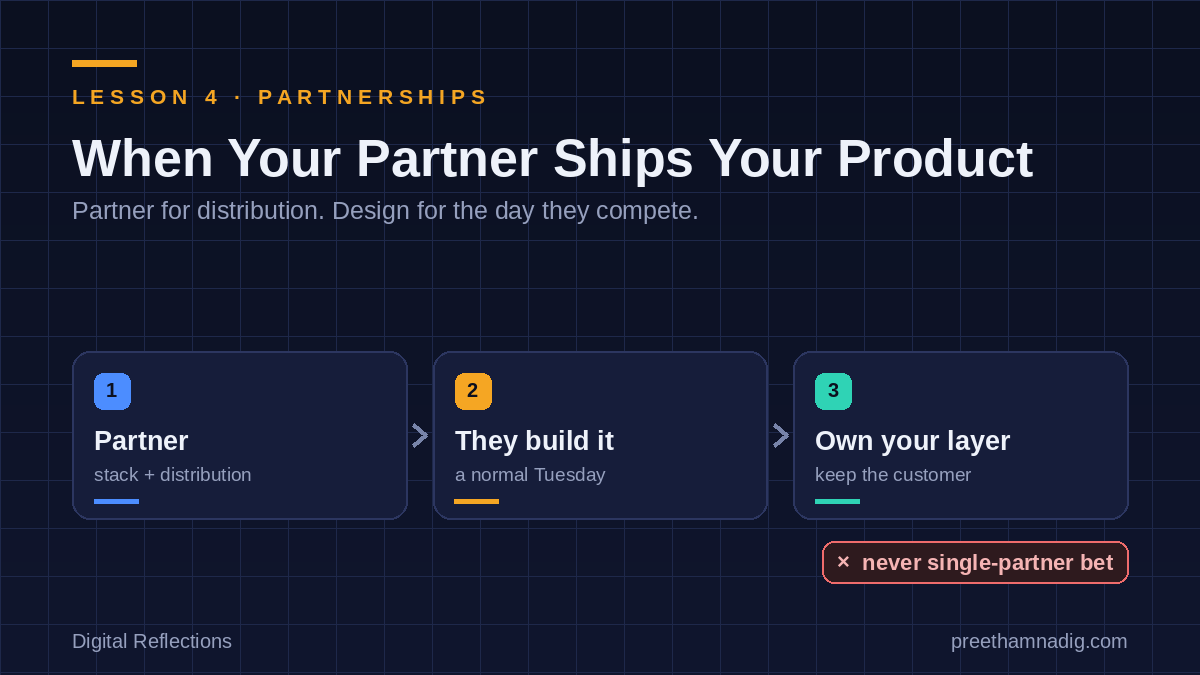
Four: your partner can become your competitor overnight
Partnerships across the stack were essential to us, and one of them shipped something that overlapped our product with no warning. That is not betrayal; it is how platform economics work, and a founder should design for it from the first conversation. When Your Partner Ships Your Product.
The wave is not the strategy
If there’s a single thread through all four, it’s this: a technology wave is an input, not a plan. It changes what is possible and it changes nothing about whether you have picked a real problem, timed your entry sensibly, learned the domain deeply enough to build for it, or thought about who else wants the layer you’re standing on. Those were the hard parts in the Big Data era and they are the hard parts now. The capability arrives on its own schedule. Everything that turns capability into a business still has to be earned, and it is earned in almost exactly the same way it was ten years ago.
I’ve Seen This Wave Before — a five-part series on two technology waves
- I’ve Seen This Wave Before — you are here
- Start With the Problem, Not the Wave
- Being Early Is Not an Advantage
- Services Before Product-Market Fit
- When Your Partner Ships Your Product
Related: Agentic AI Is Not Just LLMs and Tokens.

Leave a Reply