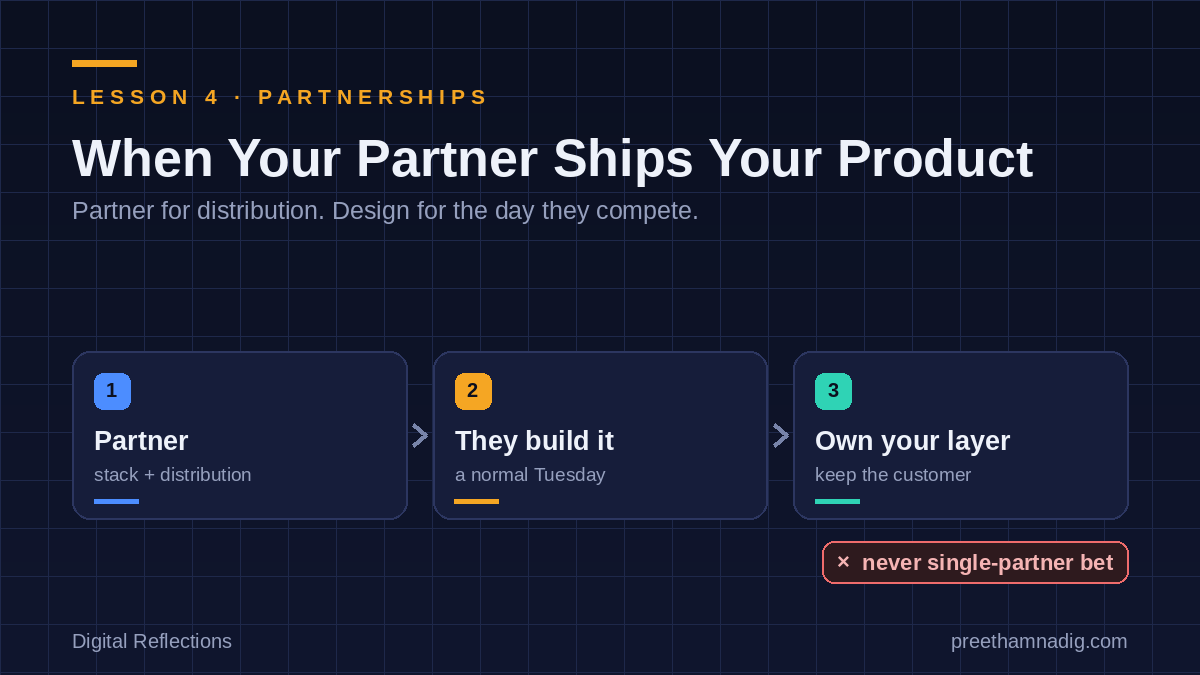
Partnerships were not optional for us. A small company selling into enterprises needs someone else’s credibility, someone else’s distribution, and a place in a stack the buyer has already committed to. We built those relationships deliberately and they worked. They were also the source of the single sharpest lesson I took out of that decade: the partner whose platform you extend can decide, without warning or malice, to ship the thing you sell.

Why the partnerships mattered in the first place
It is worth being clear that this is not an argument against partnering. For us, being part of a larger stack shortened sales cycles dramatically. It meant a buyer could place us — we were not a strange new category, we were the piece that made something they already owned work better. It gave us co-sell motion, technical credibility, and access to accounts that would never have taken a meeting with an unknown company. Those relationships were a genuine multiplier and I would build them again.
And then the roadmap arrives
What I was not prepared for was the speed and the ordinariness of it. An incumbent partner announced functionality that overlapped substantially with what we sold. There was no conversation beforehand. There did not need to be — we were not entitled to one. From their side this was a routine roadmap decision: a capability their customers kept asking for, adjacent to what they already had, cheap for them to build because they owned the platform underneath it.
My first reaction was that it was a betrayal, and that reaction was wrong. Nothing had been promised and nothing was breached. I had simply mistaken a commercial arrangement for an alignment of interests. Those are different things, and the distinction matters enormously when you are the smaller party.
The asymmetry nobody explains to you
The structural point is simple and worth stating plainly: a platform can absorb your feature far more easily than you can absorb their platform. For them, building your capability is an increment on infrastructure they already run, distributed instantly to an installed base they already own. For you, replacing them is a rebuild of the ground you are standing on.
That asymmetry means the relationship is never symmetric no matter how warm it is, and it means the gaps in a partner’s stack are not a permanent opportunity. They are a roadmap. Anything you build that is both valuable to their customers and cheap for them to replicate should be assumed to be on it. The question is not whether they will move into your space, but whether you will have built something durable by the time they do.
How I would design the relationship now
Partner for distribution; do not depend on it. A partnership that supplies most of your pipeline is not a channel, it is a dependency with a termination clause you did not write. Multiple partners, even if some are less productive, buy you the ability to survive a roadmap announcement.
Own the layer that is expensive for them to want. The durable position is where their incentives don’t reach — deep domain specificity, cross-platform work that a single-platform vendor structurally will not do, regulated or accountability-heavy pieces they would rather not carry, or data that accumulates on your side of the boundary. Generic capability sitting directly on top of their platform is the most exposed thing you can build.
Keep the customer relationship yours. If the buyer experiences you through the partner and the partner ships an alternative, you disappear from the conversation without being told. Direct relationships, direct support, and your own account presence are what make you a substitution decision rather than a default.
Read the gaps as a plan. When evaluating what to build next, ask whether it is something the platform would find easy and obvious. If yes, either move past it quickly or accept that it is a temporary revenue line rather than a position.
The same dynamic, at higher speed
This pattern is running again now, faster and more visibly. The current stack has a small number of layers with enormous distribution, and a large ecosystem of companies building capability on top of them. Capability that sits directly on the substrate gets absorbed at a pace the Big Data era never managed, and it gets absorbed without hostility — simply because it is adjacent, valuable, and cheap for the platform to add.
The founders I would bet on in this wave are the ones who partner enthusiastically and hold no illusions about it: taking the distribution, taking the credibility, and putting their engineering effort into the layer the platform has no incentive to build. That is not cynicism about partnerships. It is the only way to get the benefit of one without your company being a line on somebody else’s roadmap.
Not surprised, and not naive
If I could send one sentence back, it would be this: partner as if the relationship is permanent and build as if it is not. The partnership is real, the value is real, and the day they ship your product is a normal Tuesday for them. Expect it, design for it, and it becomes a competitive event you are ready for rather than the phone call that ends your quarter.
I’ve Seen This Wave Before — a five-part series on two technology waves
- I’ve Seen This Wave Before
- Start With the Problem, Not the Wave
- Being Early Is Not an Advantage
- Services Before Product-Market Fit
- When Your Partner Ships Your Product — you are here
Related: The Frontier Labs Are in the Squeezed Middle of Their Own Stack · The Model Is the Least Defensible Part of Your Agent.


Leave a Reply