This summer the EU formally pushed back the deadlines for the strictest part of its AI Act, the rules for high-risk AI systems. For most organisations building products and digital platforms with AI and Data, the honest first reaction is relief. The standards weren’t ready, the national authorities weren’t ready, and many companies weren’t either. The second reaction is the dangerous one: good, we can park this for a year. Read the amending law itself and it says something more useful than that. The dates moved. Most of the duties didn’t, and the ones that take longest to get ready for are exactly the ones you can’t rush at the end.

What actually changed
The change is now settled law, not a proposal. The amending act, Regulation (EU) 2026/1744 (the “Digital Omnibus on AI”), followed the European Parliament’s position of 16 June 2026 and the Council’s decision of 29 June. It was signed on 8 July, published in the Official Journal on 24 July, and entered into force on the third day after publication, 27 July 2026.
Its headline move is the one everyone has heard about. The obligations for high-risk systems (risk management, data governance, technical documentation, logging, transparency to deployers, human oversight, accuracy and robustness, and the provider and deployer duties that go with them) now apply:
- from 2 December 2027 for the “standalone” high-risk uses listed in the Act’s Annex III: things like hiring and worker management, credit scoring, education and access to essential services. That was 2 August 2026, so it’s a sixteen-month reprieve.
- from 2 August 2028 for AI that is a safety component of products already covered by EU product law (Annex I), such as medical devices. That was 2 August 2027.
The law gives its reason plainly: standards, common specifications, guidance and national competent authorities arrived late, and holding the original date would have raised costs without making anyone safer. That’s a fair reason. It’s also a reason about tooling and enforcement, not about whether the requirements make sense. The requirements stayed.
What moved, what didn’t
Here is the calendar as the amended text now reads, set against the original Regulation (EU) 2024/1689:
| Duty | Original date | Now |
|---|---|---|
| Prohibited practices (Article 5) | 2 February 2025 | Unchanged: already in force |
| AI literacy for staff who operate or use AI (Article 4) | 2 February 2025 | Still applies; reworded to “take measures to support” literacy rather than ensure a level of it |
| General-purpose model duties (Chapter V) | 2 August 2025 | Start date unchanged |
| Transparency: telling people they’re dealing with an AI system; machine-readable marking of generated content (Article 50) | 2 August 2026 | Applies; generative systems already on the market before then get until 2 December 2026 for the marking duty |
| Two new prohibitions (Article 5, added) | — | 2 December 2026 |
| High-risk, Annex III (standalone uses) | 2 August 2026 | 2 December 2027 |
| High-risk, Annex I (inside regulated products) | 2 August 2027 | 2 August 2028 |
| High-risk systems already in use by public authorities | 2 August 2030 | Unchanged |
Two things in that table deserve a closer look.
First, the new prohibitions. From 2 December 2026 the Act bans AI systems that generate or manipulate realistic sexual imagery of an identifiable person without their explicit consent, and systems that generate child sexual abuse material. Nobody reading this is building either. But look at how the ban reaches general-purpose systems: placing one on the market is caught where that output is a reasonably foreseeable, reproducible result and the system lacks “reasonable and adequate” safeguards to prevent it and to correct reported misuse. That turns a moral line into an engineering one. If your platform exposes image or video generation, the question isn’t intent. It’s whether your guardrails, abuse testing and misuse-handling are real and evidenced.
Second, “the dates moved” isn’t the whole story either. The omnibus also edits content: it clarifies when an AI component counts as a safety component, adjusts the data-governance rules for bias detection, and simplifies, but keeps, registration in the EU database for systems a provider has decided aren’t high-risk. A provider relying on that exemption still has to document its assessment before the system ships. The high-risk regime is substantially intact. It just starts later.
Why waiting is a false saving
Look at what the high-risk rules actually ask for, and ask how long each one takes to build:
- Knowing what you run. You can’t classify a system you haven’t listed. In most organisations, AI now arrives three ways: built by your teams, switched on inside software you already buy, and assembled by staff wiring agents together. Nobody has a complete list. Building one is slow, political and unglamorous, and nothing else on this page can start until it exists.
- Classifying it. High-risk status depends on the use, not the model. The same agent can be harmless summarising meeting notes and high-risk screening job applicants. That’s a judgement made use case by use case, and the exemption route requires the reasoning to be written down.
- Data lineage. The data-governance article asks for training, validation and testing data that fit the purpose, with known origins and examined biases. If your pipelines can’t say where a dataset came from, that’s a Data platform project measured in quarters, not a policy you can write in a week.
- Logs. High-risk systems must “technically allow for the automatic recording of events” over their lifetime. You can’t retrofit history: a log that doesn’t exist on the day you need it can’t be produced afterwards. Logging is an architecture decision, and for agents it means recording the tool calls and decisions, not just the prompt.
- Human oversight. Systems have to be designed so people can effectively oversee them, and deployers must assign that oversight to people with the competence, training and authority to act. That’s a design, a role and a training plan, and it touches how work is organised.
Every item there is an inventory, an architecture or an organisational change. None of it is a document you can produce in the final month. What the delay bought was time for regulators to finish the standards and stand up enforcement. It didn’t make your inventory any shorter. And for most organisations that inventory now includes agents, which act, call tools and multiply faster than the models the Act was first drafted around.
Spend the reprieve on the inventory
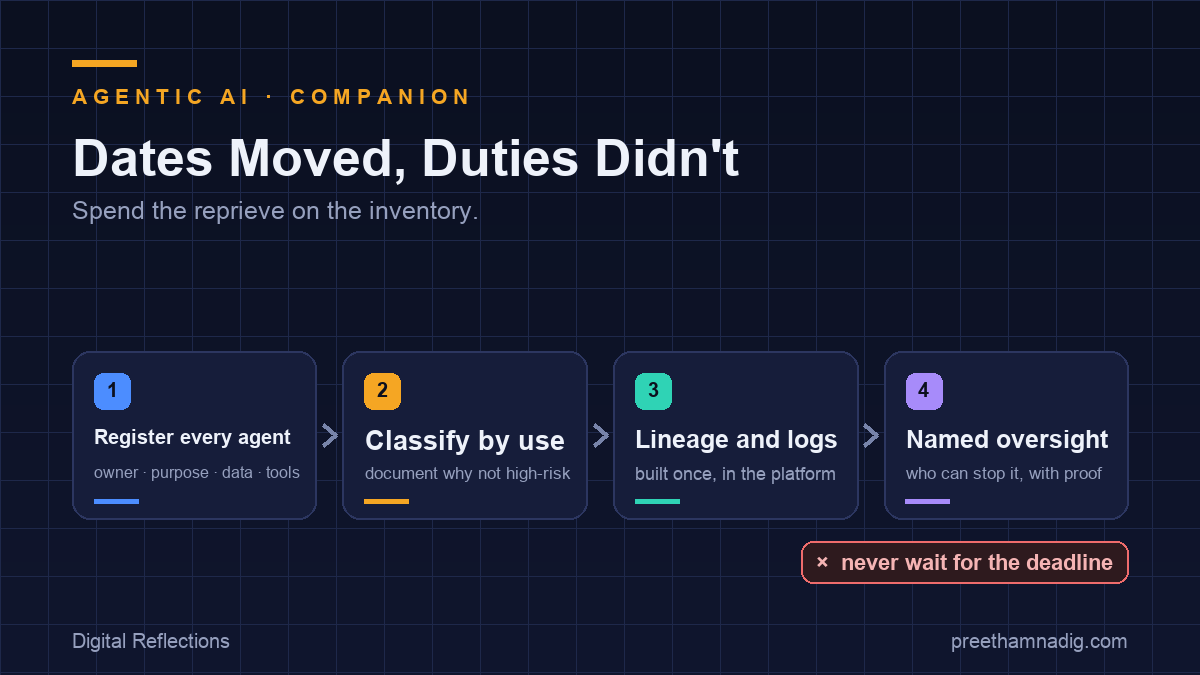
If I had sixteen months and a governance budget, I’d spend them in roughly this order:
- A register of every AI system and agent. For each: a name, an accountable owner, its purpose, the data it touches, the tools it can call, where it runs and who uses it. This is the same register I argued for in Give Every Agent a Name and Who Owns the Agent?, and it pays for itself in security and cost control long before any regulator asks for it.
- A classification against that register. High-risk, not high-risk (with the reasoning documented), or out of scope. Revisit it whenever an agent’s purpose changes, because purpose is what the classification turns on.
- Lineage and logging in the platform, not per project. Build the event log once, as a shared capability: what the system saw, what it decided, what it called, who approved. One well-designed trail can serve this regime, your own incident reviews and whatever rules apply in the other markets you operate in.
- Oversight as a named role with a record. Who can stop it, who reviews its decisions, and evidence that they did.
- A rehearsal. Pick one system you believe is high-risk and produce its evidence pack end to end, as if an authority asked tomorrow. The gaps you find are your real plan.
None of this is exotic. It’s the plumbing of running AI and Data responsibly, the same plumbing that turns a pilot into something you’d trust at scale. Most of the difficulty is organisational, which is why it’s slow, a theme I wrote about in Why Agentic AI Transformation Is Hard. Organisations that start in December 2027 will be doing it in a panic. Organisations that start now will find, by then, that the register they built for compliance became the one they run the business on.
(I’m not a lawyer, and none of this is legal advice. The dates above come from the amending regulation as published in the Official Journal; read it with your counsel, not instead of them.)
Could you list every AI system and agent running in your organisation today, with an owner and a reason it isn’t high-risk? If not, the deadline that matters isn’t 2027. It’s the date you start the list.
A companion to the Agentic AI series.
Related: Give Every Agent a Name · Who Owns the Agent? · Why Agentic AI Transformation Is Hard.


Leave a Reply