The last part of building FamilyLine, my family’s AI agent, over four weekends. By now it was genuinely useful — a warm voice, a safe agent, a travel planner. Weekend four was about making it loved. And this is the weekend my two daughters took over as the real product managers.

The best bug report I’ve ever received
The bot had been telling a morning joke. My daughters informed me, with the certainty only kids have, that the jokes were repeating. They were right — the model kept landing on the same handful of puns, and my first, naive version fell back to a small fixed list the moment it stumbled.

The fix taught me something about generation quality: variety comes from giving the model both a memory of what it already said (“don’t repeat any of these”) and permission to try again (retry a couple of times before falling back to anything canned). Move the joke to a stronger local model, feed it the recent history, let it retry — and the repetition problem simply dissolves. Then I added a word of the day for good measure.
“Did you know?” — tied to their actual syllabus
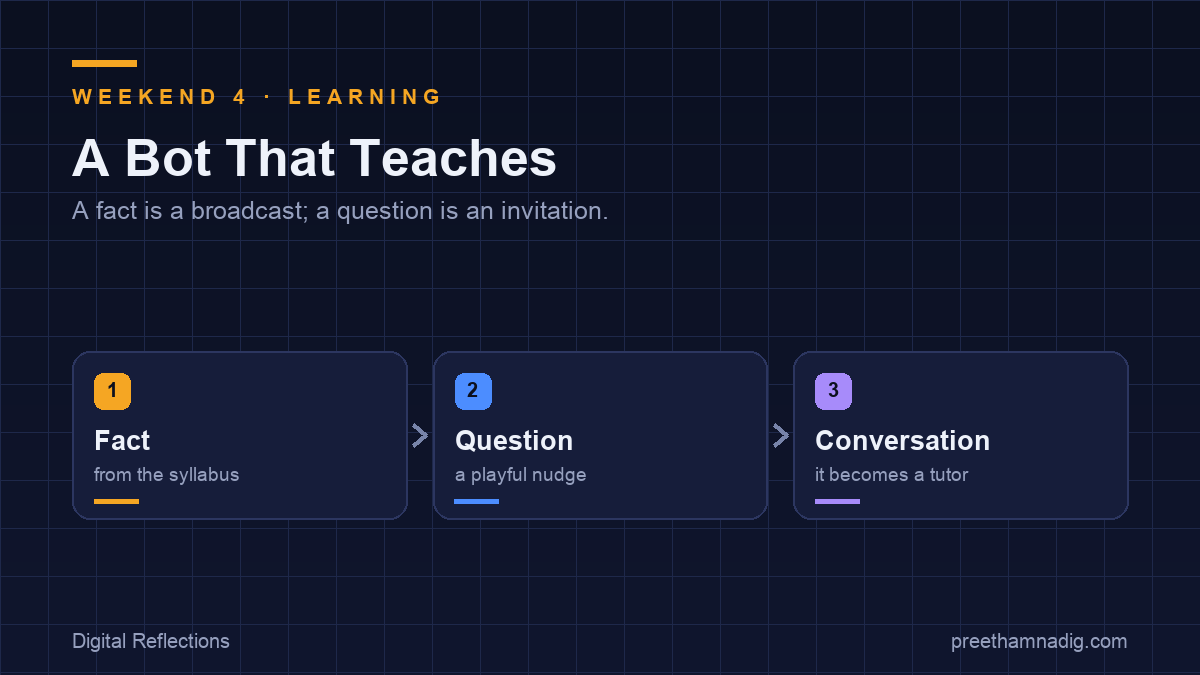
The feature I’m fondest of is a daily “Did you know?” But the twist is what makes it work: it draws its fact from my daughters’ actual school syllabus — Science, Geography, History, Maths, English, Chinese, Visual Arts — rotating the subject each day. It’s bilingual, age-appropriate, and it always ends with a small, playful question.
That last detail — the question — matters more than it looks. A fact is a broadcast. A question is an invitation. And an invitation is what turns a feature into a relationship.
The moment it stopped being a broadcast
Here’s the part that made the whole four weekends worth it. When a kid replies to the “Did you know?”, the bot continues as a tutor.
Reply “oxygen!” and it says: “Yes — and did you know most of Earth’s oxygen comes from ocean algae? What do plants make first?” Ask “why are leaves green?” — in Chinese — and it answers in Chinese, about chlorophyll, and asks what happens in autumn. It matches the language they used. It stays on the topic but happily follows their curiosity to a related one. It keeps going as long as they’re engaged, and it winds down gracefully when they do.
A morning fact became a two-way conversation about photosynthesis, at breakfast, in whichever language felt natural. That’s not a chatbot feature. That’s the thing I actually wanted to build without quite knowing it: not an assistant that does things for my kids, but one that’s curious with them.
The private half: a study tutor that keeps their secrets
That curious “did you know?” plays out in the family group, in the open. It has a quieter counterpart. Each of my daughters also has a one-to-one chat with the bot — and that’s where the real schoolwork lives. She can snap a worksheet and get a quick quiz back, run 听写 (dictation) drills for her Chinese, revise with spaced-repetition decks that resurface whatever she got wrong, and count down to an exam with a private revision plan.
The design decision I’m proudest of is where all of that stays. The content — her marks, the answers she got wrong, the topics she’s shaky on — is private to her own DM and never surfaces in the family chat. But the signal — that she did her homework, that the quiz got done — is visible to me. I can see that she studied; I can’t see what she struggled with. Accountability without surveillance — and the reason she’ll actually let the tutor find her gaps instead of hiding them. (I wrote a separate post on that privacy design — the content stays private, signal stays visible pattern.)
What kept it safe and kind
Aiming an LLM at children means the guardrails aren’t optional. Generation is filtered for age-appropriateness, the tutor is prompted to be warm and never a lecture, and the whole thing lives in our family group where a sibling can jump in — nothing private, nothing graded, just curiosity out loud. The same “ground it, bound it” discipline from weekend one, pointed at a gentler goal.
The takeaway, and the whole point
Real users are ruthless and right — and the best ones might be your kids. “The jokes repeat” and “it’s not friendly” were the sharpest product feedback I’ve ever gotten, and chasing them led to the feature I love most.

FamilyLine isn’t a startup. It’s a bot that tells my family good morning, plans our holidays, and teaches my daughters something new over breakfast — then chats with them about it, in two languages. Four weekends, one family agent, and a reminder of why I started building products and digital platforms in the first place: to make something the people I love actually use.
That’s the series. If you’re thinking about building your own family agent — or any agent — the four ideas that carried the whole thing: give it a human voice, gate its actions behind a human, know where to stop, and let real users tell you what’s wrong.
Building an AI Agent for My Family — a seven-part build log
- I Built an AI Agent for My Family
- A Voice Nobody Wants to Mute
- Propose, Don’t Act
- Find, Surface, Hand Off
- A Bot That Teaches — you are here
- The Homelab Behind the Family AI
- Homework Stays Private
Related: Where the Model Is Genuinely Load-Bearing.
Part of a personal DIY hobby, tinkered together on weekends for my own family, built entirely with open-source, self-hosted models.


Leave a Reply