A six-part architecture series with one governing principle: put the model where being wrong is cheap and recoverable, and put code where being wrong is expensive or unauditable. Most agent designs fail because they apply it in reverse.
- Put the Model Where Being Wrong Is Cheap — The governing principle, and the line nothing may cross upward.
- Use the Model to Write the Parser — Use the model once per class of problem, not once per instance.
- Where the Model Is Genuinely Load-Bearing — The short list of jobs only a model can do.
- An Agent Is a State Machine, Not a Loop — Structure the harness so every run is replayable.
- The Model Upgrade That Quietly Breaks You — Behavioural and adversarial evals, because the failure is silent.
- The Model Is the Least Defensible Part of Your Agent — Anyone can call the same API. The moat is the artifacts.
- Does a Smarter Model Change Any of This? — The companion question — and why the answer is mostly no.
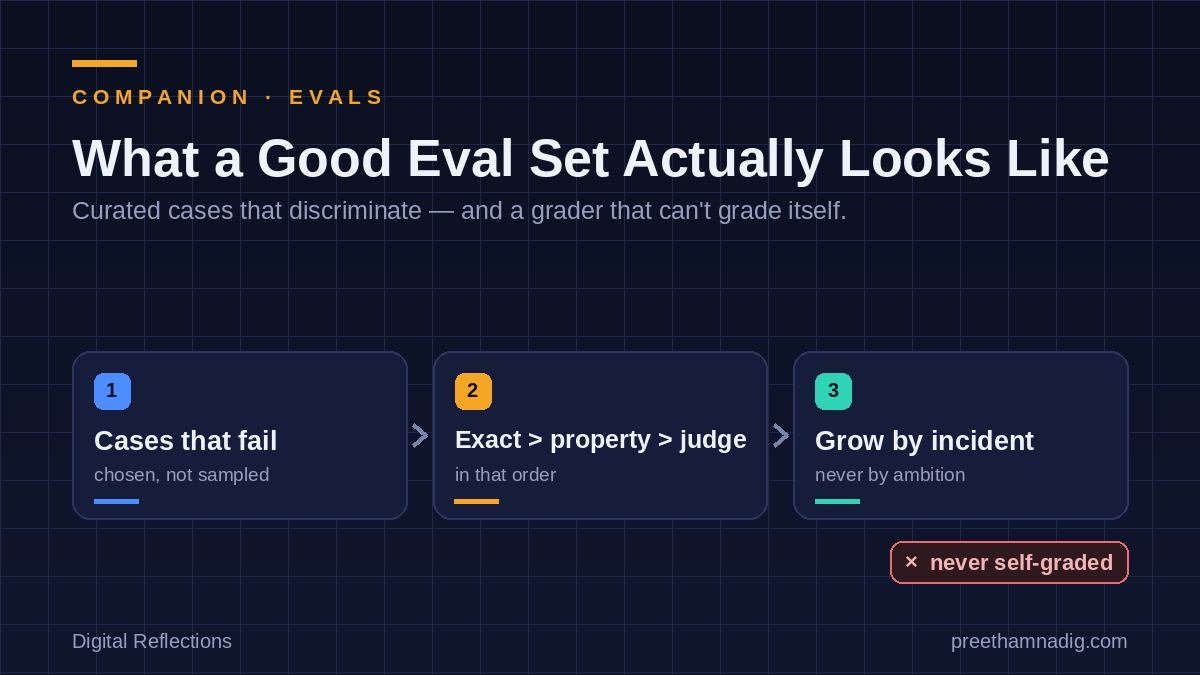
- What a Good Eval Set Actually Looks Like — Curated cases that discriminate — and a grader that can’t grade itself.