
Your organization just rolled out AI tools. Now comes the hard part: getting everyone to actually use them well.
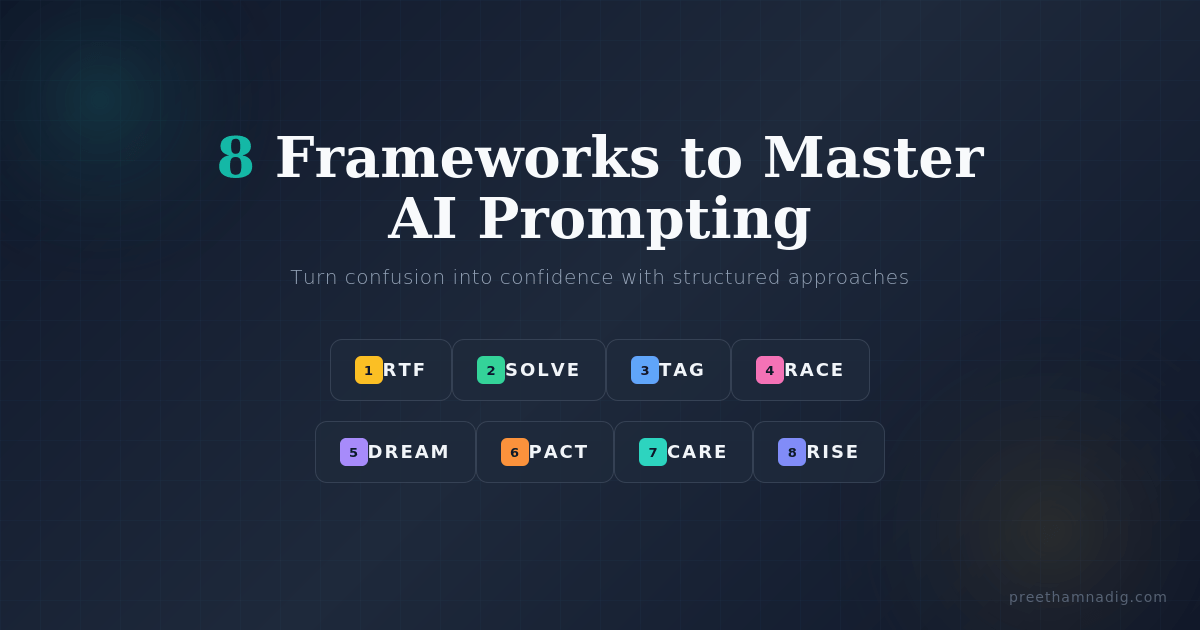
The Great Prompt Divide
Here’s a scene playing out in enterprises everywhere: A knowledge worker stares at an AI chat interface, cursor blinking, unsure what to type. They’ve attended the training. They’ve seen the demos. But when it’s time to get real work done, they freeze.
The problem isn’t the technology. It’s the translation layer—that critical gap between knowing what you want and expressing it in a way AI can act on.
I’ve watched this friction multiply across teams and departments. Some people develop an intuitive knack for prompting. Most struggle quietly, using AI as a glorified search engine or abandoning it altogether. The result? An expensive tool collecting digital dust while organizations wonder why adoption metrics remain stubbornly flat.
The solution isn’t more training videos. It’s structure.
Why Frameworks Matter
Prompting is a skill, and like any skill, it benefits from scaffolding. Frameworks provide that scaffolding. They give you a mental checklist, a starting point, a way to transform vague intent into specific instruction.
Think of prompt frameworks like recipes. You might eventually improvise in the kitchen, but you learned to cook by following recipes first. The structure freed you from decision paralysis and taught you the underlying logic of combining ingredients.
That’s exactly what these eight frameworks do for AI interaction.
Before we dive in, let’s understand what each framework offers and when to deploy it.
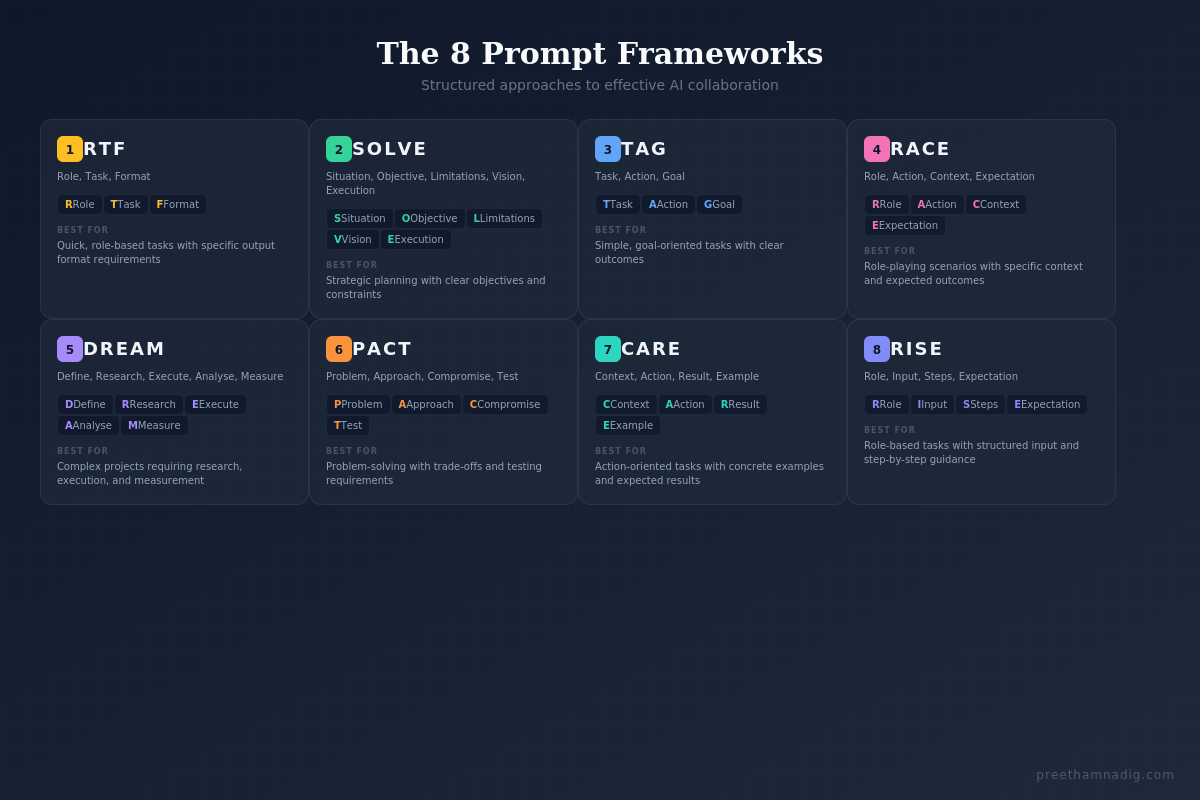
The Eight Frameworks
1. RTF: Role, Task, Format
The Components:
- Role — Who should the AI be?
- Task — What needs to be done?
- Format — How should the output look?
Best For: Quick, role-based tasks with specific output format requirements.
RTF is your everyday workhorse. It’s compact enough to remember and flexible enough to handle most common scenarios. When you need a fast, reliable result and you know exactly what format you want, RTF delivers.
Example Use Cases:
- “Act as a technical writer. Summarize this API documentation. Format as a bulleted quick-reference guide.”
- “Act as a financial analyst. Identify cost-saving opportunities in this quarterly report. Format as a prioritized table with estimated savings.”
- “Act as a marketing copywriter. Write product descriptions for these three features. Format as punchy 50-word paragraphs.”
When to Reach for RTF: You have a clear task, you know what expertise would help, and you have a specific output format in mind. It’s the Swiss Army knife of prompt frameworks.
2. SOLVE: Situation, Objective, Limitations, Vision, Execution
The Components:
- Situation — What’s the current context?
- Objective — What are you trying to achieve?
- Limitations — What constraints exist?
- Vision — What does success look like?
- Execution — How should the AI approach this?
Best For: Strategic planning with clear objectives and constraints.
SOLVE is your strategic planning framework. It’s more comprehensive than RTF because strategic work requires context. When you’re wrestling with complex problems that have real constraints and multiple stakeholders, SOLVE forces you to think through the full picture before asking for help.
Example Use Cases:
- Developing a go-to-market strategy for a new product with budget constraints and competitive pressures
- Planning a system migration where you need to balance risk, timeline, and feature parity
- Creating a change management approach for organizational transformation
When to Reach for SOLVE: The problem is strategic, constraints matter, and you need the AI to understand both where you are and where you’re trying to go.
3. TAG: Task, Action, Goal
The Components:
- Task — What’s the specific task?
- Action — What action should be taken?
- Goal — What outcome are you targeting?
Best For: Simple, goal-oriented tasks with clear outcomes.
TAG is deliberately minimal. Sometimes you don’t need elaborate context—you just need something done toward a specific goal. TAG cuts through complexity and gets straight to the point.
Example Use Cases:
- “Task: Review this email. Action: Suggest improvements for clarity. Goal: Reduce customer confusion and support tickets.”
- “Task: Analyze this dataset. Action: Identify the top three trends. Goal: Support my quarterly business review presentation.”
- “Task: Proofread this contract. Action: Flag ambiguous language. Goal: Minimize legal risk before signing.”
When to Reach for TAG: The work is straightforward, you know what you want, and adding more context would just be noise.
4. RACE: Role, Action, Context, Expectation
The Components:
- Role — What role should the AI assume?
- Action — What specific action is needed?
- Context — What background information matters?
- Expectation — What result do you expect?
Best For: Role-playing scenarios with specific context and expected outcomes.
RACE shines when you need the AI to step into a specific persona while understanding the context they’re operating in. It’s particularly useful for simulations, practice scenarios, and situations where perspective matters.
Example Use Cases:
- Preparing for a difficult conversation with a stakeholder (AI plays the stakeholder)
- Testing how customers might respond to a new pricing announcement
- Practicing a sales pitch with realistic objections
When to Reach for RACE: You want the AI to role-play convincingly within a specific context, and you need to set clear expectations for how the interaction should unfold.
5. DREAM: Define, Research, Execute, Analyse, Measure
The Components:
- Define — What’s the problem or objective?
- Research — What information is needed?
- Execute — What actions should be taken?
- Analyse — How should results be analyzed?
- Measure — What metrics indicate success?
Best For: Complex projects requiring research, execution, and measurement.
DREAM is your project management framework. It walks through the complete lifecycle of a complex initiative, from defining the problem to measuring outcomes. When you’re tackling something substantial that requires multiple phases, DREAM keeps you organized.
Example Use Cases:
- Launching a customer research initiative to understand churn drivers
- Planning a content marketing campaign with measurable outcomes
- Conducting competitive analysis that informs strategic decisions
When to Reach for DREAM: The work is substantial, spans multiple phases, and requires both execution and retrospective analysis.
6. PACT: Problem, Approach, Compromise, Test
The Components:
- Problem — What problem needs solving?
- Approach — What approach should be taken?
- Compromise — What trade-offs are acceptable?
- Test — How will the solution be validated?
Best For: Problem-solving with trade-offs and testing requirements.
PACT acknowledges a fundamental truth: real-world solutions involve trade-offs. By explicitly including compromise and testing in the framework, PACT pushes you toward solutions that are both practical and verifiable.
Example Use Cases:
- Evaluating technology vendor options with conflicting priorities (cost vs. features vs. support)
- Designing a process improvement where speed and quality tension exists
- Developing a pricing strategy that balances revenue growth and customer retention
When to Reach for PACT: The problem has no perfect solution, trade-offs are real, and you need to validate your approach before committing.
7. CARE: Context, Action, Result, Example
The Components:
- Context — What’s the relevant background?
- Action — What action is being requested?
- Result — What result is expected?
- Example — What’s a concrete example to guide the work?
Best For: Action-oriented tasks with concrete examples and expected results.
CARE recognizes that examples are often worth a thousand words of explanation. By building examples directly into the framework, CARE helps you communicate intent more precisely than abstract descriptions ever could.
Example Use Cases:
- Creating templates or standardized documents where consistency matters
- Building training materials with model answers
- Generating content that needs to match an existing style or format
When to Reach for CARE: You have a reference example that captures what you want, and providing it will dramatically improve output quality.
8. RISE: Role, Input, Steps, Expectation
The Components:
- Role — What role should the AI take?
- Input — What input is being provided?
- Steps — What steps should be followed?
- Expectation — What’s the expected outcome?
Best For: Role-based tasks with structured input and step-by-step guidance.
RISE is your process-oriented framework. When the work follows a specific sequence—and you want to maintain control over that sequence—RISE keeps the AI on track. It’s particularly valuable when you’re developing repeatable processes.
Example Use Cases:
- Building standard operating procedures that can be executed consistently
- Processing documents through a defined workflow
- Creating onboarding sequences for new team members or customers
When to Reach for RISE: The work is procedural, the sequence matters, and you want to guide the AI through specific steps rather than letting it improvise.
Choosing the Right Framework
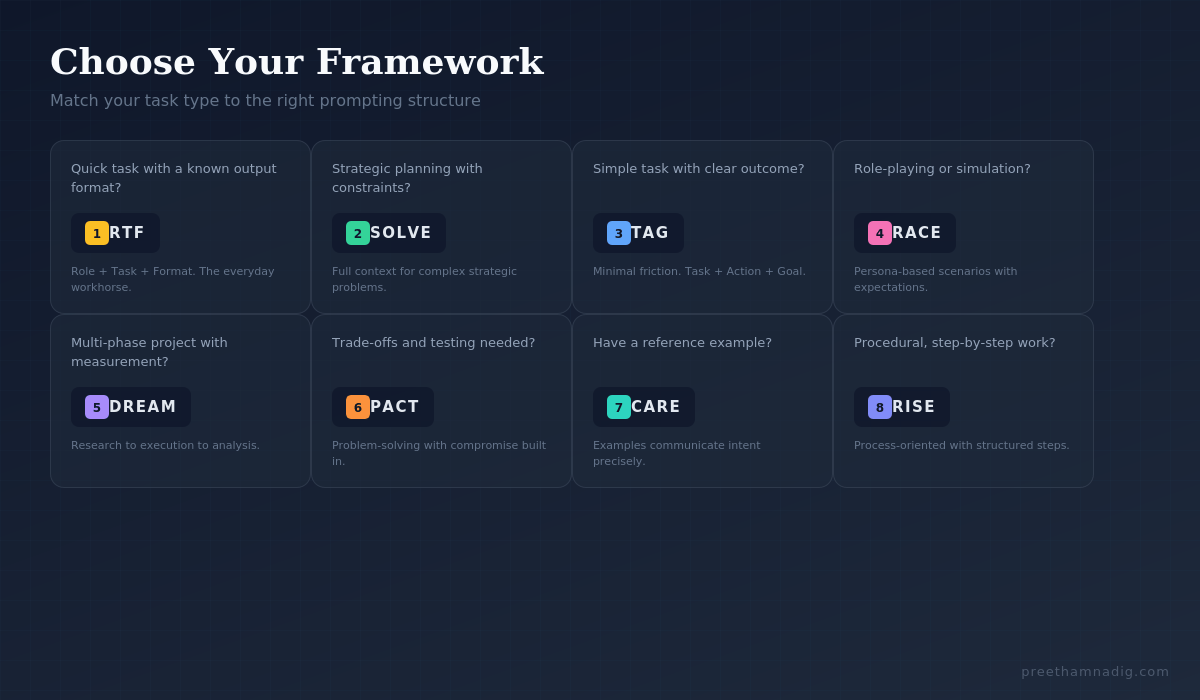
With eight frameworks available, how do you pick the right one? Here’s a decision heuristic:
Start with your intent:
- Quick task with known output? → RTF or TAG
- Strategic planning with constraints? → SOLVE
- Role-playing or simulation? → RACE
- Complex multi-phase project? → DREAM
- Problem with trade-offs? → PACT
- Have a reference example? → CARE
- Procedural, step-by-step work? → RISE
Consider complexity:
- Simpler tasks (TAG, RTF) require less setup but provide less guidance
- Complex tasks (DREAM, SOLVE) require more upfront thinking but yield more nuanced results
Think about repeatability:
- If you’ll do this task repeatedly, invest time in RISE or CARE to create a reusable template
- For one-off tasks, lighter frameworks like TAG or RTF suffice
From Framework to Fluency
These frameworks are training wheels, not permanent fixtures. As you internalize the underlying logic—the importance of context, the value of examples, the need to specify expectations—you’ll find yourself naturally incorporating these elements without consciously following a formula.
The goal isn’t perfect framework adherence. It’s effective AI collaboration.
Start with the frameworks. Practice them. Adapt them. Eventually, you’ll develop your own intuitions about what makes a great prompt. That’s when the real productivity gains begin.
Whether you’re upskilling a team or improving your own AI collaboration, having the right framework at the right moment transforms the blank-page problem into a guided conversation.
The AI is ready. The frameworks exist. Now it’s time to bridge the gap.


Leave a Reply