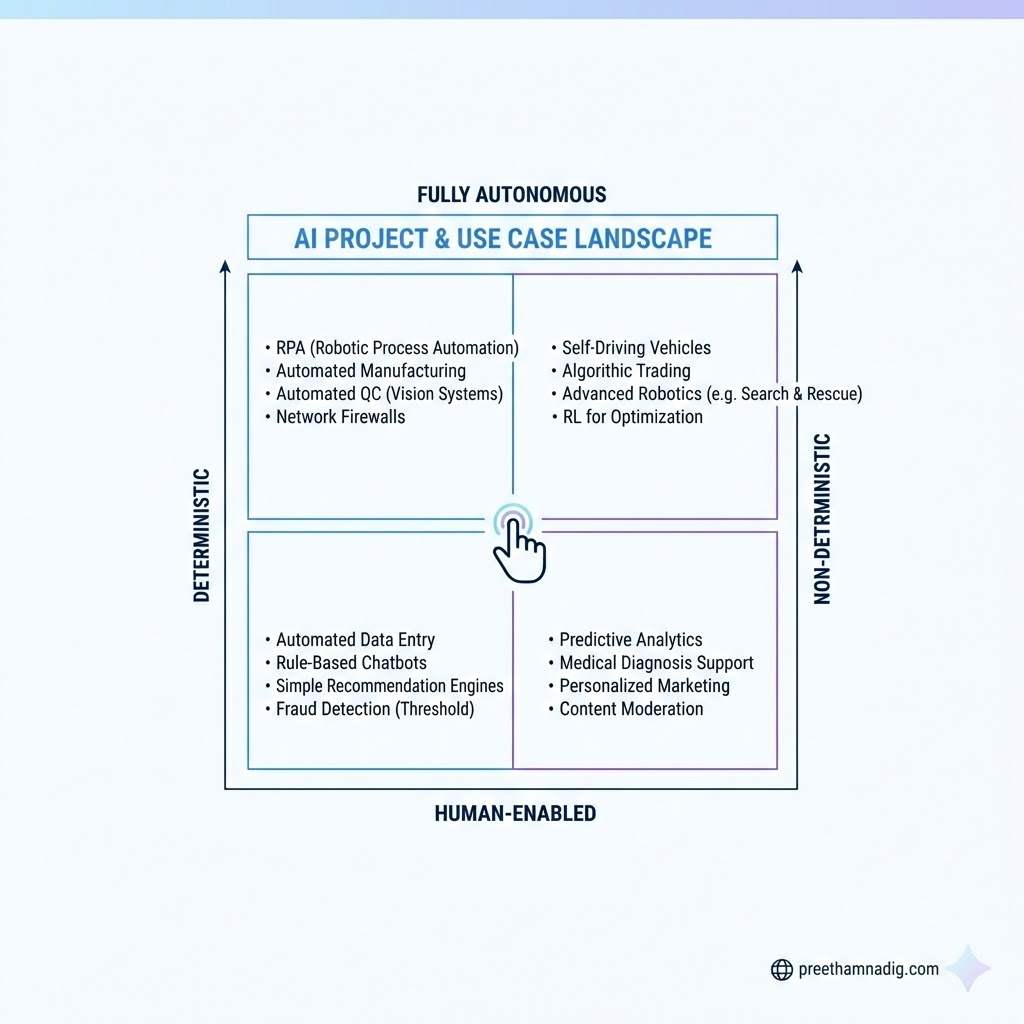
The world of Artificial Intelligence is vast and ever-expanding, offering incredible opportunities for innovation. But with so many possibilities, how do you choose the right AI project for your business or venture? The key lies in understanding the fundamental characteristics that define AI applications. In this post, we’ll explore AI projects and use cases across two crucial dimensions: Deterministic vs. Non-Deterministic and Fully Autonomous vs. Human-Enabled. By mapping your ideas onto these axes, you can better identify viable projects, anticipate challenges, and maximize your chances of success.

Let’s dive into the four quadrants that emerge from this framework:
Quadrant 1: Deterministic & Human-Enabled
This quadrant represents AI applications where the outcomes are predictable and a human is actively involved in the process, often to validate, refine, or oversee the AI’s output. These projects are typically more straightforward to implement and carry lower risks, making them excellent starting points for organizations new to AI.
Key Characteristics:
- Predictable Outcomes: Given the same input, the AI will consistently produce the same output.
- Human Oversight: Human intervention is expected and often crucial for quality control or decision-making.
- Clear Rules: The AI operates based on well-defined rules and algorithms.
Use Cases:
- Automated Data Entry and Validation: Imagine a system that extracts specific information from invoices and flags discrepancies for a human reviewer. This improves efficiency while ensuring accuracy.
- Rule-Based Customer Service Bots: Chatbots that answer frequently asked questions based on a predefined script. If a query falls outside the script, it’s escalated to a human agent.
- Personalized Recommendation Engines (Rule-Based): Simple recommendation systems that suggest products based on a user’s browsing history or predefined categories, with human analysts refining the rules over time.
- Fraud Detection (Threshold-Based): Systems that flag transactions exceeding a certain value or matching known fraud patterns for human investigation.
Considerations:
- Scalability: While predictable, complex rule sets can become difficult to manage as they grow.
- Limited Adaptability: These systems struggle with novel situations not covered by their rules.
- Human-in-the-Loop Design: Ensuring a seamless handover between AI and human is critical.

Quadrant 2: Non-Deterministic & Human-Enabled
This quadrant introduces the complexity of AI that learns and adapts, leading to less predictable outcomes. However, human involvement remains crucial for guiding the learning process, interpreting results, and making final decisions. This is where many modern machine learning applications reside.
Key Characteristics:
- Probabilistic Outcomes: The AI provides probabilities or likelihoods, rather than absolute certainties.
- Learning and Adaptation: The system improves its performance over time with more data.
- Human Interpretation: Humans are needed to understand the AI’s output and often to make the ultimate decision.
Use Cases:
- Predictive Analytics for Business Forecasting: AI models that predict sales trends or customer churn, with human analysts interpreting the forecasts and adjusting business strategies.
- Medical Diagnosis Support Systems: AI that analyzes medical images or patient data to suggest potential diagnoses, which are then reviewed and confirmed by doctors.
- Personalized Marketing Campaigns: AI that segments audiences and suggests optimal content or offers, with marketing teams refining campaigns based on performance data.
- Natural Language Processing (NLP) for Content Moderation: AI that flags potentially inappropriate content for human review, reducing the manual burden while maintaining ethical oversight.
Considerations:
- Data Quality and Quantity: These systems are heavily reliant on large, clean datasets.
- Model Explainability: Understanding why the AI made a certain prediction can be challenging (the “black box” problem).
- Bias Detection: Ensuring the AI’s learning data doesn’t introduce or amplify societal biases.

Quadrant 3: Deterministic & Fully Autonomous
This quadrant features AI systems that operate independently, following predefined rules to achieve predictable outcomes without human intervention in their day-to-day operation. These systems are powerful for automating repetitive tasks where precision and consistency are paramount.
Key Characteristics:
- Fixed Outcomes: The AI consistently produces the same result for the same input.
- No Human Intervention: Once deployed, the system operates without direct human oversight on its tasks.
- High Reliability: Designed for tasks where errors are costly and consistency is critical.
Use Cases:
- Robotic Process Automation (RPA): Software robots that automate structured, repetitive digital tasks like moving files, extracting data, or filling out forms.
- Automated Manufacturing Assembly Lines: Robots performing precise, repetitive tasks on a factory floor.
- Automated Quality Control (Rule-Based Vision Systems): Systems that inspect products for defects based on predefined visual criteria, rejecting items that don’t meet standards.
- Network Security Firewalls: Systems that block unauthorized access or malicious traffic based on a set of security rules.
Considerations:
- Robustness of Rules: The system is only as good as the rules it follows; any unforeseen scenario can break it.
- Maintenance and Updates: Rules need to be regularly reviewed and updated to remain effective.
- Audit Trails: Establishing clear logging and auditing capabilities is essential for troubleshooting and compliance.

Quadrant 4: Non-Deterministic & Fully Autonomous
This is the frontier of AI, where systems learn, adapt, and operate independently in complex, unpredictable environments. These projects offer the highest potential for disruption but also carry the greatest risks and require significant investment in research and development.
Key Characteristics:
- Self-Learning and Adaptation: The AI continuously learns from new data and experiences.
- Independent Decision-Making: The system makes decisions without real-time human intervention.
- Complex Problem Solving: Designed to tackle problems in dynamic and uncertain environments.
Use Cases:
- Self-Driving Vehicles: AI systems that perceive their environment, make navigation decisions, and operate a vehicle autonomously.
- Reinforcement Learning for Industrial Optimization: AI agents that learn optimal control strategies for complex systems like energy grids or robotic manipulation through trial and error.
- Algorithmic Trading (High-Frequency): AI systems that execute trades autonomously based on real-time market data and learned strategies.
- Advanced Robotics (e.g., Search and Rescue): Robots that explore unknown environments, identify hazards, and perform tasks without constant human guidance.
Considerations:
- Safety and Ethics: Ensuring these systems operate safely and ethically in all circumstances is paramount.
- Robustness and Generalization: Designing AI that performs well in diverse, real-world conditions.
- Regulatory Frameworks: The legal and ethical implications of fully autonomous AI are still evolving.
- Explainability (Extreme Challenge): Understanding and debugging autonomous systems can be incredibly difficult.

Conclusion: Mastering the AI Matrix
Understanding where an AI project sits on the axes of determinism and autonomy is more than just a theoretical exercise—it is a strategic necessity for any digital leader. As you navigate your roadmap, keep these three takeaways in mind:
- Risk vs. Reward Alignment: Deterministic, human-enabled projects provide the “quick wins” and stability needed to build organizational trust.
- The Scalability Leap: Transitioning toward fully autonomous systems requires a shift from managing processes to managing outcomes and guardrails.
- The Future is Hybrid: Most enterprise success stories today live in the “Human-Enabled” quadrants, where AI amplifies human expertise rather than replacing it.
By classifying your use cases early, you can set realistic expectations, allocate the right technical resources, and ensure your AI investments deliver tangible value.

Leave a Reply