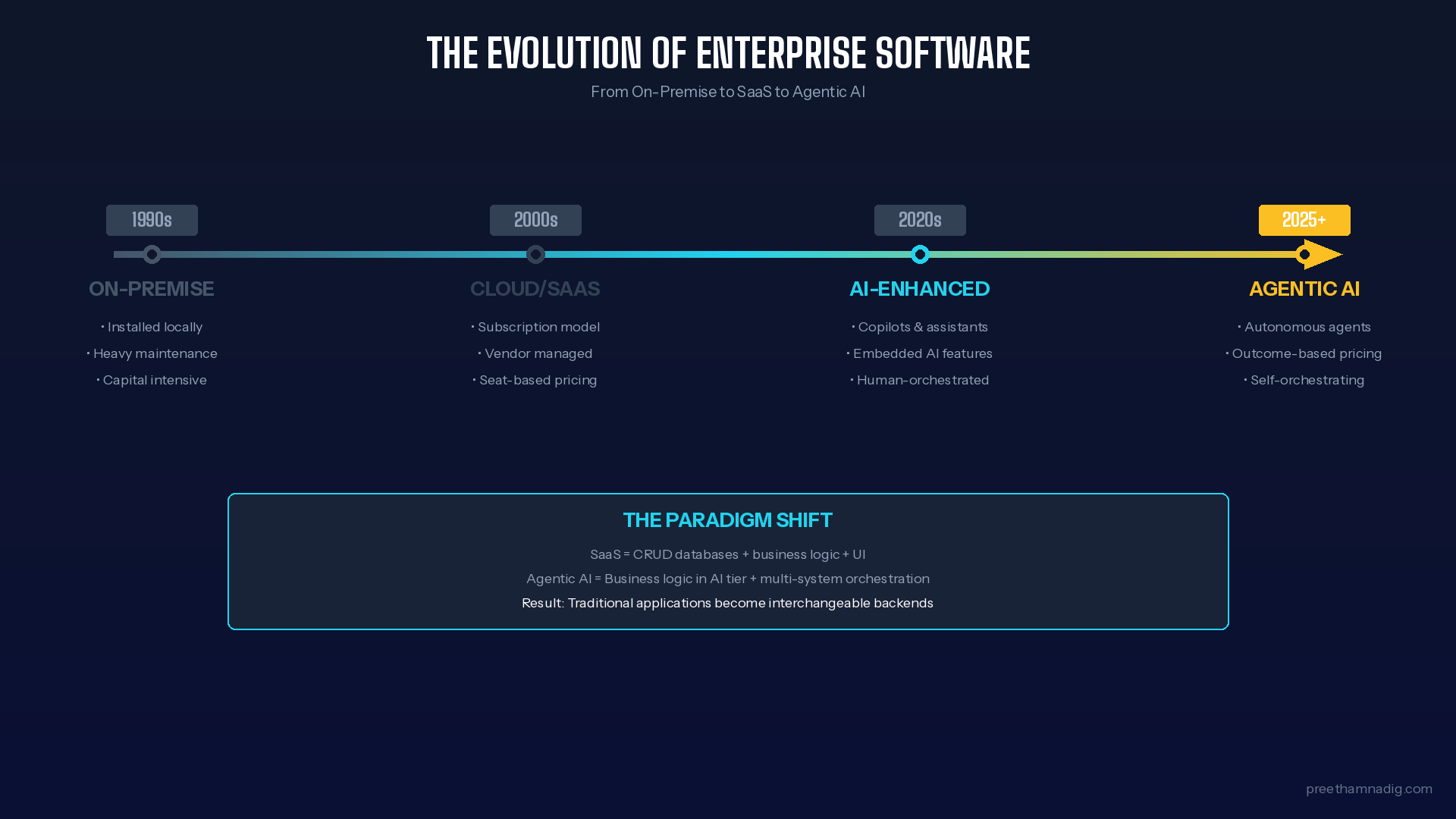
“The notion that business applications exist, that’s probably where they’ll all collapse, right? In the agent era.”
— Satya Nadella, CEO of Microsoft, BG2 Podcast, December 2024

When Microsoft’s CEO makes a statement this provocative, it’s worth paying attention. Nadella’s comments on the BG2 podcast sparked significant debate across the technology industry, with analysts from IDC, Gartner, Bain & Company, and BCG all weighing in on whether—and how—agentic AI might reshape enterprise software.
I’ve been following this discussion closely, and regardless of where you land on the “SaaS is dead” framing, the underlying trends are worth understanding. After reviewing the analyst research and public commentary from technology leaders, five consistent themes emerge that are worth exploring.
Setting the Context: The SaaS Success Story
Before diving into the emerging themes, it’s worth acknowledging SaaS’s remarkable trajectory. Marc Andreessen’s 2011 essay “Why Software Is Eating the World” captured the imagination of an entire industry. For enterprises, that transformation was led by SaaS—Software as a Service liberated IT teams from tedious on-premise installations, security patches, and complex maintenance work. Companies could deploy and scale software easily, with asynchronous collaboration between teams and functions via the cloud.
The numbers reflect this success. According to IDC, SaaS represents over 10% of IT spending and forms the backbone of digital transformation strategies worldwide. Among the ten most valuable software players SaaS delivery models dominate.
However, several industry analysts are now asking whether this model is approaching an inflection point. A 2022 survey reported that 42% of IT professionals believe their most crucial challenge is finding unused or underutilized SaaS licenses within their business. About a third believed that 20-39% of their SaaS spending was wasted. As Nadella characterized it on the podcast: SaaS applications are essentially “CRUD databases with business logic”—basic systems for creating, reading, updating, and deleting data, wrapped in business rules.
The question analysts are exploring: What happens when AI can handle both the CRUD operations and the business logic—simultaneously, across multiple systems?

Theme #1: Business Process Redesign Is Back on the Agenda
The 1990s gave us Business Process Reengineering (BPR), introduced by Michael Hammer and James Champy. Its goal was radical redesign—not just automation—of business processes to dramatically improve cost, quality, service, and speed. Historically, implementing BPR required massive capital investments and years of change management.
According to several analysts, agentic AI may be changing this equation. BCG’s research suggests that recent advances in computing power and AI-optimized chips can reduce human error and cut employees’ low-value work time by 25% to 40%. Their analysis indicates AI-powered workflows can accelerate business processes by 30% to 50% in areas ranging from finance and procurement to customer operations.
As one industry observer noted, Nadella’s vision suggests that “BPR of the 1990s is back, with people who can think end-to-end process flows. And then re-engineer those for process efficiency, using AI agents.”
The key distinction analysts are drawing: this isn’t about automating existing processes (what some call “paving the cow path”), but rather taking a clean-sheet approach to reimagine workflows based on data rather than historical habits.
Consider a common marketing workflow example cited in industry discussions. With traditional SaaS, launching a campaign involves multiple steps and tools: one system for audience segmentation and list building, another for creative asset management and approval workflows, a third for email distribution, a fourth for social scheduling, and yet another for performance analytics. These tools exist in silos, and marketing teams manually coordinate data exports, audience syncs, and reporting across them. With agentic AI, as the analysts describe it, the process could become more seamless—an agentic marketing system automatically identifying high-intent segments from CRM data, generating personalized creative variations, orchestrating multi-channel deployment, monitoring real-time performance, and reallocating budget to top-performing channels without human intervention at each step.
Theme #2: The “Build vs. Buy” Calculus May Be Shifting
For decades, the conventional wisdom in enterprise IT was clear: buy, don’t build. The economics made sense—why invest millions in custom development when you could subscribe to battle-tested solutions?
Several analysts suggest agentic AI is reopening this discussion. As one research report framed it: “The conversation is no longer about developing custom software versus purchasing off-the-shelf solutions; it’s about architecting autonomous systems that reflect your unique business logic.”
The most widely discussed case study is Klarna. When CEO Sebastian Siemiatkowski announced in September 2024 that the company would terminate its relationships with CRM and HRM SAAS, it generated significant industry attention. “We have a number of large internal initiatives that combine AI, standardization, and simplification to enable us to shut down several software-as-a-service providers,” Siemiatkowski explained publicly.
According to Klarna’s public statements, they consolidated their SaaS ecosystem into a unified, in-house knowledge stack. Their AI-powered assistant—developed with OpenAI—reportedly completed the work of 700 customer service agents, reducing average resolution time from 11 minutes to two minutes.
According to CX Today’s coverage, Klarna consolidated, unified their data architecture, and built AI capabilities on top of a coherent foundation—while still using some SaaS tools like Slack.
The emerging model some analysts describe isn’t pure build or pure buy—it’s what some call “buy-to-build.” Organizations purchase a secure foundation with governance, compliance, and infrastructure already solved, then build differentiated capabilities on top.
Theme #3: Autonomous Workflows Are Gaining Traction
Perhaps the most discussed aspect of agentic AI is its ability to execute workflows with greater autonomy. Unlike traditional AI chatbots, which respond to predefined queries with rule-based responses, agentic AI systems are designed to interact more autonomously with their environment, learn from experiences, and make decisions with less human intervention.
The analyst projections are notable:
- Gartner predicts that by 2028, agentic AI will help make 15% of everyday work decisions—up from essentially 0% in 2024.
- IDC forecasts that by 2028, pure seat-based pricing will be obsolete, with 70% of software vendors refactoring their pricing strategies around new value metrics such as consumption, outcomes, or organizational capability.
- Bain & Company suggests AI agents could power 33% of enterprise software by 2028, potentially resolving up to 80% of customer service queries.
From an IT architecture standpoint, analysts suggest this could mean a re-architecture of the enterprise tech stack. Where today’s stack is built around SaaS interfaces—screens that humans interact with—tomorrow’s may revolve more around AI agents that interact with modular backend services.
As Nadella described it: “These agents are going to be multi-repo CRUD. So they’re not going to discriminate between what the back end is. They’re going to update multiple databases, and all the logic will be in the AI tier.”
Whether this vision fully materializes remains to be seen, but the direction of investment and research is worth tracking.
Theme #4: Data Fragmentation Is Emerging as a Key Challenge
Here’s a theme that resonates across multiple analyst reports: the very SaaS tools enterprises adopted to accelerate digital transformation may be complicating their AI transformation.
According to a Forrester survey, 72% of organizations say their data exists in disparate silos. The average enterprise uses over 100 SaaS applications, each with its own data model, API limitations, and access rules.
As one analyst characterized it: “Data silos are the silent killer of enterprise AI initiatives.” The concern is that AI models trained on fragmented data may produce inconsistent insights and less reliable automation. When different AI agents operate in isolation—your CRM agent not knowing what insights your data warehouse agent has—you may be creating AI silos that mirror existing SaaS silos.
According to CMSWire’s 2025 State of Digital Customer Experience report, 28% of businesses cite “siloed systems, technology integration challenges and fragmented customer data” as a top-three barrier to success. The Lucidworks 2025 Generative AI Benchmark Report found that “mastering fundamental capabilities alone drives 2X greater impact on conversions than advanced AI capabilities in isolation.”
The root causes analysts identify are systemic: departments adopt specialized SaaS tools suited to their immediate needs, acquisitions bring new platforms into the fold, and legacy systems continue to run because replacement seems costly or risky.
This is perhaps the most actionable theme for technology leaders: regardless of how the broader “SaaS is dead” debate resolves, addressing data fragmentation appears to be a prerequisite for effective AI deployment.
Theme #5: SaaS Economics Are Under Scrutiny
The final theme emerging from analyst research concerns the economics of enterprise SaaS. According to the Vertice SaaS Inflation Index, SaaS pricing was up 11.4% in January 2025 compared to the same time in 2024—compared to the 2.7% average market inflation rate of G7 countries.
Some data points from industry research:
- SaaS costs per employee reached approximately $9,100 by the end of 2025, up from $7,900 in 2023—an increase of almost 15% in two years (Vertice)
- According to SaaStr’s analysis, 60% of vendors have introduced pricing changes that bundle AI features into subscriptions
- Nearly 50% of SaaS licenses go unused for 90 days or more (BetterCloud)
Analysts also point to vendor lock-in as an ongoing concern. Proprietary technologies, data migration challenges, and restrictive contracts can make switching providers economically difficult. High switching costs, vendor-specific API implementations, and data formats not aligned with open standards all create friction.
Whether these economics accelerate the shift toward alternative approaches—or simply prompt more aggressive vendor negotiations—is an open question. But CFOs and CIOs are clearly paying closer attention to SaaS spend optimization.
What Industry Observers Suggest for Leaders
Based on the analyst research and commentary, several recommendations emerge for technology leaders navigating this landscape:
Evaluate Your Data Architecture
Before pursuing advanced AI capabilities, assess whether your data foundation supports them. The research consistently suggests that unified data strategies drive more impact than adding AI features to fragmented systems.
Monitor the Pricing Model Evolution
Seat-based pricing may evolve as AI changes the nature of work. Leaders like Intercom and Salesforce are already experimenting with pricing tied to outcomes rather than log-ins. Understanding these shifts can inform vendor negotiations.
Consider Hybrid Approaches
The emerging consensus isn’t strictly “build” or “buy”—it’s finding the right combination. Some analysts suggest building what differentiates your organization while buying commodity capabilities.
Audit SaaS Utilization
Given the data on unused licenses and rising costs, regular audits of SaaS utilization may yield quick wins regardless of broader strategic direction.
Follow the Case Studies
Organizations like Klarna are essentially running public experiments. Their outcomes—successes and challenges—will provide valuable data points for other enterprises considering similar moves.

Closing Thoughts
Whether you find the “SaaS is dead” framing compelling or overblown, the underlying trends merit attention. The convergence of agentic AI capabilities, data architecture challenges, and evolving economics is creating genuine strategic questions for technology leaders.
As IDC noted in their analysis: “SaaS, as we know it, is being disrupted, not by decline but by evolution.” The next few years will reveal how this evolution unfolds.
What’s clear is that this is a debate worth following—and one where informed leaders will be better positioned to navigate whatever changes emerge.


Leave a Reply