In our previous post, we explored the crucial two-dimensional framework for AI projects: Deterministic vs. Non-Deterministic and Fully Autonomous vs. Human-Enabled. This matrix helps you strategically place and develop individual AI applications. But what happens when you need these diverse AI components to work together seamlessly, intelligently, and at scale?
Enter Agentic AI.
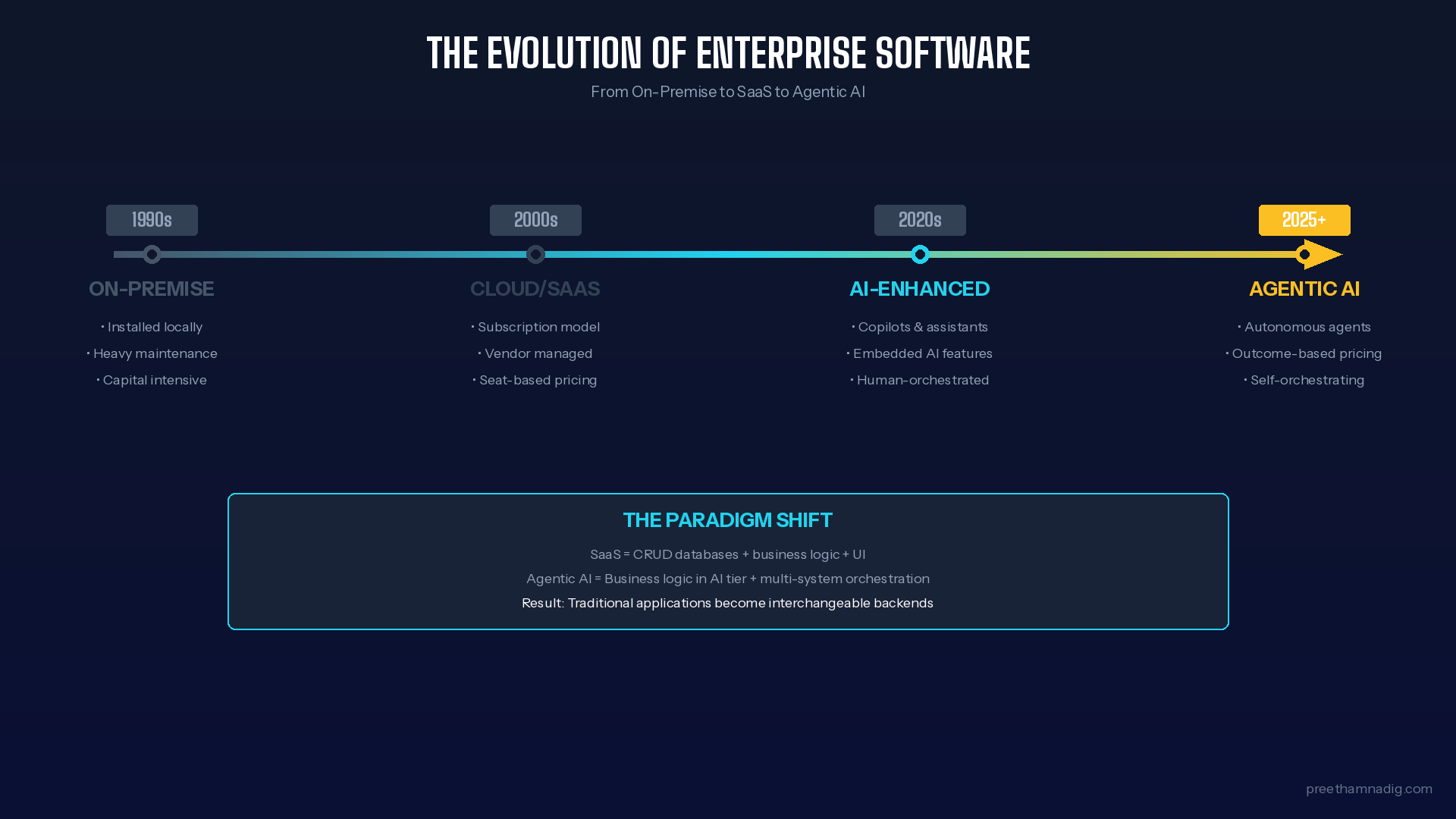
Agentic AI isn’t just another flavor of artificial intelligence; it’s an architectural paradigm shift. It’s about designing systems where individual AI agents (and even human-enabled systems) can autonomously plan, reason, and execute tasks to achieve complex goals, often by orchestrating other AI models or traditional software. Think of Agentic AI as the conductor of an orchestra, where each instrument (an AI model from our quadrants) plays its part, directed by a higher-level intelligence.
This follow-up post will explore how Agentic AI overlays and transforms our four quadrants, highlighting its critical role in orchestrating diverse AI capabilities and reinforcing the enduring relevance of our autonomy-determinism framework.
The Agentic AI Ecosystem: A New Layer of Orchestration
Agentic AI thrives on the ability to break down complex problems into manageable sub-tasks, delegate those tasks to specialized “agents” (which can be any AI model or system), and then synthesize their outputs to achieve a larger objective. These agents possess key characteristics:
- Autonomy: They can act independently to achieve their goals.
- Proactivity: They don’t just react; they initiate actions.
- Social Ability: They can communicate and collaborate with other agents (and humans).
- Responsiveness: They react to changes in their environment.
Now, let’s see how Agentic AI interacts with our four quadrants.
Quadrant 1: Deterministic & Human-Enabled with Agentic Orchestration
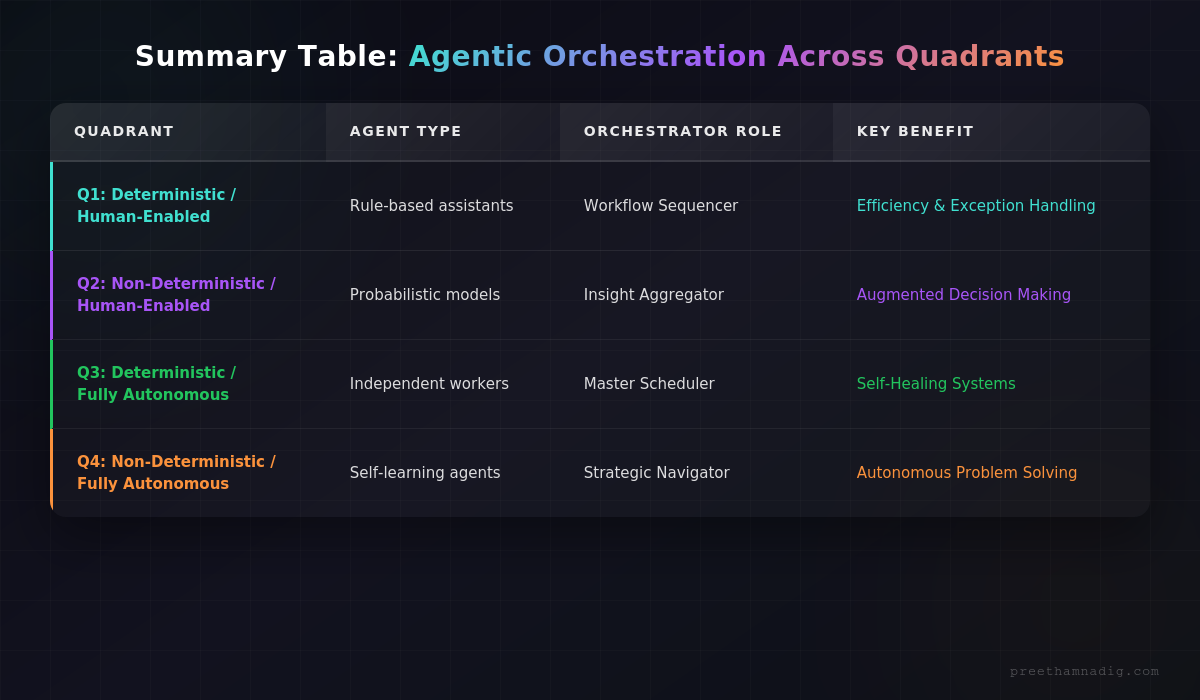
In this quadrant, agents are often rule-based and assist humans with structured tasks. An Agentic AI system can orchestrate several such agents, deciding when and how to invoke them, and presenting their outputs to a human for final review or action.
Example: Agentic Invoice Processing Imagine an Agentic AI system managing a complex finance workflow:
- Orchestrator’s Goal: Process and approve vendor invoices efficiently.
- Agent 1 (Deterministic & Human-Enabled): A “Data Extraction Agent” uses OCR to pull details from a new invoice. If it encounters a field it can’t confidently parse, it flags it for human review.
- Agent 2 (Deterministic & Human-Enabled): A “Vendor Matching Agent” verifies the vendor against a master list. If the vendor is new or has discrepancies, it routes to a human for registration.
- Agent 3 (Deterministic & Human-Enabled): A “Compliance Agent” applies pre-defined rules (e.g., spending limits, budget codes). If an invoice exceeds a certain threshold or violates a rule, it routes to a human approver.
- Agentic Orchestrator’s Role: The orchestrator manages the sequence (extract, match, comply), monitors for human interventions, and ensures the invoice progresses through the system until full approval.
In this scenario, the Agentic AI streamlines the flow, intelligently involving humans only where necessary, and ensures all deterministic checks are performed by specialized agents.

Quadrant 2: Non-Deterministic & Human-Enabled with Agentic Orchestration
This quadrant is rich with machine learning models that provide probabilistic outputs, where human judgment is still vital for interpreting results and making final decisions. Agentic AI shines here by providing context, aggregating insights from multiple non-deterministic models, and presenting information to humans in an actionable way, enhancing their decision-making capabilities.
Example: Agentic Customer Churn Prediction and Intervention Consider an Agentic AI system aimed at proactively reducing customer churn for a SaaS company.
- Orchestrator’s Goal: Identify at-risk customers and recommend personalized interventions.
- Agent 1 (Non-Deterministic & Human-Enabled): A “Churn Prediction Agent” (e.g., a neural network) analyzes customer usage patterns, support interactions, and sentiment data to assign a churn probability score.
- Agent 2 (Non-Deterministic & Human-Enabled): A “Sentiment Analysis Agent” (NLP model) processes recent customer support tickets and social media mentions to provide a nuanced understanding of customer mood.
- Agent 3 (Non-Deterministic & Human-Enabled): A “Recommendation Agent” (collaborative filtering) suggests personalized content, feature usage tips, or discounts based on similar customer profiles.
- Agentic Orchestrator’s Role:
- It invokes the Churn Prediction Agent to get a risk score.
- If the score is high, it then activates the Sentiment Analysis Agent for deeper context.
- Based on these insights, it calls the Recommendation Agent to generate potential interventions.
- Finally, the orchestrator compiles all this information into a concise “Customer Health Dashboard” and alerts a human account manager. The human can then review the AI’s predictions and recommendations, adding their nuanced understanding of the customer relationship before executing a personalized outreach.
Here, the Agentic AI streamlines the intelligence gathering and recommendation process, empowering human agents to make more informed and timely interventions, moving beyond simple reactive support.

Quadrant 3: Deterministic & Fully Autonomous with Agentic Orchestration
In this quadrant, AI systems perform high-precision, repetitive tasks based on rigid logic and pre-defined rules. While these systems operate independently, Agentic AI serves as the “Master Scheduler,” ensuring that multiple autonomous streams work in harmony and dynamically adjusting the workflow when a deterministic process reaches its limit or encounters a predictable snag.
Example: Agentic Smart Grid & Energy Management
Imagine an Agentic AI system managing a local smart energy grid for a corporate campus or a small municipality.
- Orchestrator’s Goal: Maintain grid stability and maximize the use of renewable energy while ensuring zero power interruptions.
- Agent 1 (Deterministic & Fully Autonomous): A Solar Array Agent that automatically tilts panels to the optimal angle based on the sun’s position and triggers a “stow” protocol if wind sensors detect speeds over 50 km/h.
- Agent 2 (Deterministic & Fully Autonomous): A Battery Storage Agent that initiates charging when energy prices are below a fixed threshold and discharges when the campus load hits a specific wattage.
- Agent 3 (Deterministic & Fully Autonomous): An HVAC Control Agent that adjusts building temperatures based on a strict schedule and occupancy sensors to stay within a pre-set range of 21°C–23°C.
The Agentic Orchestrator’s Role:
While each agent follows its own “if-this-then-that” logic, the Agentic Orchestrator manages the Interplay:
- Anticipatory Balancing: If the Solar Agent reports a “stow” event due to high winds, the Orchestrator doesn’t wait for the campus load to spike. It proactively signals the Battery Agent to stop charging and prepare for a discharge cycle to compensate for the lost solar input.
- Contextual Logic Overrides: If the grid experiences a sudden external surge, the Orchestrator may signal the HVAC Agent to temporarily widen its temperature range by 1 degree. This deterministic adjustment reduces immediate demand without requiring a human to manually “load shed” during a crisis.
By layering Agentic AI over these autonomous processes, you transform a collection of isolated “smart” devices into a self-optimizing ecosystem that can handle environmental shifts without constant human intervention.

Quadrant 4: Non-Deterministic & Fully Autonomous with Agentic Orchestration
This is the peak of the ecosystem, where agents learn from their environment and act without real-time human intervention. Here, Agentic AI acts as the “Chief Strategist,” aligning multiple high-complexity agents toward a singular, evolving business objective.
Example: Agentic Global Logistics & Fleet Optimization Consider a logistics giant managing a fleet of autonomous delivery drones and trucks across a continent.
- Orchestrator’s Goal: Minimize delivery costs and carbon footprint in a shifting environment.
- Agent 1 (Non-Deterministic & Fully Autonomous): A Navigation Agent (Reinforcement Learning) that pilots drones, constantly adapting to real-time wind speeds and obstacle detection.
- Agent 2 (Non-Deterministic & Fully Autonomous): A Market Pricing Agent that autonomously adjusts delivery fees based on real-time demand and competitor pricing.
- Agent 3 (Non-Deterministic & Fully Autonomous): A Predictive Maintenance Agent that decides when a vehicle should take itself “off-duty” for a repair based on sensor anomalies.
- Agentic Orchestrator’s Role:
- The Orchestrator manages the macro-strategy. If the Market Pricing Agent sees a surge in demand in a specific city, the Orchestrator commands the Navigation Agents to re-route the fleet toward that hub.
- It balances the “greed” of the Pricing Agent with the “caution” of the Maintenance Agent, ensuring the fleet doesn’t over-work itself for short-term profit.
In Quadrant 4, Agentic AI provides the moral and strategic compass for systems that are otherwise too complex for a human to manage in real-time.

Summary: The Agentic Advantage
The relevance of the Autonomy-Determinism matrix doesn’t fade with the rise of Agents; it becomes the map for their deployment.
- Deterministic Agents provide the reliable foundation.
- Non-Deterministic Agents provide the adaptive intelligence.
- Agentic AI provides the orchestration that turns a collection of tools into a unified, goal-seeking organism.



Leave a Reply